+8613003178786
  sales@lingyufab.com



The Advantages of Self-Clinching Fasteners in Sheet Metal Fabrication
30
Jul’2026The Advantages of Self-Clinching Fasteners in Sheet Metal Fabrication
In modern precision engineering, creating strong, repeatable load-bearing threads in thin sheet metal is a major manufacturing hurdle. Traditional joining methods like welding, tapping, and loose hardware often introduce structural distortion, aesthetic damage, and excessive assembly labor. To overcome these limitations, precision manufacturers rely on a highly efficient mechanical solution: self-clinching fasteners.
By utilizing cold-flow metal displacement, these specialized hardware components permanently lock into place, offering exceptional torque-out and push-out resistance. This comprehensive guide explores why self-clinching technology has become the gold standard in sheet metal fabrication and how it optimizes production efficiency.
The Challenge of Fastening in Sheet Metal Fabrication
Sheet metal fabrication inherently deals with thin materials, typically ranging from 0.5mm to 3mm in thickness. At these gauges, creating secure, threaded connections presents severe engineering challenges. Traditional methods often fail to meet the rigorous structural demands of modern B2B industries for several critical reasons:
Material Thinness: Thin metal sheets lack the cross-sectional depth required to tap strong, reliable internal threads. Tapped threads in thin aluminum or mild steel strip easily under minimal torque.
Thermal Distortion: Traditional welding, particularly spot welding or tack welding nuts to enclosures, introduces extreme localized heat. This thermal energy causes thin metal sheets to warp, buckle, and discolor, ruining strict dimensional tolerances and cosmetic finishes.
Labor-Intensive Post-Processing: Welding leaves behind unsightly slag, burn marks, and spatial splatter. To achieve a marketable, clean finish, manufacturers must invest significant labor hours into grinding, sanding, and secondary re-tapping to clear thread fouling.
Component Loose Hardware Issues: Utilizing separate nuts, bolts, and washers complicates assembly lines. Loose hardware increases the overall bill of materials (BOM), slows down manual assembly speeds, and creates loose-component risks inside critical electronic enclosures.
Incompatibility with Pre-Coated Metals: Welding destroys pre-plated, anodized, or pre-painted surfaces. This limitation forces companies to execute costly post-assembly finishing treatments rather than utilizing efficient, pre-coated raw sheets.
What Are Self-Clinching Fasteners and How Do They Work?
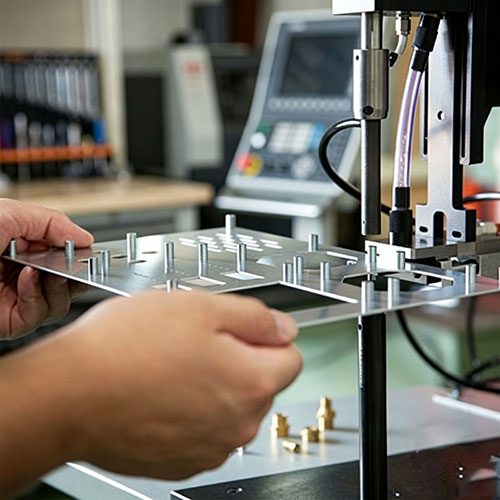
A self-clinching fastener is a threaded nut, stud, standoff, or pin that becomes a permanent, integral part of a sheet metal chassis when pressed into a ductile material. Unlike standard rivets or sheet metal screws, self-clinching technology relies entirely on the cold-flow principles of metallurgy rather than heat or external adhesives.
The mechanical installation process relies on highly precise, controlled force:
Hole Preparation: A precise circular hole is punched or laser-cut into the sheet metal host component. No deburring or countersinking is required.
Placement: The shank of the self-clinching fastener is placed into the prepared hole.
Squeezing Force: An installation press applies a parallel, continuous squeezing force to the head of the fastener.
Cold-Flow Displacement: As the profile enters the metal, the unique serrated clinching ring or ribs force the host metal to cold-flow into an undercut area around the shank of the fastener.
Permanent Interlock: The displaced metal locks securely behind the undercut, providing exceptional push-out resistance. Concurrently, the serrations or ribs embed into the metal surface, creating a high-strength anchor that completely blocks rotation when mating torque is applied.
Top 5 Benefits of Self-Clinching Fasteners for Sheet Metal Work
Implementing self-clinching hardware yields immediate dividends across your production line. Here are the top five operational and structural benefits that drive global manufacturing adaptation:
High Torque-Out and Push-Out Resistance
Once the host metal cold-flows into the fastener's undercut and knurled ring, it creates a robust mechanical bond. Self-clinching fasteners routinely withstand high tightening torque during final product assembly without loosening. Their design ensures they remain firmly anchored even under heavy vibrational stress, cyclic loading, or field maintenance adjustments.
Elimination of Thermal Distortion and Welding Risks
Because installation is entirely mechanical and completed at room temperature, there is zero thermal input. This completely eliminates the threat of metal warping, structural weakening, or heat-affected zones. This clean process allows manufacturers to maintain tight physical tolerances across ultra-thin metal enclosures and precision framework.
Streamlined Assembly Lines and Lower Total Production Costs
Self-clinching hardware acts as pre-installed, captive threads. During final product assembly, operators do not have to struggle to hold loose nuts or washers in hard-to-reach internal cavities. This massive reduction in component handling speeds up throughput, minimizes line errors, and lowers total labor costs per unit.
Flawless Aesthetic Finishes and Preservation of Coatings
The reverse side of a self-clinching installation remains perfectly flush, smooth, and unblemished. Furthermore, because no high-heat welding is involved, self-clinching fasteners can be safely installed directly into pre-finished, zinc-plated, anodized, or pre-painted sheets without damaging the anti-corrosive layer.
Enhanced Design Versatility for Mixed Materials
Self-clinching technology allows for strong threaded configurations across disparate materials. For example, a high-strength steel or stainless steel self-clinching stud can be seamlessly integrated into a lightweight aluminum panel. This gives engineering teams total freedom to optimize weight-to-strength ratios without sacrificing thread integrity.
Where Are Self-Clinching Fasteners Used in Sheet Metal Manufacturing?
Thanks to their high structural reliability and pristine cosmetic finishes, self-clinching fasteners are widely utilized across complex B2B sectors globally:
Telecom and Server Enclosures: Data centers rely heavily on massive server racks, network chassis, and complex blade assemblies. Self-clinching standoffs and nuts allow multiple circuit boards, power blocks, and internal structural brackets to mount precisely without loose hardware short-circuiting electrical lanes.
Automotive Electronics and Modules: The modern automotive sector utilizes lightweight aluminum panels for infotainment systems, EV battery management units, and sensor housings. Captive fasteners ensure threads won’t back out under constant road vibrations.
Medical Equipment and Diagnostics: Cleanliness and tight physical tolerances are paramount in medical hardware like MRI machines, patient monitors, and laboratory fluid analyzers. The clean, weld-free installation of clinching fasteners eliminates particulate contamination risks.
Industrial Control Cabinets and Power Distribution: Large industrial control panels, switchgear boxes, and outdoor electrical substations utilize robust self-clinching studs to mount heavy copper busbars, transformers, and secure hinge mechanisms.
Renewable Energy and Aerospace: From structural components inside solar tracking systems to internal avionics brackets within aerospace control boxes, these fasteners deliver high strength-to-weight performance in harsh outdoor operational environments.
Quality Control Tips: How to Ensure Perfect Installation & Clinching?
Achieving maximum performance from self-clinching fasteners requires adherence to strict quality control parameters during production. Follow these engineering guidelines to prevent failure:
Strict Hole Tolerance Control: Hole diameters must be precisely punched or laser-cut according to the manufacturer’s specification sheet. If the hole is too large, there will not be enough displaced metal to fill the undercut, destroying push-out performance. If the hole is too small, the fastener shank can warp the sheet panel.
Match Material Hardness Appropriately: The host sheet metal must always be significantly softer than the self-clinching fastener itself. If the sheet metal is too hard (e.g., certain unannealed stainless steel grades), it will resist cold-flow displacement, resulting in unseated fasteners that spin or push out under minimal stress.
Apply Squeezing Force, Never Impact: Self-clinching hardware must always be installed using a smooth, continuous parallel squeezing press. Never use an impact hammer, rivet gun, or sudden blow tool. Impact forces shatter or deform the knurled profile rather than initiating uniform metallurgical cold-flow.
Ensure Adequate Edge Distance: Avoid placing pre-cut holes too close to the edge of the sheet panel or a sharp bend line. The intense physical force of cold displacement exerts outward pressure on the host metal. If placed too close to a boundary, it can cause the panel edge to bulge or warp out of spec.
Looking for a Reliable Self-Clinching Fasteners Supplier in China?
When dealing with high-volume industrial manufacturing, the quality of your captive hardware directly dictates the integrity of your finished metal assemblies. Substandard fasteners cause catastrophic spinning failures on the assembly line, resulting in scrap metal, delayed lead times, and inflated costs.
If you are seeking a world-class manufacturing partner to optimize your supply chain, Lingyufab delivers an unmatched, comprehensive industrial solution. Based out of Shanghai, China, Lingyufab operates as a specialized, one-stop sheet metal and fastener manufacturer capable of managing your entire production pipeline under one roof.
Why Partner with Lingyufab?
Integrated Solutions: Lingyufab specializes in complete Enclosure & Chassis Assemblies, combining fabrication with Pre-installed Hardware & Sub-Assemblies to deliver ready-to-use components.
High-Volume Capacity: With a capacity exceeding 8,000 fastener and custom assembly units delivered monthly, Lingyufab ensures scalability for large-scale industrial projects.
Global Trust & Quality: Supporting over 50 major global clients, Lingyufab maintains strict quality standards for demanding industrial applications.
Responsive Service: Enjoy reliable, 24-hour reply times for engineering consultations, quotes, and sample requests.
Ready to lower your assembly costs and eliminate welding defects? Contact Lingyufab Today for a detailed production quote or to order evaluation samples.
FAQ About Self-Clinching Fasteners (Quick Guide)
Can self-clinching fasteners be used in stainless steel panels?
Yes, provided the fastener is harder than the panel material.What is the difference between riveting and self-clinching?
Unlike some rivets that may protrude, self-clinching fasteners are engineered to be pressed into the material, ensuring a flush and secure profile.What happens if a self-clinching fastener is over-squeezed?
Excessive force can damage the threads or deform the sheet metal, weakening the joint.Can I install self-clinching fasteners after powder coating?
It is highly recommended to install them before the finishing process to ensure a secure, flush, and reliable connection.