+8613003178786
  sales@lingyufab.com



The Role of Material Selection in Enclosure EMI Performance
30
Jul’2026The Role of Material Selection in Enclosure EMI Performance
Have you ever spent months developing an electronic product, only to have it fail EMC testing at the last minute? Or perhaps you have designed a perfect enclosure, only to discover that it leaks electromagnetic interference through seams and gaps that you thought were sealed? These are among the most frustrating and costly problems faced by design engineers, product developers, and procurement professionals. A product that passes functional testing but fails electromagnetic compatibility (EMC) certification cannot be sold in regulated markets—and the cost of redesigning an enclosure after the fact can easily reach tens of thousands of dollars. The root cause of many such failures traces back to one critical decision made early in the design phase: material selection.
At LINGYUFAB, we specialize in custom sheet metal fabrication for electronic enclosures, industrial cabinets, and communication equipment. With over 20 years of precision manufacturing experience since 2003 and certification as a core supplier for Mitsubishi Electric, we understand that material choice is not just a procurement decision—it directly determines whether your enclosure will pass EMC testing, perform reliably in the field, and stay within budget.
What Is EMI Shielding and Why Does Material Choice Matter?
Electromagnetic interference (EMI) shielding is the practice of enclosing electronic circuits within a conductive or magnetic barrier to block external electromagnetic fields from entering, while simultaneously preventing internal emissions from escaping. A shielded enclosure functions like a Faraday cage—a continuous conductive shell that reflects and absorbs electromagnetic waves. The effectiveness of this shield, measured in decibels (dB), depends primarily on three factors: the electrical conductivity and magnetic permeability of the material, the continuity of the enclosure's conductive surface, and the management of all openings and discontinuities.
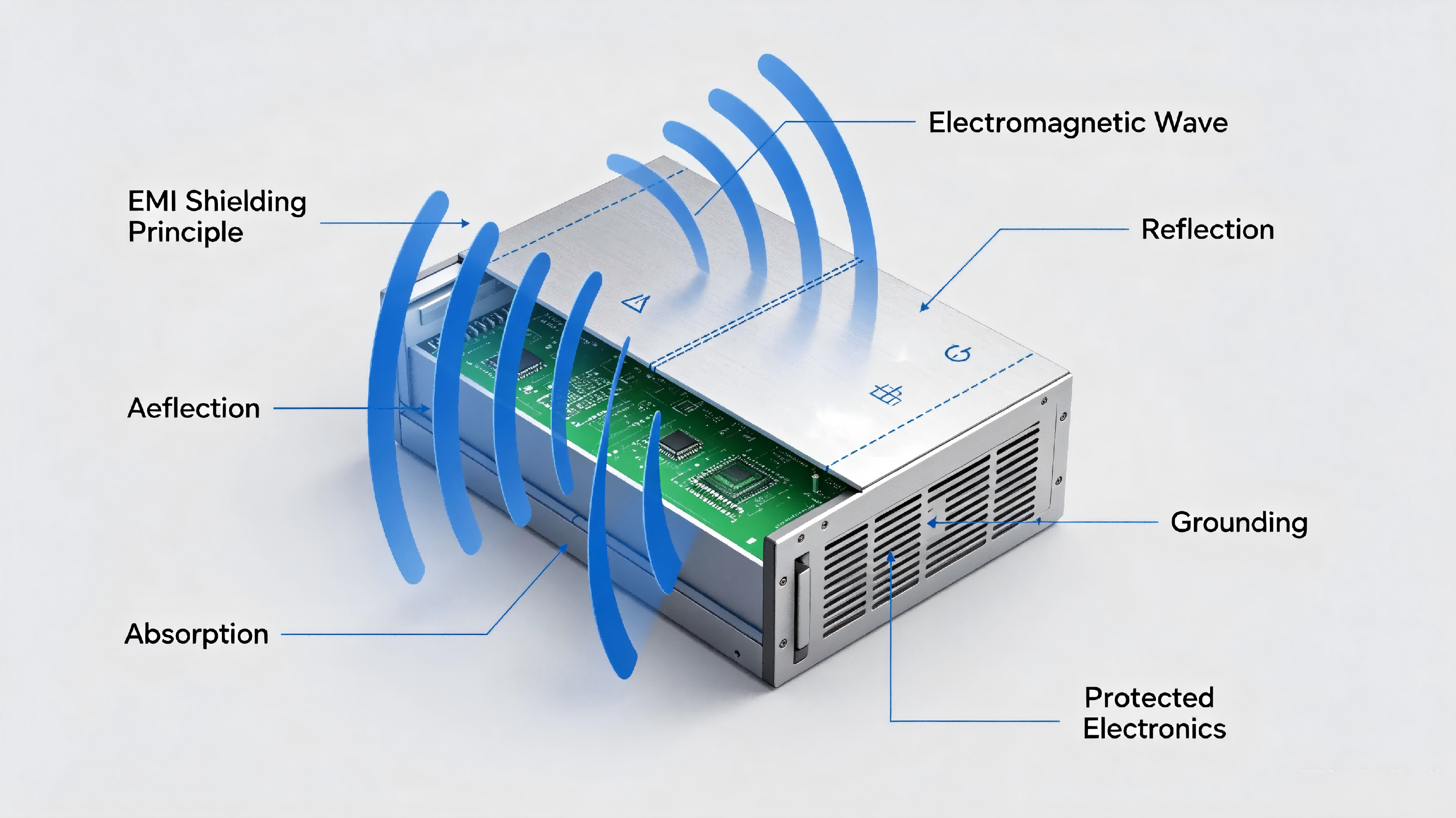
Material choice is the foundation upon which everything else is built. A highly conductive material like copper or aluminum reflects electromagnetic waves effectively, while a material with high magnetic permeability like steel absorbs magnetic fields. Select the wrong material, and even the most carefully designed enclosure will struggle to achieve the required shielding effectiveness. Select the right material, and you create a solid foundation for passing EMC certification on the first attempt.
How Does Material Choice Affect Shielding Performance?
The shielding effectiveness of an enclosure is not determined by material alone—but material sets the upper limit of what is achievable. Different metals offer vastly different shielding characteristics across frequency ranges, and understanding these differences is essential for making the right choice.
Conductivity and Reflection
For electric fields and high-frequency electromagnetic waves, shielding works primarily through reflection. Metals with high electrical conductivity—such as copper, aluminum, and silver—reflect electromagnetic waves effectively. Copper, for example, offers excellent conductivity but is expensive and heavy. Aluminum provides a good balance of conductivity, weight, and cost, making it a popular choice for many electronic enclosures.
Permeability and Absorption
For magnetic fields and low-frequency interference, shielding relies more on absorption. Materials with high magnetic permeability—such as steel and specialized alloys like Mu-metal—absorb magnetic energy rather than reflecting it. This makes steel particularly effective for low-frequency magnetic shielding, though its weight and corrosion susceptibility must be managed through finishing.
Frequency-Dependent Performance
The effectiveness of a shielding material varies with frequency. At low frequencies (below 1 MHz), magnetic permeability becomes critical—steel outperforms aluminum. At high frequencies (above 30 MHz), conductivity dominates—aluminum and copper become more effective. For broadband applications that must shield across a wide frequency spectrum, engineers often choose materials that balance both properties or combine multiple materials in a single design.
Key Advantages of Material Selection for EMI Shielding
Choosing the right material for your enclosure delivers benefits that extend far beyond EMI compliance. The material you select affects performance, cost, weight, durability, and manufacturability across the entire product lifecycle.
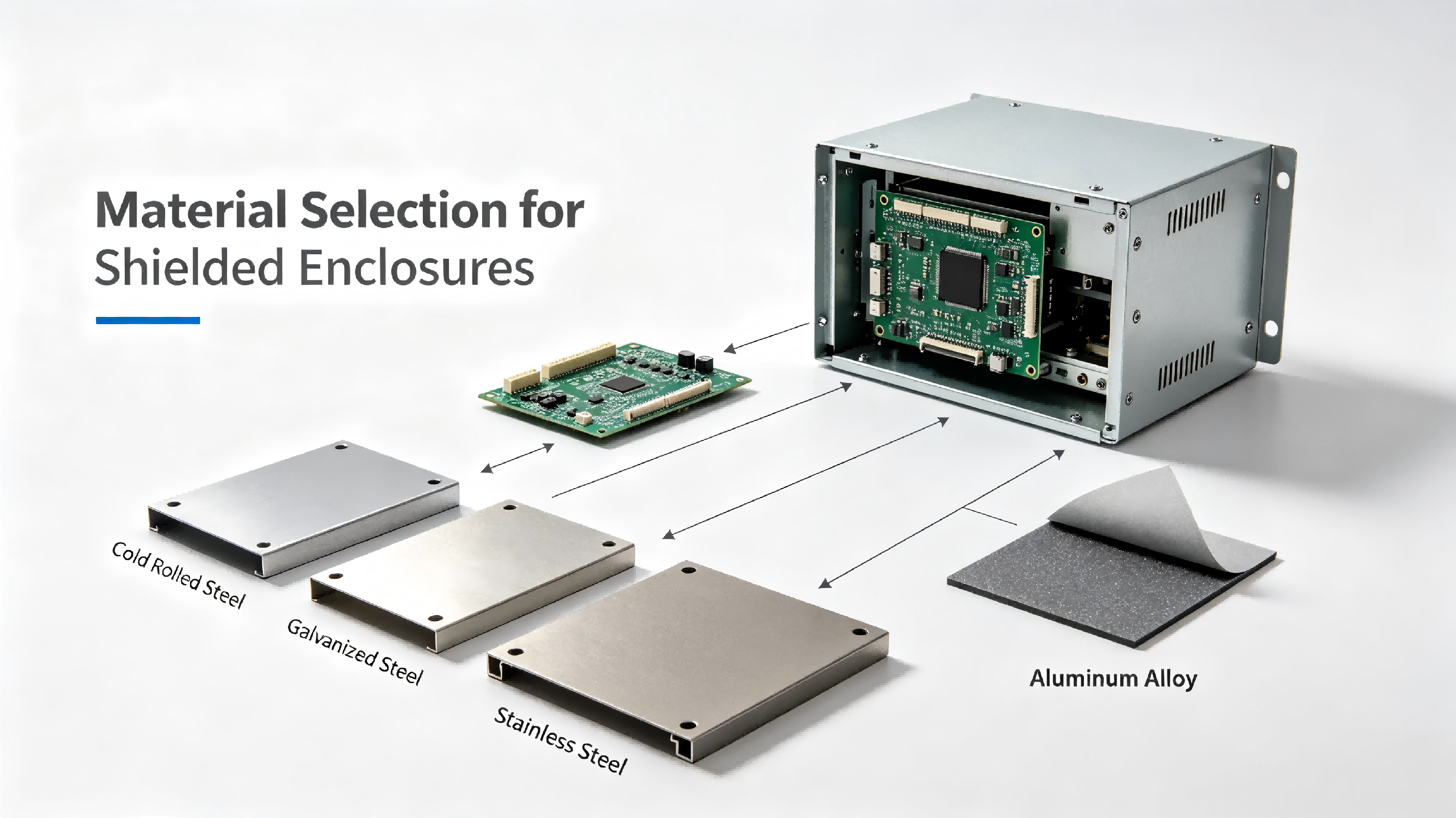
Cold Rolled Steel (CRS) offers excellent EMI shielding due to its electrical conductivity and magnetic permeability. It is the workhorse material of enclosure design—strong, formable, weldable, and cost-effective. CRS typically provides shielding effectiveness of approximately 100 dB at 1 GHz, making it suitable for most industrial and commercial applications. However, bare CRS rusts rapidly, requiring a protective finish such as powder coating or zinc plating. This adds a secondary process and cost but delivers exceptional shielding performance at a low base material cost. CRS is best suited for indoor industrial controls, server racks, and cost-sensitive enclosure projects.
Galvanized Steel (SGCC) takes CRS and adds a protective zinc coating during the rolling process. This eliminates the need for separate corrosion protection while maintaining excellent shielding effectiveness—approximately 100 dB at 1 GHz. The zinc coating provides sacrificial corrosion protection, meaning the enclosure resists rust even if the coating is scratched. For outdoor electrical cabinets, communication equipment, and industrial enclosures exposed to moisture, galvanized steel often represents the optimal balance of cost, shielding, and durability.
Stainless Steel (grades 304 and 316) offers very good shielding effectiveness at approximately 95 dB at 1 GHz, combined with excellent corrosion resistance and high structural strength. Unlike galvanized steel, stainless steel's corrosion resistance comes from its chromium content, not a surface coating, so it maintains its protective properties even when scratched or welded. It is the mandatory choice for medical devices, marine environments, food processing equipment, and any application requiring frequent wash-downs. The trade-offs are cost—stainless steel is the most expensive common enclosure material—and formability, as it is harder to bend and requires more powerful equipment.
Aluminum (5052 and 6061 alloys) weighs approximately one-third as much as steel, making it the material of choice when weight is a critical factor. It provides excellent natural corrosion resistance through its oxide layer and offers good high-frequency shielding (above 30 MHz) at approximately 90 dB at 1 GHz. Aluminum's lightweight properties make it ideal for telecom equipment, portable electronics, and electric vehicle charging stations. However, aluminum's shielding effectiveness for low-frequency magnetic fields is inferior to steel. It also requires larger bend radii—typically 1.5 times material thickness for 6061 alloy—and is more expensive than cold-rolled steel.
Where Can You Use Shielded Enclosures?
The adaptability of shielded enclosures makes them essential across a wide range of industries where electromagnetic compatibility is critical to product performance and regulatory compliance.
Industrial Equipment and Automation
Industrial machinery and automation systems generate significant electromagnetic noise from motors, drives, and switching power supplies. Shielded enclosures protect sensitive control electronics from this interference while preventing emissions from disrupting other equipment on the factory floor. Typical applications include PLC enclosures, motor drive cabinets, and robotic control boxes.
Telecommunications and Networking
Communication equipment must meet stringent EMC standards to operate reliably in dense networking environments. Shielded enclosures for telecom applications protect sensitive RF circuits from external interference while preventing internal emissions from degrading network performance. Common products include base station cabinets, network switches, and antenna filter enclosures.
Medical Devices
Medical equipment demands both EMI shielding and strict cleanliness standards. Stainless steel enclosures are the preferred choice for diagnostic equipment, patient monitoring systems, and surgical devices because they combine corrosion resistance with effective shielding. The shielding prevents interference from affecting sensitive medical measurements while protecting devices from external electromagnetic sources.
Automotive and Electric Vehicle Applications
Modern vehicles contain hundreds of electronic control units operating in close proximity. Shielded enclosures protect ECUs, battery management systems, and infotainment modules from EMI generated by motors, power electronics, and wireless communication systems. Lightweight aluminum enclosures are increasingly used in EVs to reduce overall vehicle weight.
Renewable Energy Systems
Solar inverters, wind turbine controllers, and battery storage systems operate in challenging outdoor environments while generating significant EMI. Galvanized steel and stainless steel enclosures provide the corrosion resistance and shielding effectiveness required for long-term reliability in renewable energy applications.
How to Choose the Right Material for Your Enclosure?
Understanding the scientific principles behind conductivity, permeability, and frequency response is one thing—but when you are sitting at your desk, ready to finalize a purchase order, the questions that actually matter are far more practical: "Which material is right for my product? Which offers the best value for my budget? Which will survive the environment my equipment operates in?"
To help you answer these questions quickly and confidently, we have distilled the key technical trade-offs into a simple decision-making reference table.
| If Your Primary Concern Is... | Recommended Material | Why |
|---|---|---|
| Lowest upfront cost | Cold Rolled Steel (CRS) | Lowest material cost and easiest to fabricate. Remember to budget for surface finishing to prevent rust. |
| Outdoor use with good shielding + rust protection | Galvanized Steel (SGCC) | Same shielding performance as CRS with a built-in zinc coating. The best cost-to-performance choice for most applications. |
| Harsh environments (medical, marine, food processing) | Stainless Steel (304 or 316) | Will not rust—even if scratched. The mandatory choice for sanitary and wash-down applications. |
| Lightweight / portable equipment or EV mounting | Aluminum (5052 or 6061) | One-third the weight of steel with excellent high-frequency shielding. Ideal for EVs, handheld devices, and telecom. |
| Low-frequency magnetic field shielding (< 1 MHz) | Steel (CRS or SGCC) | Steel's high magnetic permeability absorbs low-frequency magnetic fields far better than aluminum. |
The bottom line: Choose CRS for budget, SGCC for outdoor durability, Stainless Steel for harsh environments, and Aluminum for lightweight applications. Still unsure which material fits your specific project? Our engineering team is ready to review your product drawings, operating environment, and budget to provide a tailored recommendation—drawing on over 20 years of hands-on experience serving clients like Mitsubishi Electric. Contact us for a no-obligation consultation.
Your Trusted Partner for EMI Shielding Enclosures
Beyond technical specifications, the success of your enclosure project depends heavily on selecting a reliable manufacturing partner. A trustworthy supplier should provide strong engineering support, advanced manufacturing equipment, strict quality management, and clear communication throughout the project.
Lingyufab is a professional sheet metal fabrication and fastener manufacturer based in Shanghai, China, with more than 20 years of precision manufacturing experience since 2003. The company follows strict Japanese quality standards and is a certified core supplier for Mitsubishi Electric, demonstrating its commitment to precision manufacturing, consistent quality, and efficient production.
Our Engineering Support:
Our experienced engineering team provides comprehensive support throughout the design and manufacturing process. We help customers select the optimal material for their specific shielding requirements, operating environment, and budget constraints. Our Design for Manufacturability (DFM) review identifies potential EMI leakage points before production begins, recommending improvements that enhance shielding effectiveness while reducing manufacturing costs. This upstream intervention is far more cost-effective than redesigning after failed EMC testing.
Our Manufacturing Capabilities:
From laser cutting and CNC bending to welding, assembly, and surface treatment, we offer complete in-house manufacturing. Our high-precision laser cutting and CNC bending capabilities ensure tight tolerances on seams, joints, and cutouts—minimizing the gaps that compromise shielding effectiveness. For applications requiring welded enclosures, we offer TIG welding for stainless steel, MIG welding for general fabrication, and spot welding for thin sheet connections, with continuous welds specified where electrical continuity is critical.
Our Surface Finishing Services:
We offer powder coating, anodizing, electroplating, and polishing services to meet your corrosion protection and conductivity requirements. For galvanized steel enclosures, the zinc coating provides inherent corrosion protection while maintaining excellent shielding effectiveness. For aluminum enclosures requiring improved conductivity at seams, we can specify conductive anodizing or plating options.
Our Quality Assurance:
Every project undergoes rigorous quality inspection, including dimensional verification, visual examination, and welding quality assessment. We provide material test certificates (MTC) for all raw materials, ensuring full traceability and compliance. Our quality control procedures cover the complete manufacturing process from raw material inspection to finished product inspection, backed by ISO 9001, ISO 14001, and TÜV CE certifications.
For businesses developing electronic products that require EMI shielding, or for engineering teams with questions about material selection for enclosure projects, please don't hesitate to contact us. Our engineering team is available to review your design, recommend the optimal material, and provide a free quote.
Conclusion
The material choice for an electronic enclosure is not merely a cost decision—it is a fundamental engineering decision that determines whether your product will meet EMI shielding requirements, pass EMC certification, and perform reliably in the field. Cold rolled steel offers excellent shielding at low cost but requires corrosion protection. Galvanized steel provides outstanding shielding with built-in corrosion resistance. Aluminum delivers lightweight performance with good high-frequency shielding. Stainless steel offers superior corrosion resistance for harsh environments. Each material has its place, and the optimal choice depends on your specific requirements for shielding effectiveness, weight, cost, corrosion resistance, and formability.
By understanding the relationship between material properties and shielding performance, and by working with an experienced fabrication partner like LINGYUFAB, you can avoid costly redesigns, pass EMC testing on the first attempt, and bring your product to market with confidence.
FAQs
Q1: What is the best material for EMI shielding in electronic enclosures?
There is no single "best" material—the optimal choice depends on your specific requirements. Galvanized steel offers excellent shielding (~100 dB at 1 GHz) with good corrosion resistance at a moderate cost. Aluminum provides lightweight performance (~90 dB at 1 GHz) with excellent corrosion resistance. Cold rolled steel delivers excellent shielding at the lowest cost but requires protective finishing. Stainless steel offers very good shielding (~95 dB at 1 GHz) with superior corrosion resistance for harsh environments. Consult with our engineering team for a recommendation based on your specific application.
Q2: How does material thickness affect EMI shielding?
Thicker materials generally provide better shielding effectiveness, particularly at low frequencies. For low-frequency interference (such as 50 Hz power frequencies), material thickness should be at least 1.5 mm. For high-frequency (RF) interference, 0.8 to 1.2 mm thickness is typically sufficient. However, material conductivity and permeability are more significant factors than thickness alone.
Q3: Does galvanized steel provide good EMI shielding?
Yes. Galvanized steel provides excellent EMI shielding effectiveness—approximately 100 dB at 1 GHz—while offering built-in corrosion protection through its zinc coating. This makes it an ideal choice for outdoor electrical cabinets, communication equipment, and industrial enclosures exposed to moisture.
Q4: Can I use aluminum for an enclosure that needs good low-frequency shielding?
Aluminum provides good high-frequency shielding (above 30 MHz) due to its high conductivity, but its low-frequency magnetic shielding is inferior to steel. For applications requiring low-frequency magnetic shielding, steel or galvanized steel is generally recommended.
Q5: How important are seams and joints for EMI shielding?
Seams and joints are critical. Even a 0.5 mm gap in a seam can leak EMI at frequencies above 1 GHz. The shielding effectiveness of an enclosure can be reduced to 40 dB or less due to discontinuities. Overlapping joints (minimum 5 mm overlap) and conductive gaskets should be used to maintain electrical continuity across seams.
Q6: What file formats do you accept for enclosure design drawings?
We accept 3D files in STEP (.stp) , IGS (.igs) , and SolidWorks (.sldprt) formats for material weight calculation and bend unfolding. We accept 2D drawings in PDF , DWG , and DXF formats for tolerances, surface finishes, and thread specifications. If you don't have drawings, we offer reverse engineering services from physical samples.