+8613003178786
  sales@lingyufab.com



What Are Self-Clinching Fasteners for Sheet Metal Parts?
30
Jul’2026What Are Self-Clinching Fasteners for Sheet Metal Parts?
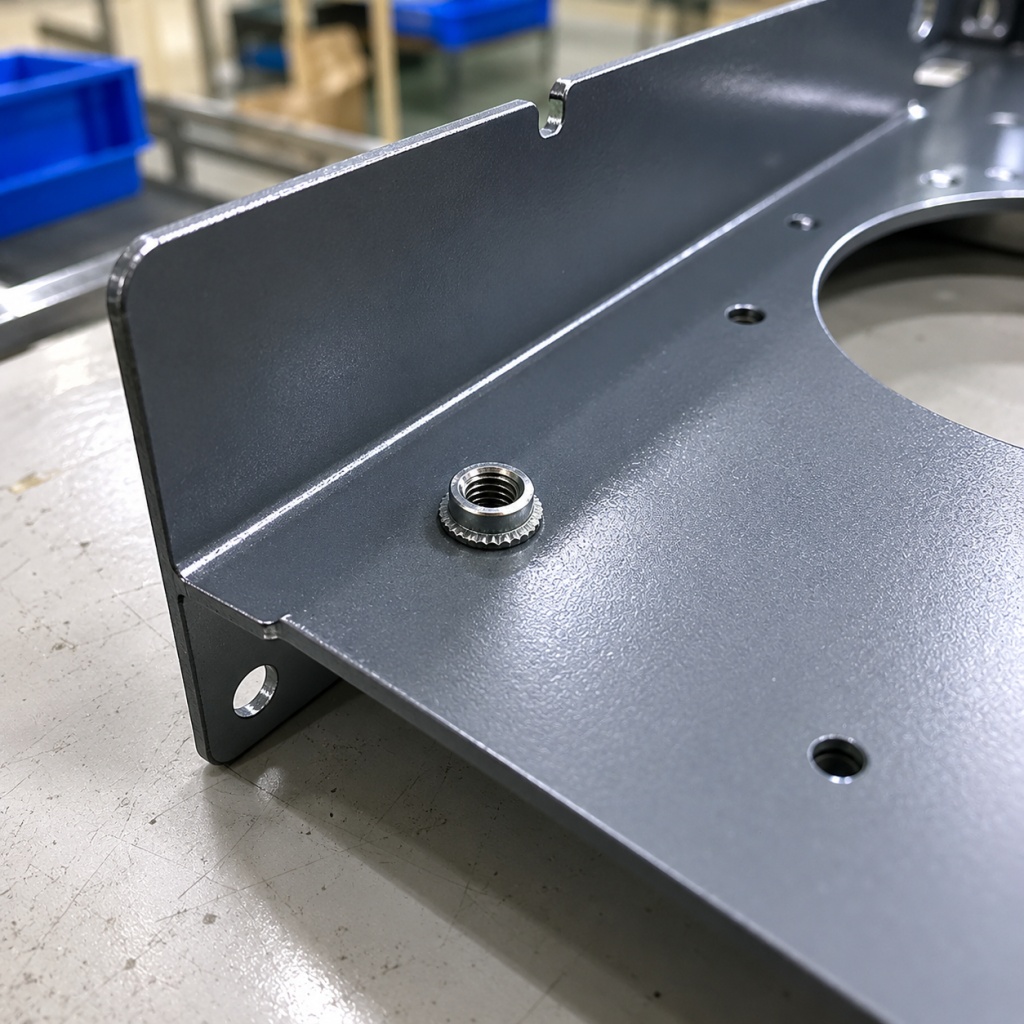
Self-clinching fasteners are specialized hardware components designed to be pressed into sheet metal to create reliable threaded or mounting points. They are widely used in enclosures, cabinets, brackets, panels, chassis, covers, and many other fabricated sheet metal parts where a strong, repeatable fastening point is needed.
For OEM buyers, self-clinching fasteners are far more than minor hardware items. The right selection affects assembly strength, installation efficiency, serviceability, part appearance, and whether the final product goes together smoothly. A sheet metal part can be cut and bent perfectly, but if the clinch nut, stud, or standoff is placed incorrectly, the final assembly can still fail or require rework.
Lingyufab supports sheet metal fabrication projects that involve both fabricated metal parts and matching fastener solutions. In real OEM work, we review hardware insertion alongside material thickness, hole position, bending clearance, finishing requirements, and final assembly needs—rather than treating fasteners as an isolated purchase.
Why Self-Clinching Fasteners Are Used in Sheet Metal Parts
Sheet metal is often too thin to provide adequate thread engagement when tapped directly. In many enclosures, panels, and brackets, buyers need a stronger threaded point for screws, bolts, grounding connections, covers, hinges, or internal components. Self-clinching fasteners solve this by becoming a permanent, fixed feature of the sheet metal component once installed.
When installed correctly, a self-clinching fastener resists push-out and rotation during assembly. This lets operators or end users tighten screws from one side of the product, with no need to hold a loose nut on the back side. In products such as electrical cabinets, telecom housings, server rack parts, and machine covers, this makes assembly noticeably faster and cleaner.
They are also valuable when the exterior surface needs to stay clean. Instead of welding a nut or relying on a loose fastener that can shift during assembly, a clinched fastener provides a stable threaded point with minimal visual impact on the finished part.
Common Types of Self-Clinching Fasteners
Different sheet metal products call for different hardware. The most suitable type depends on the assembly structure, material thickness, load requirements, and access direction.
Self-clinching nuts
Self-clinching nuts are pressed into sheet metal to create internal threads. They are commonly used in panels, brackets, enclosures, and chassis where screws are installed and removed repeatedly. For example, an electrical enclosure might use clinch nuts so the cover or internal mounting plate can be fixed securely, with no loose nuts rattling around inside the cabinet.
Self-clinching studs
Self-clinching studs provide an externally threaded post that is fixed permanently to the sheet metal part. They are commonly used for mounting components, grounding connections, spacing structures, or attaching parts from the opposite side. Stud location and perpendicularity matter here, because even a small angular error can make downstream assembly difficult.
Self-clinching standoffs
Standoffs create spacing between the sheet metal and another component, such as a PCB, inner plate, cover, or module. They are common in electronics housings, control boxes, and equipment panels. Height, thread size, and installation position should be confirmed early, since standoffs often dictate the final assembly clearance.
Threaded inserts and special hardware
Some products require threaded inserts, floating fasteners, panel fasteners, or other specialized hardware. These are typically chosen when there is a specific need for alignment, repeated assembly, limited access, or vibration performance. The fastener should be selected as part of the product design, not bolted on as an afterthought.
How Self-Clinching Fasteners Are Installed
Self-clinching fasteners are installed by pressing them into accurately prepared holes in the sheet metal. Under controlled force, the fastener displaces the surrounding sheet material and locks firmly into place. Unlike welding, the process does not rely on melting the base material. And unlike loose hardware, the fastener becomes a permanent feature of the sheet metal part.
In day-to-day production, the basic process typically includes:
· checking the drawing and hardware specification
· confirming material type and sheet thickness
· preparing the correct hole size before insertion
· pressing the fastener with suitable equipment and controlled force
· checking thread condition, position, and seating
· confirming that the hardware does not loosen, rotate, or interfere with later assembly
Although the process sounds simple, small errors can cause real problems. A slightly oversized hole can reduce holding strength. A fastener installed too close to a bend line can interfere with forming. And a threaded insert left unprotected during coating can become difficult to use after finishing.
Practical Details OEM Buyers Should Notice
This is where many real sheet metal projects are won or lost. Self-clinching hardware should be reviewed alongside the full fabrication route, especially if the part will later be bent, welded, powder coated, or assembled with other components.
Sheet thickness must match the fastener
Every self-clinching fastener has a recommended sheet thickness range. If the sheet is too thin, the fastener may not hold properly. If the sheet is too thick or too hard, installation can damage the fastener or leave an unstable fit. Buyers should not select hardware by thread size alone—sheet thickness is equally important.
Hole size and hole quality matter
Clinch fasteners depend on accurate hole preparation. If the hole is too small, installation can deform the part. If it is too large, the fastener can rotate or pull out. Burrs, uneven edges, or the wrong punching direction can also affect seating. For this reason, hole dimensions should be clearly marked on the drawing or confirmed with the supplier before production begins.
Distance from bends and edges should be checked
Fasteners placed too close to a bend, edge, slot, or formed feature can create interference during bending or later assembly. A nut that looks fine on a flat drawing can become hard to reach once the part is bent into shape. This is why hardware positions should be reviewed against the bend sequence and final product structure.
Surface finishing can affect threads and contact points
If the part will be powder coated, plated, or painted after hardware insertion, threaded holes, studs, grounding points, and contact surfaces may need protection. Coating buildup inside threads can make assembly difficult, while coating over grounding areas can compromise electrical contact. These requirements should be communicated before production—not after the parts are already finished.
Fastener direction and assembly access should be clear
Some hardware must be installed from a specific side of the sheet. The design should clearly indicate which side is the visible surface, which side receives the fastener, and how the final assembly will be carried out. This is especially important for enclosures, control boxes, and panels where the appearance side and the assembly side are different.
Common Applications of Self-Clinching Fasteners
Self-clinching fasteners are used across many products where sheet metal parts need reliable threaded connections or mounted components.
Electrical and electronic enclosures
Control boxes, telecom cabinets, server rack parts, and equipment enclosures frequently use clinch nuts, studs, and standoffs for covers, mounting plates, grounding points, and internal component installation. Reliable hardware placement reduces assembly time and improves repeatability.
Industrial equipment and machine covers
Machine guards, equipment housings, brackets, and access panels often need fixed threaded points for installation, maintenance, or removable covers. Self-clinching fasteners make these assemblies cleaner than loose nuts and more serviceable than fully permanent joints.
Sheet metal brackets and frames
Brackets and light structural frames may use clinch nuts or studs when parts have to be joined during final assembly. Proper fastener selection maintains strength while keeping the design compact.
Appliances and commercial products
Home appliance panels, commercial cabinets, display structures, and custom OEM products often rely on clinching hardware to simplify assembly and keep visible surfaces clean. In these products, the fastener has to perform mechanically while also supporting the appearance requirements of the finished part.
What Affects the Price of Self-Clinching Fasteners and Hardware Insertion?
The cost of self-clinching fastener projects depends on both the hardware itself and the insertion work involved during sheet metal fabrication.
Fastener type and specification
A standard clinch nut is generally simpler than a specialized standoff, stud, floating fastener, or custom hardware. Thread size, material, plating, strength requirements, and brand or standard all affect cost.
Quantity and number of insertion points
A part with one or two clinch nuts is a very different job from a cabinet panel with dozens of hardware points. More insertion points mean more labor, inspection, and process control.
Material and thickness
Different sheet materials behave differently during insertion. Carbon steel, stainless steel, aluminum, and galvanized steel may call for different fastener choices and installation settings. Harder materials and thinner sheets often need closer review.
Position accuracy and inspection needs
When the hardware position drives final assembly, inspection becomes more important. Projects with tight alignment requirements may require closer checking of hole locations, fastener seating, and thread usability.
Surface treatment and packaging
If the part needs powder coating, plating, or export packaging after insertion, threads and surfaces may need protection. Masking, post-coating thread checks, and packaging protection can all add to the final project cost.
Factors to Consider When Purchasing Sheet Metal Parts with Clinch Fasteners
When sourcing sheet metal parts with self-clinching hardware, buyers should look past the unit price of the fastener. The more important question is whether the complete part will assemble correctly and perform reliably in service.
Provide complete drawings
The drawing should specify fastener type, thread size, installation side, material thickness, hole position, and any critical assembly dimensions. If the hardware serves grounding or repeated maintenance access, that should be noted as well.
Confirm the fabrication sequence
In some designs, hardware insertion needs to happen before bending. In others, it comes after forming or after surface treatment. The right sequence depends on access, part shape, coating needs, and assembly requirements.
Review coating and masking requirements
If powder coating or plating is required, confirm which areas must stay functional after finishing. Threads, studs, grounding points, and close-fitting surfaces should be protected or inspected after finishing where necessary.
Check assembly function, not only hardware appearance
A clinch nut can look properly seated yet still cause problems if the screw will not enter smoothly, the nut rotates under torque, or the mating part fails to align. Functional inspection is often more telling than appearance checks alone.
Why One-Stop Sheet Metal Fabrication and Fastener Support Matters
In many OEM projects, the buyer needs more than sheet metal parts or fasteners as separate items. They need fabricated parts that already include the correct threaded points, hardware, surface finish, and assembly function.
When sheet metal fabrication and fastener sourcing are split across suppliers, small details slip through. The fastener may not match the sheet thickness, the hole may be prepared incorrectly, or the inserted hardware may interfere with bending or coating. These issues rarely surface until assembly begins, which is exactly when they become costly to fix.
A supplier that understands both sheet metal fabrication and fastener application can catch these details earlier. For OEM buyers, this means fewer interface problems, clearer responsibility, and a smoother path from drawing to finished part.
Self-Clinching Fastener and Sheet Metal Supplier in China
Lingyufab supports OEM sheet metal projects that require hardware insertion and matching fastener solutions. We work from customer drawings to coordinate sheet metal fabrication processes including laser cutting, CNC bending, welding, surface finishing, and final assembly, while also reviewing the practical fastener requirements for each part.
For enclosures, cabinets, brackets, panels, covers, frames, and industrial housings, self-clinching fasteners should be considered as part of the complete product design. Material thickness, hole size, insertion side, coating protection, and assembly clearance all determine whether the finished part works as expected.
If you are looking for a sheet metal fabrication supplier in China that can support self-clinching fasteners and hardware insertion for OEM projects, Lingyufab can review your drawings and provide a practical manufacturing solution tailored to your application requirements.
FAQ
What are self-clinching fasteners?
Self-clinching fasteners are hardware components pressed into sheet metal to create fixed threaded or mounting points. Common types include clinch nuts, studs, standoffs, and specialized inserts.
Why are self-clinching fasteners used instead of loose nuts?
They provide a fixed threaded point in thin sheet metal, cut assembly time, and allow installation from one side of the product without holding a loose nut on the opposite side.
Can self-clinching fasteners be used after powder coating?
In many cases they are installed before coating, but the correct sequence depends on the part design and coating requirements. Threads and contact areas may need masking or inspection after finishing.
What affects the holding strength of a self-clinching fastener?
Holding strength depends on fastener type, sheet material, sheet thickness, hole size, installation force, and correct seating. Material hardness and the distance from bends or edges can also play a role.
How should I specify self-clinching fasteners in a drawing?
The drawing should show fastener type, thread size, installation side, hole position, sheet thickness, quantity, and any masking, grounding, or assembly requirements.
Call to Action
Need sheet metal parts with self-clinching fasteners for your next project? Send Lingyufab your drawings, hardware requirements, material specifications, or product details, and our team will review the design and provide a practical solution for your OEM manufacturing needs.