
 +8613003178786
 sales@lingyufab.com
Solving a Custom Sheet Metal Challenge: Diamond Embossing Dies for Australian Galvanized Profiles
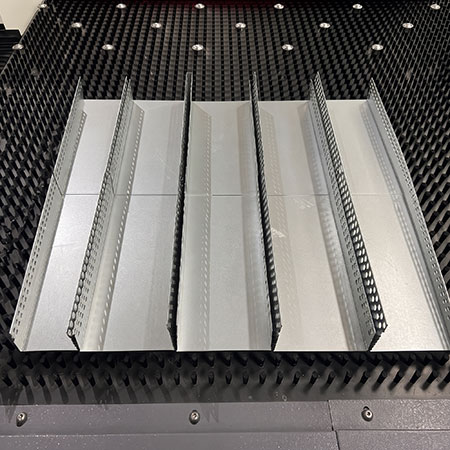
Project Background
Project Region: Australia
Client Type: Architectural Metal Products Manufacturer
Industry: Building & Construction (Light Steel Structures)
Product Type: Galvanized Steel Profiles with Special Surface Textures
Material: 1.15 mm BMT Galvanized Steel
Sample Quantity: 10 pieces
Processes: Custom Tooling, Diamond Embossing, Laser Cutting, CNC Bending
Project Background and Client Requirements
An Australian architectural metal products manufacturer recently approached Lingyufab with a highly specialized sheet metal fabrication request. They required custom sheet metal profiles made from 1.15 mm BMT galvanized steel, featuring a unique surface texture applied to specific areas. At the same time, the outer dimensions, hole positions, and bending structures had to meet exact engineering tolerances.
Unlike standard fabrication, the primary challenge of this project lay in achieving the special surface pattern. The client provided reference materials for a specific rolling knurl tool—the Wilson Wheel Rolling Knurl—and requested that the final product replicate this distinct diamond-pattern effect.
To validate the manufacturing approach and visual appearance, the project began with a pilot run of 10 prototype samples.
The specific technical requirements were:
Material: 1.15 mm BMT Galvanized Steel.
Apply a uniformly arranged, special surface texture to designated areas.
Achieve a knurled effect similar to the Wilson Wheel Rolling Knurl.
Ensure all hole positions, outer dimensions, and bending structures strictly match the drawings.
Produce 10 prototype samples for validation.
Note: While the client had clear expectations for the final texture, they permitted the use of standard patterns suitable for thin steel sheets, without requiring an exact replication of all original tool parameters.
The Technical Bottlenecks: Why Standard Processes Failed
During the initial assessment, our engineering team identified several significant bottlenecks:
1. Unavailability of Specialized Rolling Tools
The referenced Wilson Tool Rolling Knurl Wheel was not readily available for purchase. We attempted to source the original tool and domestic alternatives, but no suitable configurations could be found, and no domestic suppliers could meet the rolling requirements for this specific project.
2. Limitations of Standard Fabrication
Traditional laser cutting and CNC bending processes cannot create surface textures. We needed to completely rethink the tooling structure and find an alternative processing method to achieve the desired effect.
3. Thin-Gauge Forming Control
Working with 1.15 mm galvanized steel required extreme precision during the texturing process. Our engineers had to carefully manage:
Embossing depth and pattern consistency.
Localized deformation of the sheet metal.
Preventing reverse-side marking (ghosting).
Protecting the integrity of the zinc coating.
Ensuring subsequent laser cutting and bending were not compromised by the surface deformation.
4. Multi-Process Coordination
We needed to logically sequence the embossing, laser cutting, and bending processes to ensure seamless transitions and prevent cumulative errors.
Lingyufab's Engineering Solution: Reverse Engineering and Custom Dies
Faced with the difficulty of sourcing the rolling tool, Lingyufab did not compromise on the client's vision. Instead, our engineering team conducted a deep analysis of the reference tool, product photos, and surface textures provided by the client.
Using the confirmed Ø6 mm hole diameter in the reference photo as a baseline for scale, our engineers reverse-engineered the diamond pattern's geometry, arrangement, and spacing.
After technical evaluation, we proposed a custom diamond embossing die as an alternative solution. By utilizing a stamping/embossing die, we could replicate a surface texture nearly identical to the client's reference.
Initial Design Reference Parameters:
| Parameter | Reference Dimension |
|---|---|
| Pattern Shape | Diamond |
| Single Point Size | Approx. 1.2 × 1.0 mm |
| Transverse Pitch | Approx. 2.5 mm |
| Longitudinal Pitch | Approx. 3.2 mm |
| Arrangement | Staggered |
| Embossing Depth | Approx. 0.25 mm |
(Note: These parameters were derived from the client's reference photos to form the project design baseline, not the official parameters of the original manufacturer's tool.)
Before manufacturing, we generated a dedicated pattern layout drawing and submitted it to the client for approval.
The Manufacturing Process: Multi-Step Precision
To ensure the structural integrity of the 1.15mm galvanized steel, we designed a strict production workflow. The optimal sequence was determined to be: Embossing first, followed by laser cutting, and finally bending.
Step 1: Custom Die Development
Based on the approved pattern and scale, we designed and manufactured a dedicated diamond embossing die.
Step 2: Full-Sheet Embossing
The diamond texture was applied to the flat sheet metal before any cutting. This approach provided better material stability and support during the high-pressure embossing process, minimizing distortion.
Step 3: Laser Cutting
Once the embossing was complete, we utilized high-precision laser cutting to profile the outer shape and punch the precise hole patterns according to the drawings. Cutting after embossing ensured the flatness required for accurate cutting.
Step 4: CNC Bending
The profiles were then formed using our CNC bending centers, adhering strictly to the structural drawings.
Step 5: Quality Inspection
Every piece underwent rigorous inspection, checking outer dimensions, hole positions, embossing consistency, surface condition (no damaged zinc coating), and bend angles.
Project Success and Client Value
The project was successfully completed, and 10 perfect prototype samples were delivered to Australia.
Through independent research and custom tooling development, Lingyufab successfully overcame the obstacle of unavailable imported rolling tools. The custom diamond embossing die achieved the exact visual effect the client was looking for.
This project demonstrates Lingyufab's comprehensive capabilities in non-standard sheet metal development and special process applications:
Special Process Substitution: Finding feasible alternatives through technical analysis when imported tools are unavailable.
Non-Standard Die Development: Designing custom dies based on physical photos, dimensions, and texture requirements.
Multi-Process Integration: Seamlessly combining embossing, laser cutting, and CNC bending into one cohesive workflow.
Overseas Customization: Providing end-to-end support for global clients, from technical analysis to prototype manufacturing.
Why Choose Lingyufab for Non-Standard Projects?
In special sheet metal product development, client requirements cannot always be met by standard, off-the-shelf processes.
This Australian project demonstrates that Lingyufab is more than just a provider of standard sheet metal fabrication services. When challenges arise, we possess the engineering depth to conduct process research, develop custom tooling, and integrate multiple manufacturing steps.
Whether you need standard laser cutting and CNC bending, or complex custom stamping, embossing, and assembly, our engineering team is ready to turn your challenging requirements into practical, high-quality production solutions.
Ready to discuss your custom sheet metal project? Contact Lingyufab today with your design files and technical requirements. Our engineering team will review your specifications and provide a competitive quote within 24 hours.
FAQs
1. Can you manufacture custom embossed sheet metal parts without existing tools?
Yes. As demonstrated in this case study, if standard or imported tools are unavailable, our engineering team can reverse-engineer the required texture from photos or samples, design a custom die, and manufacture it in-house to meet your prototyping or mass production needs.
2. What is the minimum order quantity for custom die development?
We are highly flexible. For this specific project, the client only required 10 pieces for validation. We support everything from 1-piece prototypes to large-scale production runs, applying the same rigorous engineering standards regardless of volume.
3. Why was the embossing process done before laser cutting?
When working with thin-gauge materials like 1.15mm steel, forming the entire flat sheet first provides better structural stability and prevents the metal from warping during the embossing process. Laser cutting the outer profile afterward ensures dimensional accuracy.
4. How do you protect the galvanized coating during embossing?
We carefully control the embossing depth (e.g., 0.25mm in this project) and use polished tooling to ensure the zinc coating is stretched, not fractured or flaked, maintaining the material's corrosion resistance.
5. Do you offer surface texturing on other materials besides galvanized steel?
Yes. We can apply custom embossing, knurling, and texturing to various materials, including cold-rolled steel (SPCC), stainless steel, and aluminum alloys, depending on your application.