
 +8613003178786
  sales@lingyufab.com
Press Brake Forming
Leading Press Brake Forming Service Manufacturer
As a premier custom sheet metal fabrication provider, Lingyufab delivers high-precision press brake forming services for global OEMs and industrial clients. Combining advanced CNC press brake technology, automated bending setups, and rigorous quality inspection, Lingyufab handles complex geometries and tight tolerances across small-batch prototypes and large-scale commercial production runs.
China Press Brake Forming Manufacturer
Operating as a top-tier China press brake forming manufacturer, Lingyufab integrates cost-efficient manufacturing capabilities with international quality standards.
Our modern facility features multi-axis CNC bending machines capable of processing carbon steel, stainless steel, aluminum, and specialized alloys. By leveraging efficient production workflows and skilled technical teams, Lingyufab provides global customers with competitive pricing, swift turnaround times, and reliable manufacturing consistency.
Press Brake Forming Techspecs
To meet demanding engineering requirements, Lingyufab's press brake forming operations adhere to strict technical parameters:
| Parameter | Specification / Range |
|---|---|
| Bending Force Capacity | 30 Tons – 500 Tons |
| Max Sheet Length | Up to 4,000 mm (13 feet) |
| Thickness Range | 0.5 mm – 16 mm (varies by material) |
| Controlled Axes | Up to 8-axis CNC control (X, R, Z1, Z2, Y1, Y2, Crown) |
| Bending Methods | Air Bending, Bottoming, Coining |
| Tolerance Range | Angle: ±0.5° | Linear Dimension: ±0.1 mm |
Custom Press Brake Forming Parts
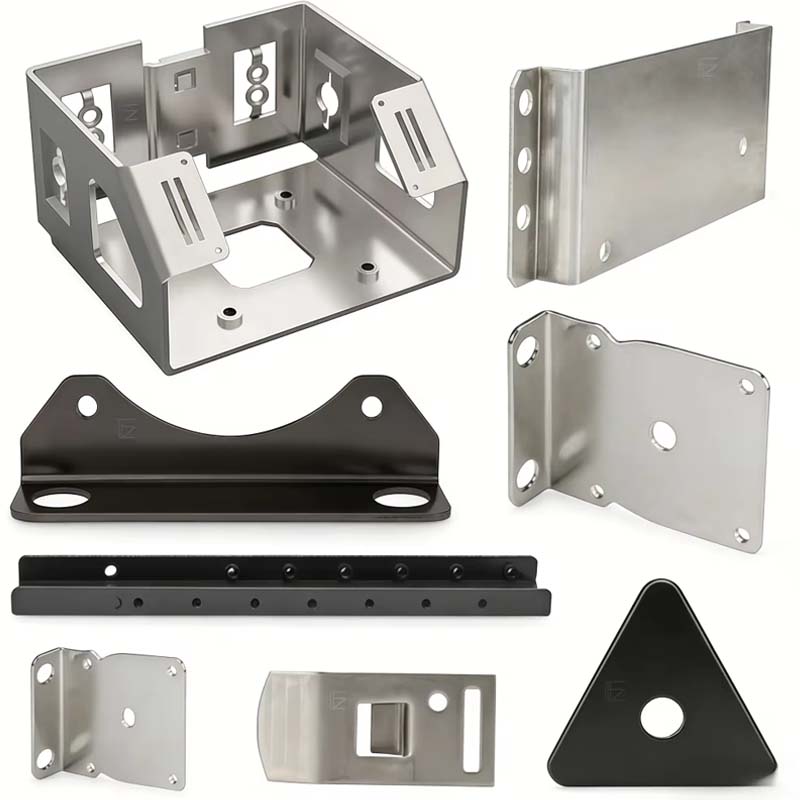
Lingyufab specializes in end-to-end custom press brake forming tailored to your engineering drawings (STEP, IGES, DXF, PDF). From intricate electrical enclosures to heavy structural channels, Lingyufab engineers assist in optimizing bend radii, relief notches, and k-factor calculations to ensure flawless repeatability and seamless assembly integration.
Applications of Press Brake Forming
Press brake forming is an indispensable metalworking process with a vast array of applications across diverse industries. At Lingyufab, we leverage this versatility to create critical components that power, house, and support essential equipment worldwide. In the realm of industrial machinery, press brake formed parts like guards, brackets, and panels are foundational to robust machine construction. The automotive sector relies heavily on this technology for structural chassis components, brackets, and body panels requiring high strength and precision. Within the electronics and telecommunications fields, the process is essential for fabricating the delicate yet durable enclosures, racks, and server cabinets that protect vital equipment. For the construction and infrastructure industries, press brake bending produces various structural profiles, HVAC duct connectors, and complex metal cladding. From heavy-duty mining equipment frames to fine-gauge electrical mounting plates, the application of press brake forming by Lingyufab transforms diverse metal materials into the high-quality parts critical to modern infrastructure.
What is Press Brake Forming?
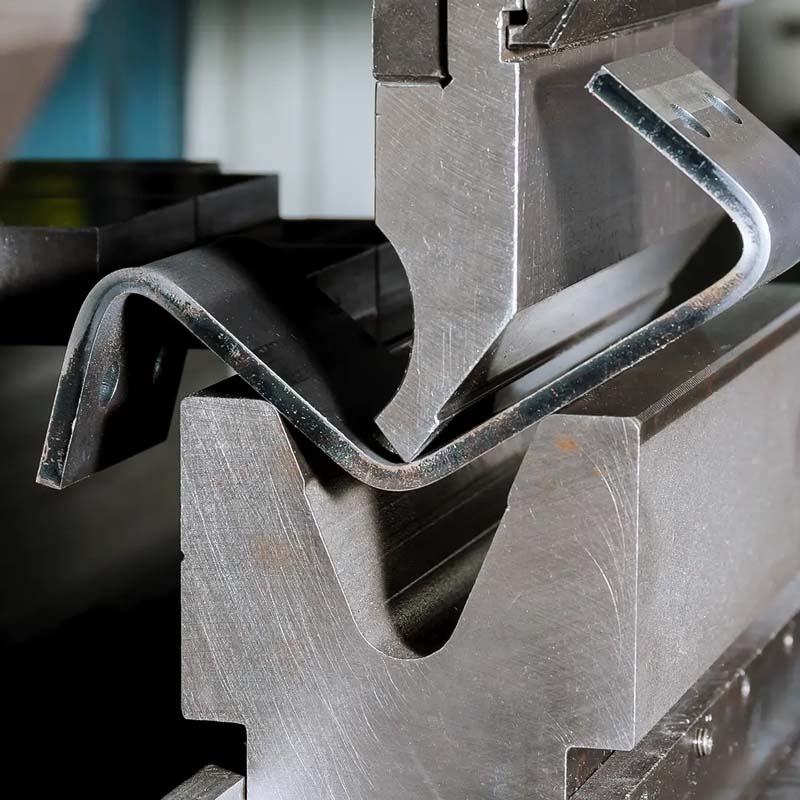
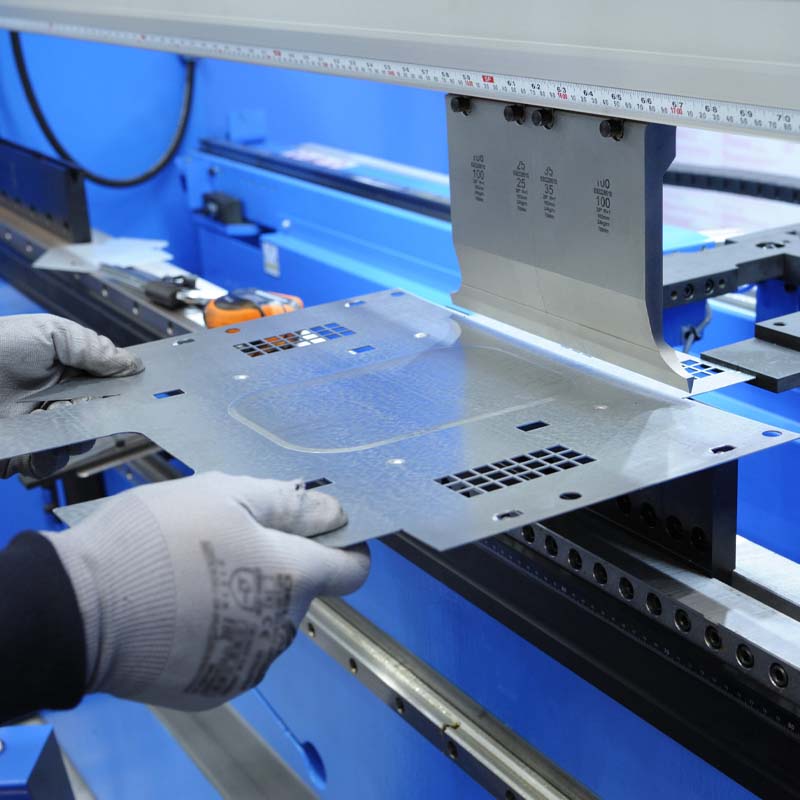
Press brake forming (commonly referred to as press brake bending) is a metalworking process used to bend sheet metal into predefined angles, channels, and structural profiles. The sheet metal workpiece is placed over a stationary die, while a descending punch applies force along a straight line, plastically deforming the sheet without fracturing it.
Features of Press Brake Forming
High Precision & Repeatability
Advanced CNC back-gauges and hydraulic control ensure exact bend angles and dimensions across large production batches.
Versatile Geometry Handling
Capable of creating simple 90° bends, complex multi-bend profiles, channels, Z-shapes, and closed boxes.
Tooling Adaptability
Quick-change punch and die tooling allows smooth transitions between different material thicknesses and bend radii.
Cost Efficiency
Eliminates expensive custom hard tooling required in traditional stamping processes, making it ideal for both low and high volumes.
Applications of Press Brake Forming
Press brake formed parts engineered by Lingyufab are essential components across numerous global industries:
Automotive & Commercial Vehicles
Chassis brackets, cross-members, panels, and reinforcement channels.
Electronics & Telecom
Server racks, control cabinets, mounting brackets, and chassis boxes.
Industrial Machinery
Machine covers, guards, structural frames, and material handling chutes.
HVAC & Construction
Ductwork connectors, architectural cladding, framing channels, and mounting plates.
Press Brake Forming Guide for Sheet Metal Assembly
To achieve seamless downstream assembly (welding, riveting, or bolted fastening), Lingyufab recommends following key DFM (Design for Manufacturability) guidelines for press brake bending:
Minimum Bend Radius
Maintain an internal bend radius equal to or greater than the material thickness (R ≥ T) to avoid micro-cracking along the outer curve.
Hole-to-Bend Clearance
Keep holes and cutouts at a distance of at least 2 × T + R away from the bend line to prevent hole distortion during forming.
Flange Height
Ensure the minimum flange length is at least 4 × T so the sheet rests securely on the lower die opening during bending.
Relief Notches
Add bend relief notches at corners to prevent material tearing and flange distortion.
Press Brake Forming Material
Lingyufab processes a wide range of ferrous and non-ferrous metals, selecting the optimal tooling and bend parameters for each material type:
Press Brake Forming Accuracy
At Lingyufab, achieving consistent accuracy requires precise control over springback, material thickness variation, and machine deflection:
CNC Automatic Crowning Systems
Compensate for ram and bed deflection under high tonnage to maintain uniform bend angles across the entire sheet length.
Angle Measurement Sensors
Real-time laser or contact angle sensors adjust punch depth dynamically during the stroke to correct for springback variations in high-strength metals.
Precision Ground Tooling
High-grade hardened tooling minimizes tool wear and ensures tight dimensional tolerances down to ±0.1 mm.
How to Control Quality for Press Brake Forming?
Lingyufab's quality assurance protocols strictly govern every stage of the manufacturing process:
First Article Inspection (FAI)
Every setup undergoes 100% CMM and digital protractor validation before mass production commences.
In-Process Statistical Control
Scheduled sampling checks monitor bend angles, critical hole distances, and surface finishes during runs.
Material Certification
Full traceability with raw material test reports (MTR) verifying chemical composition and tensile strength.
Final Assembly Validation
Checking key interfaces against mating master gauges or check fixtures to guarantee easy field assembly.
What parts can be manufactured by Press Brake Forming?
Lingyufab manufactures a wide array of functional sheet metal components, including:
- Enclosures, Cabinets, and Control Boxes
- Mounting Brackets, Gussets, and Support Arms
- U-Channels, C-Channels, and Z-Profiles
- Machine Frames, Panels, and Protective Covers
- Heat Sink Brackets, Busbar Connectors, and Chassis Plates
Press Brake Forming Manufacturer | Lingyufab
As a dedicated B2B manufacturing partner, Lingyufab provides complete engineering support, rapid prototyping, and scalable volume production. From initial DFM review to final surface treatment and packaging, our factory delivers reliable OEM sheet metal components built strictly to specification.
Contact the Lingyufab engineering sales team today to submit your RFQ and 3D CAD files for a competitive quote.
Press Brake Forming FAQ
Q1: What is the maximum thickness of sheet metal Lingyufab can bend on a press brake?
Lingyufab can handle carbon steel up to 16 mm and aluminum/stainless steel up to 10–12 mm depending on the length and required bend radius.
Q2: How does Lingyufab handle material springback during press brake bending?
Lingyufab's CNC press brakes calculate material-specific springback factors based on tensile strength, grain direction, and thickness. We utilize over-bending algorithms and real-time laser angle monitoring to achieve exact target angles.
Q3: Can Lingyufab provide surface finishing for press brake formed parts?
Yes, Lingyufab offers complete finishing solutions including powder coating, anodizing, electro-plating (zinc, nickel), passivating, and silk-screening after the forming process is complete.
Q4: What file formats does Lingyufab accept for custom bending quotes?
Lingyufab prefers 3D step files (.STEP or .IGES) for geometry evaluation along with 2D vector files (.DXF, .DWG, or .PDF) specifying tolerances, bend callouts, and material requirements.
What Is Powder Coating for Sheet Metal Parts?
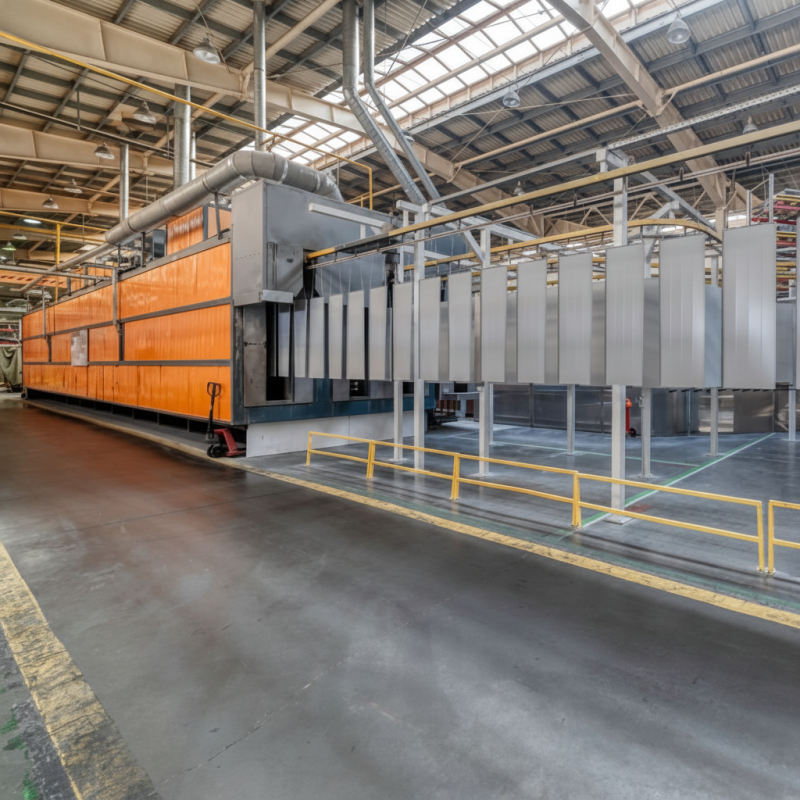
Powder coating is a common surface finishing process for sheet metal parts, used to improve corrosion resistance, appearance, and durability. Learn the process, applications, pricing factors, and sour
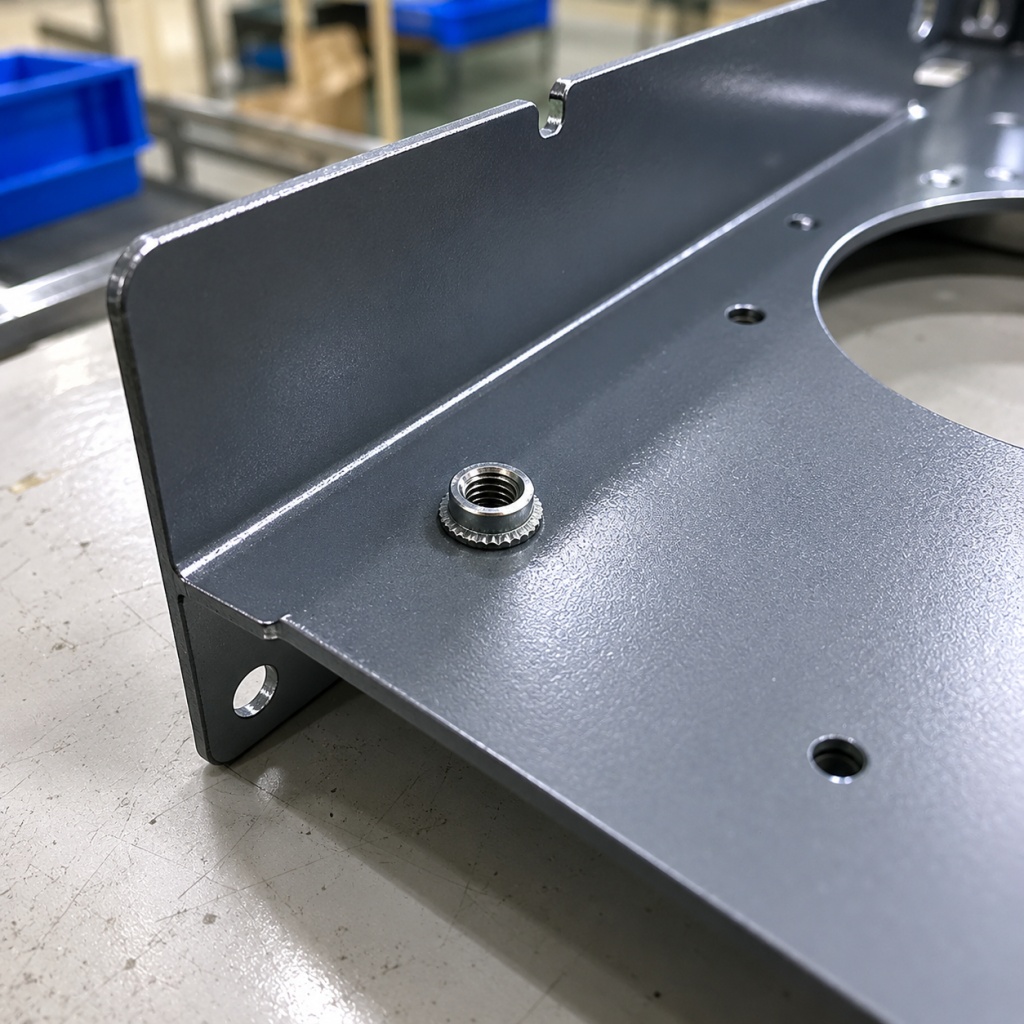
What Are Self-Clinching Fasteners for Sheet Metal Parts?
Self-clinching fasteners are specialized hardware components designed to be pressed into sheet metal to create reliable threaded or mounting points. They are widely used in enclosures, cabinets, brack
How to Design Cost-Effective Sheet Metal Parts?
Design cost-effective sheet metal parts. Tips on material, structure, assembly & finishing.
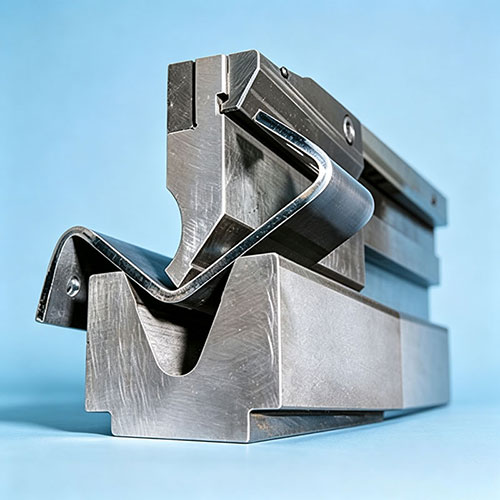
How to Design Rigid and Lightweight Sheet Metal Parts?
Design rigid, lightweight sheet metal parts. Tips on materials, structure & manufacturability.