+8613003178786
  sales@lingyufab.com



Common Laser Welding Defects and How to Solve Them
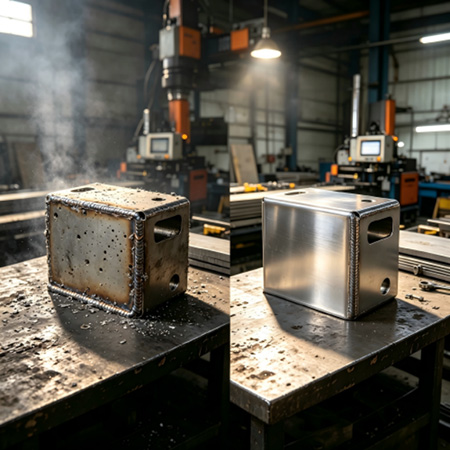
22
Sep’2026Common Laser Welding Defects and How to Solve Them
Laser welding is an advanced joining process that uses a high-energy density laser beam to fuse metal components with minimal heat input and exceptional precision. But even the most sophisticated laser welding system can produce defects when parameters are not properly optimized. Have you ever received a batch of welded assemblies where the welds looked fine at first glance, only to discover porosity or cracks during testing? Or perhaps you have seen parts distorted from excessive heat, or spatter that required hours of cleanup? These are among the most common and costly frustrations in sheet metal fabrication. Unlike traditional welding, where defects are often visible immediately, laser welding defects can hide beneath the surface until they cause catastrophic failure.
At Lingyufab, we see these defects every day—and we know how to prevent them. With over 20 years of precision manufacturing experience since 2003 and certification as a core supplier for Mitsubishi Electric, our advanced fiber laser welding systems deliver consistent quality across a wide range of materials and thicknesses. This guide covers the most common defects in laser welding, what causes them, and how to solve them.
Why Laser Welding Defects Happen
Laser welding defects typically result from a combination of factors: improper parameter settings, poor joint preparation, material incompatibility, or inadequate shielding gas coverage. Laser power, welding speed, focus position, shielding gas flow, and joint fit-up all affect weld quality.
Understanding these root causes is the first step to preventing defects. This guide walks you through the five most common defects in laser welding and shows you what to do about each one.
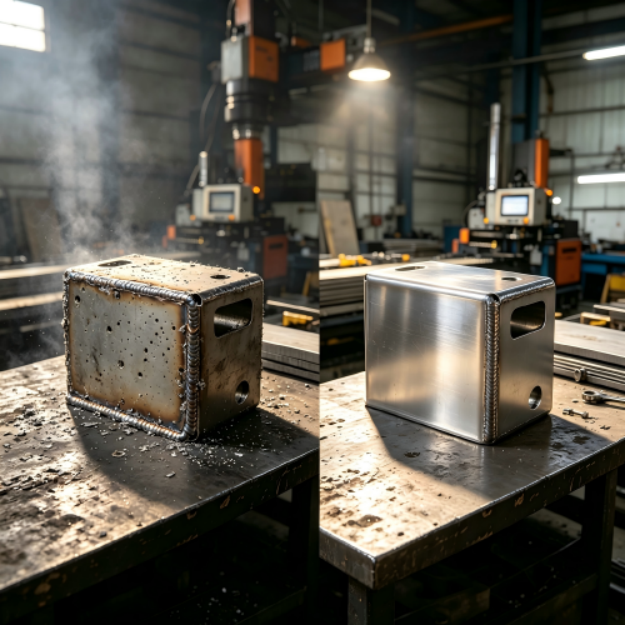
Defect 1: Porosity — The Hidden Threat
Porosity appears as gas pockets trapped in the weld bead—from scattered surface pores to subsurface voids that only show up during testing. Small holes or bubbles form when gas gets trapped in the weld pool.
What causes it: The most common cause is improper surface condition—oil, rust, paint, or grease on the base metal prevents proper weld penetration and leads to gas entrapment. For galvanized steel, the zinc coating vaporizes at around 900°C and creates gas bubbles in the weld pool. Moisture in welding consumables and inadequate shielding gas coverage also contribute. In laser welding, rapid solidification can trap gases that would otherwise escape in slower processes.
How to solve it: For minor surface porosity, grinding out the affected area and re-welding may work. For extensive subsurface porosity, the weld must be completely removed and redone.
How to prevent it: Thoroughly clean the base metal before welding—remove all oil, grease, rust, paint, and moisture. For galvanized steel, grind away the zinc coating in the weld zone or use specialized welding techniques. Use dry, high-quality shielding gas with proper flow rate. Ensure proper joint fit-up—seam gaps should ideally not exceed 10% of material thickness (maximum 0.2mm for autogenous welding). Lingyufab’s laser welding systems feature real-time seam tracking and atmospheric protection to prevent porosity.
Defect 2: Cracking — The Most Serious Defect
Cracking is the most serious welding defect because it compromises structural integrity. Cracks can appear immediately after welding (hot cracks) or hours or days later (cold cracks). Laser welding’s rapid cooling rate can increase cracking susceptibility in certain materials.
What causes it: Weld cracks often result from combined factors: high thermal stress during heating and cooling, brittle base metals, and excess hydrogen in the weld. Hot cracking happens during solidification when the metal is still hot—common in aluminum and high-strength steels. Cold cracking occurs after the weld has cooled, typically due to hydrogen embrittlement combined with high residual stress. Materials with excessive phosphorus or oxygen have been observed to cause brittle welds.
How to solve it: Cracks cannot be reliably fixed by re-melting—this often makes them worse. The only reliable fix is to grind out the cracked area and re-weld with corrected parameters.
How to prevent it: Control heat input—use appropriate welding parameters to minimize thermal stress. Preheat when welding high-strength steels or when the material is cold. Use low-hydrogen welding consumables. Minimize residual stress by using proper joint design and clamping. For aluminum, avoid welding alloys with high crack sensitivity. Use dynamic laser beam wobble technology to prevent hot cracking and porosity in aluminum alloys. Lingyufab’s engineering team reviews your joint design before welding, identifying potential cracking risks.
Defect 3: Spatter — The Cleanup Problem
Spatter is the expulsion of molten metal droplets during welding that stick to the surrounding surface. On thin sheet metal, spatter is more than cosmetic—it creates surface imperfections that affect subsequent finishing operations and can scratch mating surfaces.
What causes it: Incorrect welding parameters—too high power or improper focus position are primary causes. Poor technique, contaminated material, or insufficient shielding gas also contribute. In laser welding, spatter is often related to keyhole instability or excessive energy density.
How to solve it: Remove spatter mechanically using a chisel or grinder, or chemically using anti-spatter compounds. For high-volume production, spatter removal adds significant time and cost.
How to prevent it: Optimize laser power and focus position for the specific material and thickness. Use proper shielding gas flow and composition. Ensure joint surfaces are clean and free of contamination. Maintain proper joint fit-up to prevent keyhole instability. For applications where spatter is unacceptable, consider using pulsed laser welding modes. Lingyufab’s advanced fiber laser systems feature precise power control and real-time monitoring to minimize spatter formation.
Defect 4: Incomplete Penetration and Lack of Fusion
Incomplete penetration occurs when the weld metal does not extend through the full thickness of the joint. Lack of fusion is poor adhesion of the weld bead to the base metal, resulting in an unmolten contact area.
What causes it: The most common causes are insufficient laser power, incorrect focus position, or excessive welding speed. Poor joint fit-up—gaps that are too large—can also prevent proper fusion. Inconsistent material thickness or improper joint preparation are contributing factors.
How to solve it: Incomplete penetration typically requires complete rework—grinding out the weld and re-welding with corrected parameters.
How to prevent it: Use sufficient laser power for the material thickness. Ensure proper focus position and maintain consistent welding speed. Ensure proper joint fit-up—seam gaps should ideally not exceed 10% of material thickness. For gaps up to 0.5-1.0mm, dynamic wobble heads or integrated wire feeders can reliably bridge gaps. Lingyufab’s welding systems feature multi-axis CNC control and real-time seam tracking to ensure consistent penetration depth.
Defect 5: Distortion and Warping
Distortion occurs when uneven heating and cooling creates thermal stresses that deform the part. While laser welding’s low heat input significantly reduces distortion compared to traditional welding, it can still occur if parameters are not properly optimized.
What causes it: Excessive heat input is the primary cause. Improper welding sequence, insufficient fixturing, and incorrect welding parameters all contribute. While laser welding produces a minimal heat-affected zone (0.1-0.5mm), cumulative heat in multi-pass or multi-weld assemblies can still cause distortion.
How to solve it: Distortion is difficult to fix after the fact. Mechanical straightening works for mild distortion but may work-harden the material. In severe cases, the part must be scrapped.
How to prevent it: Control heat input—use the lowest practical laser power and fastest travel speed that still achieves good penetration. Use jigs and clamps to hold parts in position during welding. Apply welds in a controlled order—symmetrical or from the center outward, balancing heat distribution. Use copper backing bars to act as heat sinks—they draw heat away from the weld zone and reduce distortion. Lingyufab designs custom jigs to hold parts in position and act as heat sinks, and our laser welding systems feature extremely low thermal input (0.1-0.5mm HAZ) that eliminates panel warping, buckling, and discoloration.
How Lingyufab Prevents Laser Welding Defects
Lingyufab is a professional sheet metal fabrication manufacturer and sheet metal supplier based in Shanghai, China, with over 20 years of precision manufacturing experience since 2003. We follow strict Japanese quality standards and are a certified core supplier for Mitsubishi Electric.
What sets Lingyufab apart as a sheet metal supplier is our systematic approach to laser welding quality:
• Process selection — We select the right welding process based on material and thickness—TIG for thin stainless steel, pulsed MIG for thin carbon steel, and laser welding for applications requiring minimal distortion and high speed
• Heat management — Our fiber laser systems deliver extremely low heat input (0.1-0.5mm HAZ), eliminating panel warping and manual post-straightening
• Precision control — Positioning accuracy of ±0.02mm to ±0.05mm meets tight tolerances for medical, aerospace, and electronics applications
• Real-time monitoring — Photodiode sensors and vision seam-tracking systems dynamically adjust laser focus and output power in real time
• Jigging and fixturing — We design custom jigs to hold parts in position and act as heat sinks
• Quality inspection — Non-destructive testing including helium leak testing, 3D surface profiling, and penetrant testing
Our in-house capabilities include: Laser welding — High-speed, low-distortion welding with minimal heat input. Laser cutting, CNC bending, assembly, surface treatment, and fastener installation—all under one roof. ISO 9001, ISO 14001, and TÜV CE certified. Full material traceability with Mill Test Certificates.
One supplier, full responsibility. From laser cutting and CNC bending to welding, surface treatment, and fastener installation, we handle everything under one roof. This integration ensures consistent quality, shorter lead times, and a single point of accountability for your entire project.
If you are concerned about laser welding defects in your sheet metal parts, our engineering team is available to review your requirements and provide a free consultation. We’ll help you identify risks before production begins. If you are looking for a reliable sheet metal fabrication supplier, please don’t hesitate to contact us.
Quick Laser Welding Defect Prevention Checklist for Buyers
| What to Check | What to Look For |
|---|---|
| Springback | Bend angles match drawing within ±0.5°—check for angles that are too open |
| Cracking | Any cracks on the outside of the bend—any crack is a reject |
| Wrinkling | Ripples or bulges on the inside of the bend or along flanges |
| Tooling marks | Excessive indentations, scratches, or scoring along the bend |
| Flange length | Flange lengths match drawing within specified tolerance |
| Part-to-part consistency | All parts in batch are dimensionally identical |
FAQs
Q1: What is the main advantage of laser welding over TIG welding? Laser welding focuses energy into a significantly smaller area, traveling 4 to 10 times faster than TIG welding. This cuts total heat input by up to 80%, practically eliminating heat distortion and warping on thin sheet metal while removing the need for manual grinding.
Q2: What causes porosity in laser welding? The most common cause is improper surface condition—oil, rust, paint, or grease on the base metal. For galvanized steel, zinc vaporization creates gas bubbles. Moisture in consumables and inadequate shielding gas also contribute. Thorough cleaning and proper gas coverage prevent porosity.
Q3: What is the typical positioning accuracy for laser welding? Lingyufab’s fiber laser welding systems achieve positioning accuracy of ±0.02mm to ±0.05mm, meeting tight tolerances for medical, aerospace, and electronics applications. This precision ensures exact seam placement across thousands of production units.
Q4: How do you handle material springback in laser welding? Laser welding is a joining process, not a forming process—springback is not directly applicable. However, proper joint fit-up is essential. Seam gaps should ideally not exceed 10% of material thickness (maximum 0.2mm for autogenous welding). For gaps up to 0.5-1.0mm, dynamic wobble heads or wire feeders can bridge gaps reliably.
Q5: Can Lingyufab laser weld different materials? Yes. Lingyufab laser welds stainless steel, aluminum, carbon steel, galvanized steel, and copper alloys. We can also weld dissimilar metals—stainless steel to aluminum, copper to steel, and other combinations—with specialized parameters. Each material requires specific laser power, focus, and shielding gas settings.
Q6: What file formats do you accept for welding quotes? We accept 3D files in STEP (.stp), IGS (.igs), and SolidWorks (.sldprt) formats, and 2D drawings in PDF, DWG, and DXF formats. For welding specifications, we also need material type, thickness, joint design, and any specific quality requirements.