+8613003178786
  sales@lingyufab.com



Thin Sheet Metal Welding: 5 Critical Issues and How to Solve Them
21
Sep’2026Thin Sheet Metal Welding: 5 Critical Issues and How to Solve Them
Have you ever received a welded thin sheet metal assembly where the welds looked fine at first glance, only to discover the part was warped beyond use? Or perhaps you have struggled with burn-through on thin stainless steel, where every attempt to weld just creates another hole? These are problems unique to thin sheet metal that don't occur when welding thick plate.
Welding thin sheet metal—typically under 3mm—presents challenges that are fundamentally different from welding heavy sections. A process that works perfectly on 5mm steel will destroy 1mm steel. The heat that creates a strong weld on thick material will burn straight through thin material before you can react. This guide focuses exclusively on the unique welding issues that occur in thin sheet metal applications—not the general welding defects that can affect any thickness.
At Lingyufab, we weld thin sheet metal every day. With over 20 years of precision manufacturing experience since 2003 and certification as a core supplier for Mitsubishi Electric, we have developed specific techniques to handle the challenges of thin materials. This guide covers five critical issues that occur when welding thin sheet metal and how to solve them.
Why Thin Sheet Metal Is Different
Welding thin sheet metal requires a completely different approach than welding thick plate. The primary challenge is heat management. Thin material has low thermal mass—it heats up fast and cools down fast, leaving almost no margin for error.
Three factors make thin sheet welding uniquely challenging: First, heat input must be precisely controlled. On thin material, a 10% increase in amperage that would be barely noticeable on 6mm steel will cause immediate burn-through on 1mm steel. Second, distortion is magnified. The same welding heat that causes minor bowing on a thick plate will cause significant warping on thin sheet. Third, joint fit-up is critical. A 0.5mm gap that is acceptable on thick material will cause burn-through or lack of fusion on thin sheet.
Understanding these differences is essential for solving thin sheet welding problems.
Issue 1: Burn-Through — The Thin Material Nightmare
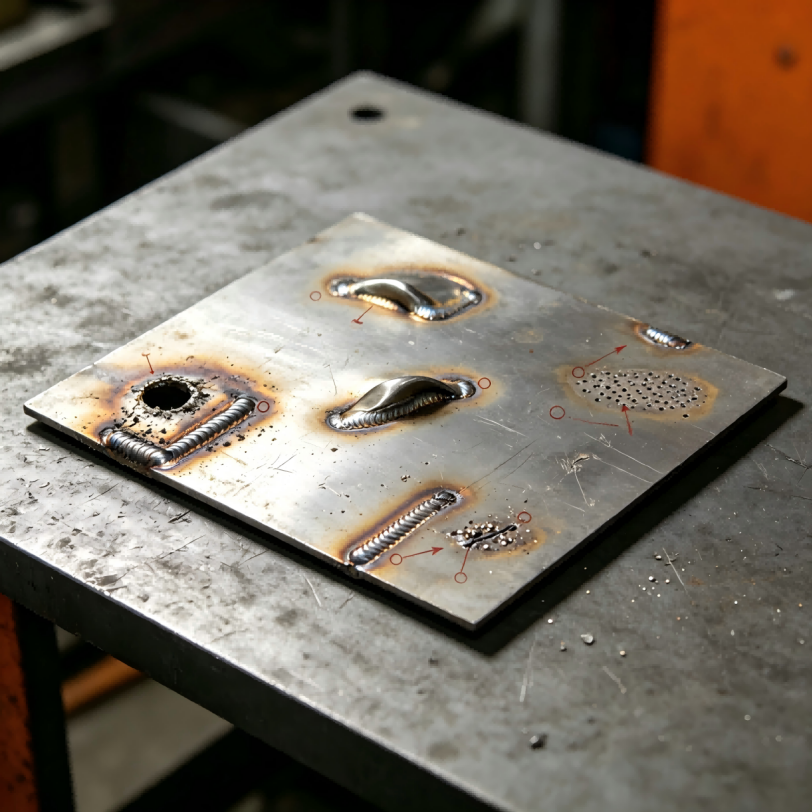
Burn-through is the most common and visible problem in thin sheet welding. The arc melts completely through the material, leaving a hole instead of a weld. This is a geometry-failure defect where the molten metal falls through the material, leaving a hole or a heavily sagged root. It's especially common on stainless steel sheet metal.
Why it happens: Burn-through happens because the heat input exceeds the material's heat capacity. Too much amperage, too slow travel speed, or insufficient heat dissipation all contribute. The thinner the material, the faster it will burn through. Unlike thick plate where you can simply increase amperage to get better penetration, thin material requires a delicate balance.
How to solve it: For existing burn-through, minor holes can be filled and re-welded with lower heat input. For severe cases, the part may need to be scrapped—a burned-through hole cannot be magically repaired.
How to prevent it: Use pulse welding—pulsed MIG reduces heat input by up to 30% compared with conventional MIG. Use a smaller wire diameter—0.024 inch (0.6mm) for thin sheet, not 0.035 inch. Clamp copper or aluminum backing bars behind the weld zone to absorb and dissipate heat. Ensure weld gaps are as small as possible—closely fitted joints help avoid burn-through. For extreme thin material (under 1mm), consider laser welding or spot welding instead.
Issue 2: Distortion — The Assembly Problem
Distortion is the most frequent quality issue in thin sheet welding. The part warps, twists, or bows, making it impossible to assemble. Once warped, thin steel can deform in ways that are almost impossible to fix. This is a geometry-failure defect where the part shape becomes compromised.
Why it happens: Uneven heating and cooling creates thermal stresses that exceed the stiffness of thin material. Thick plate can resist contraction forces; thin sheet cannot. The mismatch between high heat input and low material stiffness means the material moves wherever the heat goes. Welding on thin sheet is like trying to weld on paper—it will curl and distort.
How to solve it: Distortion is difficult to fix after the fact. Mechanical straightening works for mild distortion but may work-harden the material. Thermal straightening requires skill to avoid making it worse. In severe cases, scrap the part and start over with improved prevention.
How to prevent it: Use the lowest practical amperage and fastest travel speed that still achieves good penetration. Use copper backing bars to act as heat sinks—they draw heat away from the weld zone and reduce distortion by up to 50%. Use skip welding—weld short sections at intervals, let them cool, then fill in the gaps. Use jigs and clamps to hold parts in position. Apply welds in a controlled order—symmetrical or from the center outward, balancing heat distribution.
Issue 3: Porosity — The Hidden Defect
Porosity appears as gas pockets trapped in the weld bead—from surface pores to subsurface voids that only show up during testing. Small holes or bubbles form when gas gets trapped in the weld pool.
Why it happens: Thin materials are often more susceptible to contamination because they are more easily damaged by surface preparation. Oil, rust, paint, or grease on the base metal prevents proper weld penetration and leads to gas entrapment. For galvanized steel, the zinc coating vaporizes at around 900°C and creates gas bubbles in the weld pool. Moisture in welding consumables and inadequate shielding gas coverage also contribute.
How to solve it: For minor surface porosity, grinding out the affected area and re-welding may work. For extensive subsurface porosity, the weld must be completely removed and redone.
How to prevent it: Thoroughly clean the base metal before welding—remove all oil, grease, rust, paint, and moisture. For galvanized steel, grind away the zinc coating in the weld zone or use specialized welding wires. Use dry, high-quality shielding gas with proper flow rate. Store welding consumables in a dry environment. A clean, dry weld zone is the best defense against porosity.
Issue 4: Cracking — The Most Serious Defect
Cracking is the most serious welding defect because it compromises structural integrity. Cracks can appear immediately after welding (hot cracks) or hours or days later (cold cracks).
Why it happens: On thin sheet metal, cracking is often related to high cooling rates. Thin material cools quickly because it has less mass to retain heat. This rapid cooling can trap hydrogen in the weld, leading to hydrogen cracking. Materials with excessive phosphorus or oxygen have been observed to cause brittle welds. High residual stress from excessive heat input or poor joint design also contributes.
How to solve it: Cracks cannot be reliably fixed by re-melting—this often makes them worse. The only reliable fix is to grind out the cracked area and re-weld with corrected parameters.
How to prevent it: Control heat input—use appropriate welding parameters to minimize thermal stress. Preheat when welding high-strength steels or when the material is cold. Use low-hydrogen welding consumables. Minimize residual stress by using proper joint design and clamping. For aluminum, avoid welding alloys with high crack sensitivity.
Issue 5: Spatter — The Surface Problem
Spatter is the expulsion of molten metal droplets during welding that stick to the surrounding surface. On thin sheet, spatter is more than cosmetic—it creates surface imperfections that affect subsequent finishing operations and can scratch mating surfaces.
Why it happens: Conventional MIG welding produces more spatter than TIG or pulsed processes. Incorrect welding parameters—too high current or voltage, improper wire feed speed—are the primary causes. Poor technique or contaminated material also contribute.
How to solve it: Remove spatter mechanically using a chisel or grinder, or chemically using anti-spatter compounds. For high-volume production, spatter removal adds significant time and cost.
How to prevent it: Use pulse welding—pulsed MIG with a high-argon shielding gas can reduce spatter by up to 90%. Use a smaller wire diameter—0.024 inch for thin material. Apply anti-spatter spray to protect surrounding surfaces. Advanced processes like Cold Metal Transfer (CMT) can reduce spatter significantly and cut heat input by roughly one third compared with conventional MIG. For applications where spatter is unacceptable, consider TIG welding—it produces virtually no spatter.
Thin Sheet Welding Quick Reference Guide
| Issue | Root Cause | Best Prevention |
|---|---|---|
| Burn-through | Too much heat, too slow travel speed | Pulse welding, copper backing, smaller wire |
| Distortion | Uneven heating, insufficient fixturing | Skip welding, jigs, copper heat sinks |
| Porosity | Dirty surface, zinc vaporization | Clean thoroughly, grind zinc away |
| Cracking | Rapid cooling, hydrogen, high stress | Preheat, low-hydrogen consumables |
| Spatter | Conventional MIG, incorrect parameters | Pulse welding, TIG welding |
Lingyufab: Your Trusted Sheet Metal Partner for Welding Quality
Lingyufab is a Shanghai-based sheet metal fabrication manufacturer and sheet metal supplier with over 20 years of experience since 2003. We are a certified core supplier for Mitsubishi Electric and operate under strict Japanese quality standards.
What sets us apart is our systematic approach to thin sheet welding—a capability many general fabricators lack:
Process selection — TIG for thin stainless, pulsed MIG for thin carbon steel
Heat management — copper backing bars, pulse welding, optimized speeds
Jigging and fixturing — custom jigs to prevent distortion
Our in-house capabilities include:
Welding (TIG for stainless, MIG for general fabrication, spot for thin sheet), laser cutting, CNC bending, assembly, surface treatment, and fastener installation—all under one roof. ISO 9001, ISO 14001, and TÜV CE certified.
If you have welding problems with thin sheet metal parts, send us your requirements for a free consultation.
Quick Thin Sheet Welding Checklist for Buyers
| What to Check | What to Look For |
|---|---|
| Burn-through | Holes or sagging on the underside of the weld |
| Distortion | Warping, twisting, or bowing—check flatness |
| Porosity | Gas pockets in the weld bead—visible or hidden |
| Cracking | Any crack on weld surface—any crack is a reject |
| Spatter | Excessive molten metal droplets on surfaces |
| Weld appearance | Uniform bead consistent in width and height |
FAQs
Q1: What is the biggest challenge in welding thin sheet metal? Heat control. Thin material has low thermal mass—it heats up quickly and cools quickly. The margin for error is minimal. A 10% increase in amperage that would be barely noticeable on thick material will cause burn-through on thin sheet.
Q2: How can I prevent burn-through on thin stainless steel? Use pulse welding or TIG for precise heat control. Use a smaller wire diameter—0.024 inch (0.6mm) for thin sheet. Clamp copper backing bars behind the weld zone to absorb heat. Ensure weld gaps are as small as possible. For extreme thin material (under 1mm), consider laser welding or spot welding.
Q3: Why does thin sheet metal warp so much during welding? Thin material has less stiffness to resist the contraction forces created by heating and cooling. The same welding heat that causes minor bowing on thick plate will cause significant warping on thin sheet. The mismatch between heat input and material stiffness is the primary cause.
Q4: What is the best welding process for thin sheet metal? For thin carbon steel and galvanized steel, pulse MIG with 0.024 inch wire works well. For thin stainless steel, TIG is preferred for precise heat control. For very thin materials (under 1mm), spot welding or laser welding are often the best options. The right process depends on material, thickness, and application.
Q5: Can Lingyufab weld thin sheet metal? Yes. Lingyufab specializes in thin sheet metal welding. We have over 20 years of experience welding stainless steel, aluminum, carbon steel, and galvanized steel in thin gauges. We select the right process—TIG, MIG, or spot welding—based on the material and thickness.
Q6: What is the maximum thickness for thin sheet welding? Thin sheet welding typically refers to materials under 3mm (1/8 inch). However, the techniques described in this guide are most critical for materials under 1.5mm (1/16 inch), where heat management becomes most challenging.