+8613003178786
  sales@lingyufab.com



Cut Edge Quality in Sheet Metal: Comparing Laser Cutting, Stamping, and Shearing
26
Aug’2026Cut Edge Quality in Sheet Metal: Comparing Laser Cutting, Stamping, and Shearing
Have you ever received a batch of sheet metal parts that looked perfectly fine at first glance, only to discover during assembly that the edges were too rough for welding, or that burrs were scratching adjacent components? Perhaps you have specified a cutting method based purely on cost or speed, only to find that the edge quality didn't meet your downstream requirements—causing rework, delays, and unexpected expenses? These are common frustrations faced by design engineers, procurement professionals, and quality managers. The quality of a cut edge is not just about appearance—it directly affects weldability, formability, assembly fit, and corrosion resistance.
At Lingyufab, we understand that choosing the right cutting method is about more than just throughput. With over 20 years of precision manufacturing experience since 2003 and certification as a core supplier for Mitsubishi Electric, we offer multiple in-house cutting capabilities including laser cutting, stamping, and shearing, and select the right process based on material type, thickness, part geometry, and quality requirements. This guide compares the edge quality characteristics of the three processes to help you make the right choice for your project.
Why Cut Edge Quality Matters
The edge of a cut part is not a cosmetic detail—it is a functional surface that affects core part performance in multiple aspects.
Weldability — Rough edges with dross or slag require cleaning before welding. Oxidized edges from oxygen-assisted cutting may produce weld porosity and compromise welding quality.
Formability — Edges with micro-cracks or work-hardened zones are more prone to tearing during bending or stamping. The physical stress generated by stamping can extend beyond the cutting edge and affect subsequent processing.
Assembly fit — Burrs and uneven edges interfere with part matching accuracy and can scratch mating surfaces during assembly.
Corrosion resistance — Rough edges with oxide layers or heat-affected zones are more susceptible to corrosion in service environments.
Fatigue performance — Edges with micro-cracks, rough surfaces, or heat-affected zones are more susceptible to fatigue failure. Smoother edges with minimal defects generally deliver better long-term fatigue performance.
Understanding the Three Cutting Methods
Laser Cutting: Precision and Clean Edges
Laser cutting uses a focused, high-energy laser beam to melt or vaporize material, with an assist gas including nitrogen, oxygen, or compressed air blowing the molten metal away from the kerf. The process is CNC-controlled and requires no hard tooling.
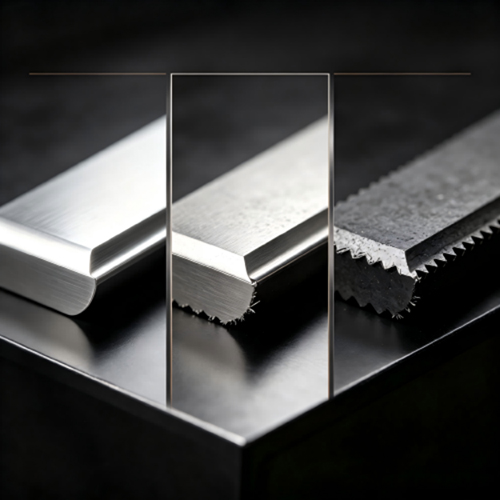
Edge quality characteristics: Laser cutting produces the cleanest edges among the three methods. When parameters are optimized, laser cutting can achieve burr-free edges that require no secondary deburring. Modern fiber laser systems can achieve high cutting speeds while maintaining stable edge quality. Unlike mechanical cutting, laser cutting does not produce micro-cracks and minimizes hardness changes at the cutting edge.
Limitations: Laser cutting introduces a heat-affected zone (HAZ) where material properties are altered by thermal exposure. As a general guideline, the HAZ width of stainless steel is typically kept within 0.2mm, and that of carbon steel within 0.3mm. Laser-cut edges may form oxide layers when adopting oxygen assist gas.
Stamping: High Speed with Work-Hardened Edges
Stamping is a cold-working process that uses dies and presses to cut or form sheet metal. The cutting action is mechanical, where a punch forces the material into a die to form a sheared edge.
Edge quality characteristics: Stamping produces edges with a typical sheared surface consisting of a burnished zone and a fracture zone, along with residual burrs. Edge quality is highly dependent on die clearance, punch condition, and material properties. Stamping does not produce heat-affected zones and retains the original metallurgical properties of materials. However, the physical stress of stamping often extends beyond the cutting edge, and the burr height of stamped edges varies with die clearance and material type.
Limitations: Stamping inevitably produces burrs on the cutting line, which usually requires secondary deburring treatment. The shearing action causes material work hardening on edges, increasing the difficulty of subsequent forming and welding processes. The quality of sheared edges directly affects the stretchability and flangeability of follow-up stamping operations.
Shearing: Simple and Economical with Rougher Edges
Shearing is the simplest sheet metal cutting method, which uses a straight blade to cut sheet metal in linear paths. It is mostly used for processing blanks for secondary manufacturing.
Edge quality characteristics: Shearing produces the roughest edges among the three processes. The cut edge has an obvious fracture zone and prominent burrs. The cutting action causes plastic deformation on the edge surface, forming a rollover on the top edge and burrs on the bottom edge. Meanwhile, work-hardened zones will be generated on sheared edges, affecting the formability of subsequent processing.
Limitations: Shearing is only applicable to straight cutting and almost requires secondary processing including deburring and grinding before welding and forming. Its edge quality stability is lower than laser cutting and stamping, fluctuating with blade sharpness, clearance and material characteristics.
Key Edge Quality Metrics
Five core standard metrics should be adopted to evaluate cut edge quality of sheet metal parts.
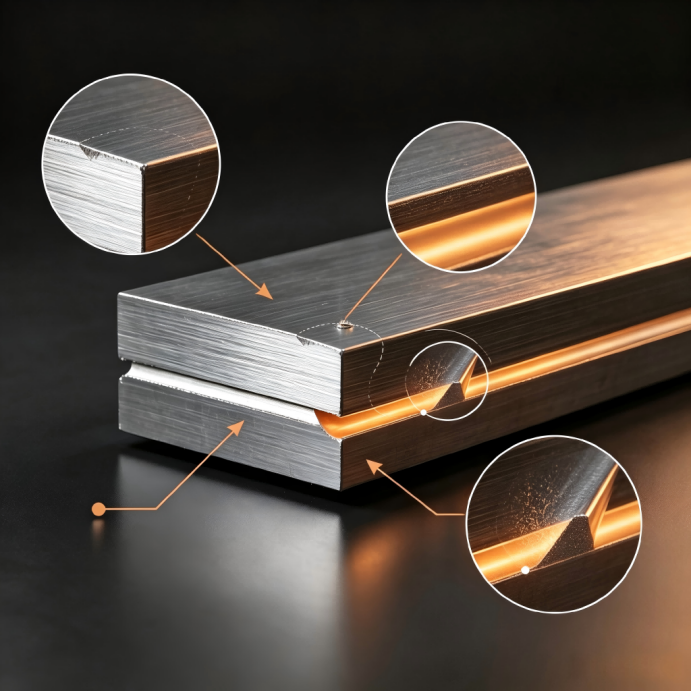
Burr Height — The height of raised metal on cutting edges. The acceptable burr height for conventional sheet metal parts ranges from 0.1mm to 0.2mm. Burrs or dross are formed when molten metal in the kerf solidifies before being completely removed. Burr-free edges eliminate the need for secondary deburring procedures.
Surface Roughness — The smoothness of cutting surfaces. Qualified laser-cut surfaces present uniform fine striations, while irregular and jagged striations indicate abnormal cutting parameters. Surface roughness determines the friction characteristics and appearance quality of part edges.
Verticality — The perpendicularity of cutting edges relative to the sheet metal surface. Verticality error is negligible for thin materials, but becomes a key quality index for materials with thickness over 10mm.
Heat-Affected Zone (HAZ) — The regional area where material physical and chemical properties are changed by cutting heat. The conventional control standard is that the HAZ width of stainless steel is within 0.2mm, and carbon steel within 0.3mm.
Micro-cracks — Tiny cracks on cutting edges, which may expand and cause part failure during forming or service. Laser cutting can effectively reduce micro-cracks, while stamping is prone to micro-cracks affected by material properties and die conditions.
Factors Affecting Edge Quality
Material Type and Thickness — Stainless steel and carbon steel require differentiated cutting parameters, and stainless steel usually needs higher assist gas pressure and adjusted cutting speed. In general, thicker materials tend to form rougher cutting edges.
Cutting Parameters — Unreasonable laser cutting speed, power and focus position will cause uneven material melting and vaporization, resulting in serrated edges. The matching state between focus spot position and material thickness directly determines the dross formation effect.
Assist Gas — The type and flow rate of assist gas are critical to laser cutting quality. Nitrogen is preferred for producing oxide-free clean edges, while oxygen can improve the cutting efficiency of carbon steel but will cause surface oxidation. Insufficient or uneven gas pressure will lead to irregular solidification of molten metal and defective edges.
Tooling Condition — For stamping and shearing, die and blade conditions directly determine edge quality. Worn tools will produce more burrs and rough edges. Reasonable die clearance is essential for stable shearing quality, and the optimal clearance ratio is usually 7% to 11% of material thickness.
How to Choose the Right Cutting Method
Choose laser cutting for clean low-burr edges, complex part geometries, tight tolerance requirements, thin to medium sheet metal within 15mm aluminum thickness, minimal secondary processing, and scenarios with high requirements on edge weldability and formability.
Choose stamping for high-volume mass production, fixed and stable part geometries, acceptable upfront tooling costs, ultra-high production efficiency requirements, zero tolerance for heat-affected zones, and allowable edge burrs and work hardening.
Choose shearing for simple straight cutting, non-critical edge quality requirements, parts requiring subsequent secondary processing, and cost priority projects.
Where Edge Quality Matters Most
Cutting edge quality is a key factor affecting product performance in multiple industries and application scenarios.
Electronics and Electrical Equipment — Equipment enclosures and cabinets require clean edges to ensure reliable sealing, grounding and assembly. Burrs will damage internal wiring and interfere with component fitting, so laser cutting is the preferred process for such parts.
Medical Devices — Medical equipment components require smooth and burr-free edges to avoid personnel injury and ensure convenient cleaning and disinfection. Laser cutting or precision stamping with secondary deburring is commonly adopted.
Automotive and Electric Vehicles — Advanced high-strength steels are sensitive to edge cracks during stamping, and edge quality directly affects material stretchability and flangeability. Laser cutting can minimize edge micro-cracks and hardness changes, while stamped edges need strict process control to guarantee quality stability.
Industrial Equipment — Structural components need stable edge quality to ensure welding accuracy and assembly consistency. Rough edges will increase welding preprocessing time and reduce welding structural stability.
Lingyufab: Your Trusted Sheet Metal Supplier for Precision Cutting
Lingyufab is a professional sheet metal fabrication manufacturer and supplier based in Shanghai, China, with more than 20 years of precision manufacturing experience since 2003. The company strictly implements Japanese quality standards and is a certified core supplier of Mitsubishi Electric.
We support full in-house cutting processes to match diversified project requirements, including high-precision laser cutting with minimal burrs and heat-affected zones, high-efficiency stamping for mass production with standardized die maintenance, and cost-effective shearing for simple blank parts.
Our full-range in-house manufacturing capabilities cover CNC bending with high precision and batch consistency, diversified welding processes including TIG welding for stainless steel, MIG welding for conventional fabrication and spot welding for thin sheet connection, complete surface treatment including powder coating, anodizing, electroplating and polishing, as well as integrated assembly and fastener installation services.
We implement one-stop integrated manufacturing, covering all processes from cutting and bending to welding, surface treatment and assembly. This integrated mode ensures stable product quality, shorter delivery cycles and single-point quality accountability. All raw materials are equipped with Mill Test Certificates to achieve full quality traceability. The company has passed ISO 9001, ISO 14001 and TÜV CE certifications, with full-process quality inspection covering raw material incoming inspection, production process inspection and finished product delivery inspection.
Our professional engineering team can provide free process selection and scheme optimization suggestions according to your project requirements. Welcome to contact us for sheet metal fabrication customization services.
Quick Edge Quality Checklist for Buyers
Check core edge quality indicators before part acceptance to ensure compliance with downstream processing requirements.
| What to Check | Laser Cutting | Stamping | Shearing |
|---|---|---|---|
| Burr height | Generally ≤0.1mm; burr-free possible | Varies with die condition; may require deburring | Significant burrs; requires deburring |
| Surface roughness | Smooth with fine striations | Burnished + fracture zones | Rough fracture zone |
| Heat-affected zone | Present (typically ≤0.2-0.3mm) | None | None |
| Micro-cracks | Minimal | Possible with AHSS | Possible |
| Edge hardness | Slightly hardened | Work-hardened | Work-hardened |
| Suitable for welding | Yes (may require edge prep) | Yes (may require deburring) | Requires edge prep |
| Suitable for forming | Yes | Yes | Limited |
Conclusion
Cut edge quality is a key functional index rather than a cosmetic detail, which determines the weldability, formability, assembly accuracy and overall service reliability of sheet metal parts. Laser cutting can provide ultra-clean edges with minimal burrs and micro-cracks, suitable for complex structural parts, high-precision tolerance requirements and critical application scenarios. Stamping features high production speed and stable batch quality, applicable to high-volume standardized production, but requires regular die maintenance to control burr defects. Shearing is the most economical and simple process for linear cutting, but its edge quality is poor and only suitable for pre-processing of simple blanks.
By mastering the edge quality characteristics of the three cutting processes and cooperating with professional manufacturers such as Lingyufab with full-process manufacturing capabilities, you can select the optimal processing scheme that balances quality, cost and production efficiency.
FAQs
Q1: What is the most important edge quality metric for laser cutting?
Burr height or dross is the core evaluation index of laser cutting quality, which is formed by incomplete removal of solidified molten metal in the kerf. Surface roughness and edge verticality are also important evaluation standards, especially for thick sheet metal processing.
Q2: Why do laser-cut edges have a heat-affected zone?
Laser cutting is a thermal processing technology that melts or vaporizes materials through high-temperature laser beams. The heat-affected zone refers to the edge area where material properties are changed by cutting heat. The standard control range is within 0.2mm for stainless steel and 0.3mm for carbon steel.
Q3: Can laser cutting achieve burr-free edges?
Yes. Optimized processing parameters including accurate focus position, reasonable assist gas flow and matching cutting speed can realize completely burr-free cutting edges without secondary deburring.
Q4: What causes burrs in stamping?
Stamping burrs are mainly caused by unreasonable die clearance, worn punch and die tools, and material property differences. Optimizing the die clearance ratio to 7% to 11% of material thickness and regular tool maintenance can effectively reduce burr generation.
Q5: Can Lingyufab do both laser cutting and stamping?
Yes. Lingyufab has independent laser cutting and stamping production lines, and can select the most suitable process according to part structure, production volume and quality requirements without technical bias.
Q6: What file formats do you accept for quotes?
We support 3D files in STEP, IGS and SolidWorks SLDPRT formats, and 2D drawing files in PDF, DWG and DXF formats. We also provide reverse engineering customization services according to physical samples for customers without drawing documents.