+8613003178786
  sales@lingyufab.com



Stud Welding vs. Self-Clinching Fasteners: Which Is Right for Your Project?
31
Aug’2026Stud Welding vs. Self-Clinching Fasteners: Which Is Right for Your Project?
What are Stud Welding and Self-Clinching Fasteners
When designing sheet metal assemblies, engineers often face a critical decision: should they specify stud welding or self-clinching fasteners? Both methods create permanent threaded attachment points in metal components, but they achieve this through fundamentally different processes, each with distinct advantages and limitations.
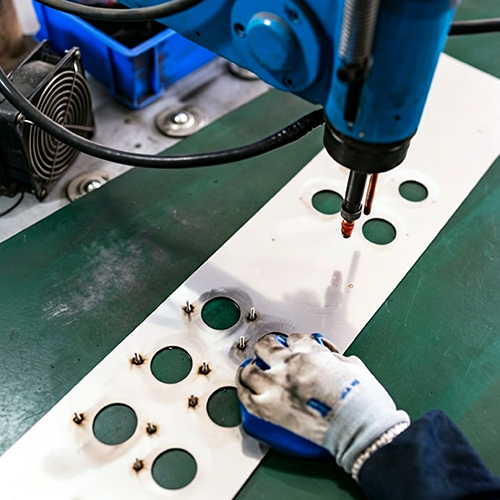
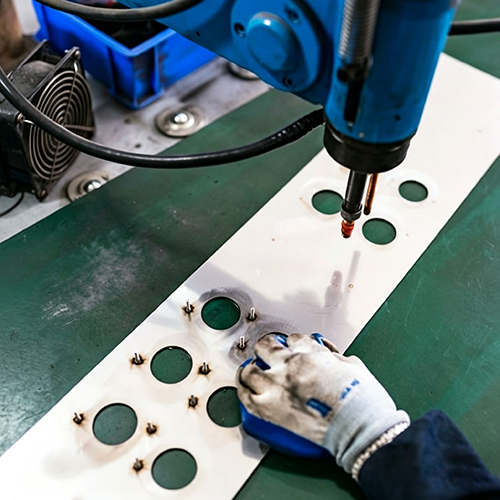
Stud welding is a process that uses an electric arc to melt the base of a stud and a small area of the sheet metal surface, forging them together in milliseconds. The result is a metallurgical bond that is often stronger than the stud itself. This process requires only one-side access to the workpiece and leaves no visible mark on the opposite side.
Self-clinching fasteners are mechanically installed using a press. A precisely sized hole is punched or drilled into the sheet metal, and the fastener is squeezed into place. The surrounding metal cold-flows into an undercut groove and around knurling on the fastener, creating a permanent mechanical lock. This cold-forming process introduces no heat to the metal, preserving the integrity of coatings and thin materials.
Lingyufab specializes in both fastening technologies as part of our comprehensive sheet metal fabrication services. We manufacture custom stud-welded sub-assemblies and custom self-clinching integrated components in-house, giving us the unique ability to recommend—and deliver—the optimal solution for your specific application.
Key Differences Between Stud Welding and Self-Clinching Fasteners
| Aspect | Stud Welding | Self-Clinching Fasteners |
|---|---|---|
| Installation Access | One side only | Both sides required |
| Visible Mark on Front | None (100% invisible) | Flush circle visible |
| Heat Input | Yes (instantaneous arc) | None (cold process) |
| Torque Resistance | Moderate | Excellent |
| Best For | Cosmetic/external panels | Structural/internal assemblies |
| Min Sheet Thickness | 0.6mm and above | 0.5mm and above |
Aesthetic Advantages of Custom Stud-Welded Sub-Assemblies
For products where appearance matters—medical devices, consumer electronics, or premium industrial equipment—the cosmetic impact of fastening choices cannot be overlooked.
Custom Stud-Welded Sub-Assemblies offer a truly invisible solution. Because no hole is drilled through the material, the front face of the sheet metal remains completely pristine. When a stud is welded to the back of a 1mm thick brushed aluminum panel, the front face shows no burn marks, dimples, or any indication of the fastener's presence. This makes stud welding the preferred choice for "Class A" cosmetic surfaces.
Custom Self-Clinching Integrated Components, while sitting flush with the surface, leave a visible circular outline of the fastener head. When thin coatings like powder coating or wet paint are applied, this faint circle can "telegraph" through the finish, becoming visible to the naked eye. For applications where aesthetics are paramount, this can be a significant drawback.
Mechanical Strength: Custom Self-Clinching Integrated Components Excel
When it comes to strength, the two technologies differ in important ways.
Custom Self-Clinching Integrated Components excel in torque resistance. Because the fastener is mechanically locked into the sheet metal through cold flow, it can withstand substantial rotational forces. Self-clinching fasteners offer high pushout and torque-out resistance, making them ideal for applications where bolts will be frequently tightened and loosened, such as access panels requiring regular maintenance.
Custom Stud-Welded Sub-Assemblies provide excellent tensile strength—in most cases, the stud itself will break before the weld fails. However, the torque resistance is comparatively lower. If an assembly technician over-tightens a nut on a welded stud, the stud can snap off at the weld joint.
Heat and Material Considerations
The heat generated during welding is a critical factor to consider.
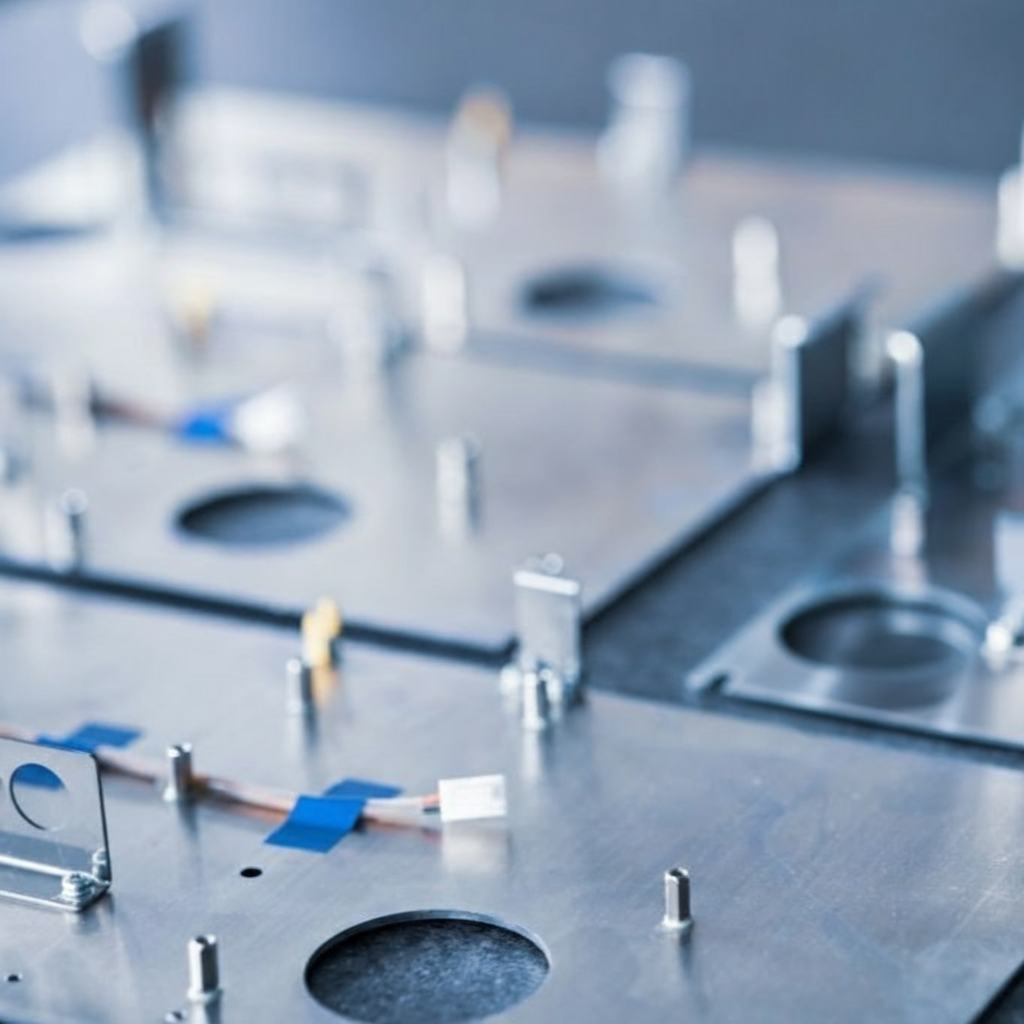
Stud welding, particularly capacitor discharge (CD) welding, uses a very short weld cycle—typically 6 milliseconds. The heat is concentrated and dissipates rapidly, minimizing the risk of distortion. However, the metal surface must be clean and un-plated to ensure a good electrical arc, which can complicate finishing workflows.
Custom Self-Clinching Integrated Components are cold-formed, introducing zero heat to the metal. This preserves the integrity, shape, and protective coatings of the base material. They can even be installed after painting or anodizing without damaging the surface finish, eliminating the need for touch-ups. This makes self-clinching an excellent choice for components that require post-finishing assembly.
For thin sheets, self-clinching fasteners offer a clear advantage. They can be installed in metal as thin as 0.20mm, compared to the approximate 0.6mm minimum recommended for stud welding.
Production Efficiency and Labor
Custom Self-Clinching Integrated Components require minimal operator skill. No special certifications are needed, and the pressing operation is quick, consistent, and repeatable. They can even be installed using automated equipment during the in-die process for high-volume production.
Custom Stud-Welded Sub-Assemblies are also fast to produce—operators can weld 10-15 studs per minute—but require a clean, un-plated surface and proper equipment setup. Weld quality depends on factors like surface cleanliness and consistent electrical contact.
When to Choose Custom Stud-Welded Sub-Assemblies vs. Custom Self-Clinching Integrated Components
| Design Requirement | Recommended Solution |
|---|---|
| Cosmetic surface with no visible marks | Custom Stud-Welded Sub-Assemblies |
| Maximum torque resistance | Custom Self-Clinching Integrated Components |
| Thin sheet metal (<0.6mm) | Custom Self-Clinching Integrated Components |
| One-side assembly access | Custom Stud-Welded Sub-Assemblies |
| Post-coating installation | Custom Self-Clinching Integrated Components |
| Structural load-bearing | Custom Self-Clinching Integrated Components |
| Field service and maintenance | Custom Self-Clinching Integrated Components |
Common Applications Across Industries
Custom stud-welded sub-assemblies are widely used in the automotive industry for attaching trim components, routing wiring harnesses, and grounding electrical circuits. They are also ideal for electrical enclosures, server chassis, and any application where a clean, unmarked surface is required.
Custom self-clinching integrated components are extensively used in medical devices, computers, communication equipment, aerospace, and industrial robotics—particularly in thin sheets where threading is difficult and in applications requiring high fastening strength.
For complex assemblies like precision electrical-control-box assembly or outdoor electrical enclosures, Lingyufab can provide either solution based on your specific design priorities—whether that means invisible front-face finish or maximum torque resistance.
Why Partner with Lingyufab for Both Fastening Solutions
Lingyufab brings over 20 years of precision sheet metal experience to every project. As a certified core supplier for Mitsubishi Electric, we understand what it takes to meet stringent quality and delivery standards.
What sets us apart is our ability to deliver both custom stud-welded sub-assemblies and custom self-clinching integrated components under one roof. We operate high-precision laser cutting systems, CNC bending centers, stamping presses, and cold heading machines for bolts and nuts. By offering both technologies in-house, we provide objective, unbiased recommendations based solely on your design requirements—not on our equipment limitations.
We operate under the ISO 9001:2015 quality management system, with rigorous inspection at every stage from raw material to final delivery. Every batch of material comes with an original Mill Test Certificate, and we support composition analysis by third-party laboratories. Whether you need a single prototype or a full production run, we apply the same rigorous standards to ensure your components meet your exact specifications.
Not sure which fastening solution fits your project best? Contact Lingyufab today to discuss your design requirements. Our engineering team is available to review your drawings, recommend the most suitable fastening method, and provide a competitive quote within 24 hours. Request your free quote now and experience the Lingyufab difference.
Frequently Asked Questions
What is the minimum sheet thickness for stud welding?
Stud welding can be reliably performed on sheets as thin as 0.6mm with capacitor discharge (CD) welding, leaving no marks on the opposite side.
What is the minimum sheet thickness for self-clinching fasteners?
Self-clinching fasteners can be installed in sheet metal as thin as 0.5mm, and some ultra-thin designs work in metal as thin as 0.20mm.
Can self-clinching fasteners be installed after powder coating?
Yes. Because self-clinching is a cold process, fasteners can be installed after coating without damaging the surface finish—a significant advantage over welding, which requires clean, un-plated surfaces.
Which method provides better torque resistance?
Custom Self-Clinching Integrated Components offer superior torque resistance due to their mechanical lock. Custom Stud-Welded Sub-Assemblies, while strong in tension, have lower torque resistance and can fail if a nut is over-tightened.
Does Lingyufab offer both fastening solutions?
Yes. Lingyufab manufactures both Custom Stud-Welded Sub-Assemblies and Custom Self-Clinching Integrated Components in-house. Our engineering team can help you evaluate your specific application and recommend the optimal solution based on your design priorities—whether that's cosmetic appearance, torque resistance, or sheet thickness constraints.