+8613003178786
  sales@lingyufab.com



Sheet Metal Stamping Die Development: From Design to Mass Production
28
Aug’2026Sheet Metal Stamping Die Development: From Design to Mass Production
Have you ever wondered how automotive body panels, electronic connectors, or appliance housings are produced by the thousands—each one identical to the last—at incredible speed? The answer lies in the stamping die. A stamping die is typically a one-of-a-kind, custom-designed tool. Unlike a store-bought item, it doesn't come with instructions for assembly, operation, and maintenance. If even one of those factors isn't done correctly, catastrophic tooling and stamping failure can result.
At Lingyufab, we understand that developing a stamping die is one of the most complex and critical steps in high-volume sheet metal production. With over 20 years of precision manufacturing experience since 2003 and certification as a core supplier for Mitsubishi Electric, we have developed a systematic approach to die development that ensures quality, reliability, and cost-effectiveness. This guide walks you through the complete stamping die development process—from initial design review to mass production—so you can understand what goes into creating the tooling that will produce your parts by the thousands or millions.
What Is a Stamping Die?
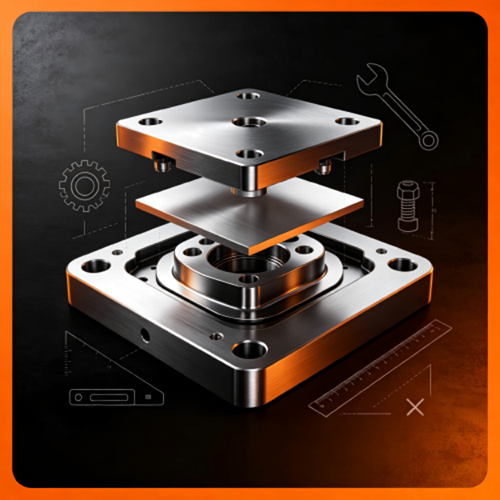
A stamping die is a custom-built precision tool mounted in a stamping press that cuts, bends, and forms flat sheet metal into finished components. Once the tooling is built, a stamping press can produce dozens to hundreds of identical parts per minute, maintaining tight dimensional consistency over millions of cycles. While the upfront cost to create a die can be significant, that one-time expense is spread across large production runs, lowering the cost per part.
Stamping dies are typically used for high-volume production. For low part volumes, it sometimes makes sense to produce the parts using lower-cost methods like press brake bending, welding, and machining. But for projects requiring thousands or millions of identical parts, stamping is the most cost-effective solution.
The Die Development Process: 8 Stages from Design to Production
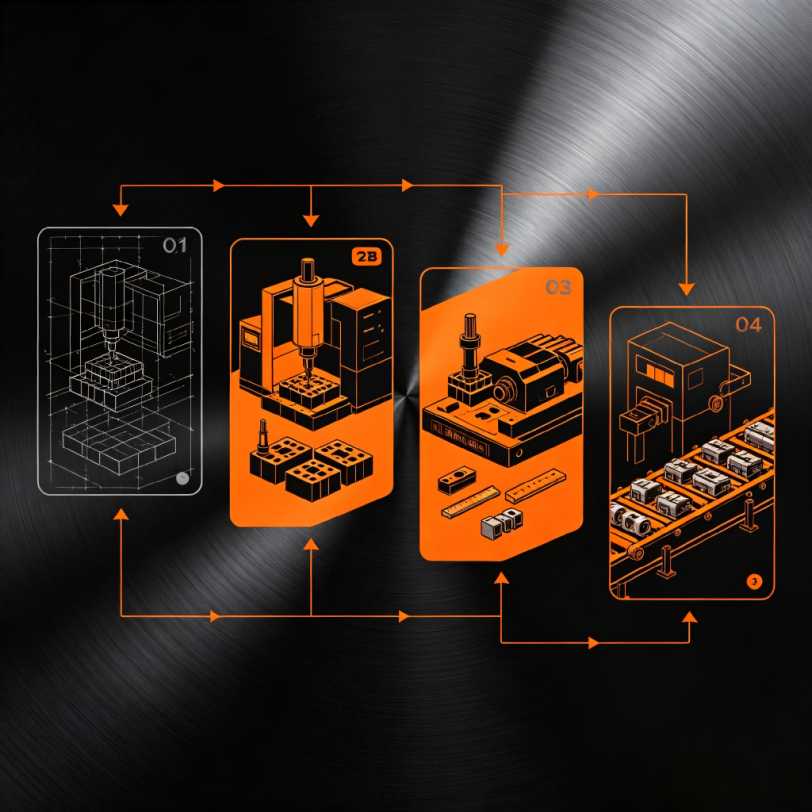
The development of a stamping die follows a systematic, multi-stage process. Each stage requires specialized expertise and attention to detail. Here is what the process looks like:
Stage 1: Customer Drawing and Part Review
The process begins with your part drawing. This is the final design data that will be used to develop the die. During this stage, the engineering team reviews the part geometry, material, thickness, tolerance, forming difficulty, and production volume.
Before you can even begin to think about the process needed to design and build the die, you must determine if the part in question can actually be made using sheet metal stamping. Many parts have dimensional and tolerancing characteristics that cannot be met using a conventional stamping process. It takes years of experience to be able to look at a part and determine if it can be stamped.
The team also analyzes the part print, looking carefully at the part geometry, the specified tolerance, and the material type and thickness. These factors are critical when deciding on the manufacturing process steps and tool design. The part material influences die material, die length, press tonnage, lubricant type and application, and the thickness and geometry of die sections and components.
At this stage, all potential criticalities in die and product development are considered. In special cases, simulation may be provided to highlight any modifications needed to the part. Soft tools may also be manufactured to produce functional prototypes, allowing test assemblies and field testing before starting production of the definitive dies.
Stage 2: Process Engineering and Strip Layout
Don't confuse a die designer with a process engineer. Process engineers determine the process steps that must be executed to transform flat sheet metal from a blank to a finished part. This is undisputedly the most important step that determines the success of the stamping operation. If the process for making the part, even a single forming or cutting operation, is not correct, the die and stamping process will fail.
This stage involves planning the stamping sequence, strip layout, forming direction, trimming strategy, and die structure. For a progressive die, this is called a strip layout. This layout defines the process, the type of carrier to be used, how the scrap will be shed, how the part will get carried through the tool, and how it will be ejected from the die.
The general guideline is to establish all the forms on your part first and trim and pierce the part in secondary processes. When deep forms in the sheet metal are required, deep drawing will likely be necessary.
Stage 3: CAE Simulation
For particularly critical products, simulation of the stamping is sometimes necessary to verify the consistency between the part shape and the material used. Through simulation, the team can ask for possible geometry modifications to avoid any forming problems related to the material used.
CAE simulation evaluates thinning, wrinkling, cracking, springback, and material flow before die manufacturing. Key areas of analysis include material flow, drawbead design, blank holder force, and springback compensation. Thanks to simulation, potential production criticalities are addressed before any steel is cut. For buyers, this means fewer surprises during die tryout and lower risk of costly design changes late in the development cycle.
Stage 4: Die Design
The development of the die project is the core of the business. Die designers determine the mechanical means for executing the process steps as easily as possible. The die designer makes decisions such as tool steel type, die geometry, and die length.
Experienced die designers often act as the process engineer as well, meaning they determine the number of steps needed to make the part, as well as design the mechanical means of executing the process.
At this stage, possible criticalities are identified, and the objective is to design the dies so that optimizations are possible with low marginal costs. The design of a deep-drawing die is completely different from the design of a progressive die. For a deep-drawing die, the main issue is enabling easy intervention in the production process to avoid breakages as material characteristics change. For a progressive die, it is crucial to consider any potential stamping criticalities due to raw materials with different characteristics—thickness, springback, or elastic modulus—which may require later reworking of the parts. With this in mind, idle steps on the die are provided to handle such potential criticalities. With progressive dies, the designer must be able to minimise the strip width (saving raw material) and limit the size of the die so it can be installed on smaller presses (saving machine cost). Accurate design can lead to significant savings on the final cost of the part through optimized material usage and reduced press requirements.
Stage 5: Die Manufacturing
Once the design is finalized, die manufacturing begins. This involves CNC machining, WEDM cutting, turning, grinding, heat treatment, and assembly. Key areas of focus include machining accuracy, insert fit, cutting edge quality, and assembly precision.
The course of the project is monitored on a regular basis against a Gantt-diagram that defines time and cost targets. Monitoring the course of the project is crucial to achieve the delivery target agreed with the customer.
Manufacturing stamping dies requires specialized equipment and skilled craftspeople. The mold cavity surface and contact positions need to have a high degree of polish. The clearance between the mold plates needs to achieve high accuracy. The mold material needs to achieve good hardness.
Stage 6: Die Tryout and Validation
Die tryout is the critical testing phase where the die is installed on a stamping press to validate its performance under real production conditions. The die is tested on production presses to validate speed, accuracy, and part quality. Real-world testing ensures reliability before full production begins.
During tryout, the team evaluates material flow, trimming quality, piercing accuracy, and overall process stability. Any necessary adjustments to forming conditions are made at this stage. The team checks for cracking, wrinkles, springback, burr, and other defects.
The tryout process also validates the die structure and forming process. First samples are inspected and verified. Die build and tryout typically takes 4 to 8 weeks.
Stage 7: First-Article Inspection
After the die has been tried out and adjusted, first-article inspection is performed. This involves dimensional inspection of the first 5 to 10 parts produced from the die. Coordinate measuring machines (CMM) are typically used to verify that all critical dimensions meet the drawing specifications. This inspection typically takes 1 to 2 weeks.
Stage 8: Production and Ongoing Quality Control
Once the die has been validated and first articles approved, mass production begins. During production, the stamping process must be controlled to ensure stability. Key focus areas include inspection frequency, die maintenance, and output quality.
The goal is not only to make the part shape—a reliable stamping process must also control burr, springback, material flow, tolerance, surface quality, die wear, production speed, and long-term repeatability. Establishing a process control plan helps ensure consistency across batches and reduces variability. This includes defining inspection frequencies, monitoring die wear patterns, and implementing preventive maintenance schedules to maintain part quality over millions of cycles.
Types of Stamping Dies
Stamping dies come in several configurations, depending on the part's geometry and production requirements:
Progressive Dies — The most common high-volume stamping process. Coiled sheet metal is fed through a series of stations within a single die, with each station performing a different operation. The part is progressively formed as it moves from station to station.
Transfer Dies — The part is moved from one die station to another using mechanical transfer systems. This process is suitable for larger parts that cannot be easily handled in a progressive die.
Single-Station (Line) Dies — Each operation is performed in a separate die on a separate press. This is suitable for lower volumes or simpler parts.
Compound Dies — Multiple operations are performed in a single stroke of the press at one station. For example, blanking and piercing can be done simultaneously.
When Die Development Matters Most
Die development is critical across a wide range of industries:
Automotive — Body panels, chassis components, brackets, and structural parts all require precision stamping dies. The automotive industry is one of the largest consumers of stamped components, requiring millions of parts per year with tight tolerances and consistent quality.
Electronics — Connectors, terminals, shielding components, and enclosures for consumer electronics and telecommunications equipment require high-precision stamping dies.
Appliances — Household appliances rely on stamped components for housings, panels, brackets, and internal structural parts.
Aerospace — Aircraft components, brackets, and structural parts are produced through stamping, where precision and consistency are critical.
Lingyufab: Your Trusted Sheet Metal Supplier for Stamping Solutions
Lingyufab is a professional sheet metal fabrication manufacturer and supplier based in Shanghai, China, with over 20 years of precision manufacturing experience since 2003. We follow strict Japanese quality standards and are a certified core supplier for Mitsubishi Electric.
As a leading sheet metal supplier, Lingyufab offers comprehensive stamping capabilities—from die design and manufacturing to production stamping:
Die design — Experienced engineers design dies optimized for your part geometry, material, and production volume
Die manufacturing — In-house CNC machining, WEDM cutting, grinding, and assembly capabilities
Stamping production — High-speed production for high-volume runs, with consistent quality across millions of cycles
Integrated manufacturing — From stamping to welding, assembly, and surface treatment, all under one roof
Our comprehensive in-house capabilities include:
Stamping — High-speed production with dies designed and fabricated to your specifications
Laser cutting — High-precision cutting for accurate flat patterns and prototypes
CNC bending — Precision bending for parts that don't require stamping volumes
Welding — TIG welding for stainless steel, MIG welding for general fabrication, and spot welding for thin sheet connections
Surface treatment — In-house powder coating, anodizing, electroplating, and polishing
Assembly and fastener installation — Complete assembly with direct installation of our own manufactured SEMS fasteners, bolts, nuts, and self-clinching fasteners
One supplier, full responsibility. From die design and manufacturing to stamping, welding, surface treatment, and assembly, we handle everything under one roof. This integration ensures consistent quality, shorter lead times, and a single point of accountability for your entire project. Every batch of raw materials comes with a Mill Test Certificate (MTC), ensuring full traceability and compliance. We operate under ISO 9001, ISO 14001, and TÜV CE certifications, with quality control covering the complete manufacturing process from raw material inspection to finished product inspection.
If you are considering stamping for your high-volume sheet metal project, our engineering team is available to review your part design and provide a free die development consultation. If you are looking for a reliable sheet metal fabrication supplier, please don't hesitate to contact us.
Quick Stamping Die Development Checklist for Buyers
| Assessment Category | What to Check | Key Considerations / Details |
|---|---|---|
| Part Suitability | Can the part actually be stamped? Is stamping the right process? | Evaluate geometry, thickness, and batch size to confirm stamping feasibility. |
| Material Selection | Is the specified material formable and compatible with stamping? | Consider ductility, yield strength, springback behavior, and surface quality. |
| Production Volume | Does the volume justify the die investment? (Typically 10,000+ parts) | Low volumes may use simple tooling; high volumes justify costly progressive dies. |
| Tolerances | Are tolerances realistic for stamping? | Economic precision is around ±0.1mm; tighter tolerances significantly raise tooling costs. |
| Die Type | Progressive, transfer, or single-station—which is right for your part? | Depends on complexity, volume, and size; progressive dies suit high-speed mass production. |
| Lead Time | Die development typically takes 8–16+ weeks—plan accordingly. | Complex parts or specialty steels may extend timelines; factor into project scheduling. |
| Tryout & Validation | Is there a plan for die tryout and first-article inspection? | Includes trial materials, inspection equipment, acceptance criteria, and rework loops. |
| Supplier Capability | Does your supplier have experience with similar parts and die types? | Review past projects, equipment, technical team, and quality systems (e.g., IATF 16949). |
Conclusion
Stamping die development is a complex, multi-stage process that requires specialized expertise, precision equipment, and rigorous quality control. From initial part review through process engineering, CAE simulation, die design, manufacturing, tryout, and production, each stage must be executed with care to ensure the final die delivers consistent quality over millions of cycles. By understanding the die development process and working with an experienced partner like Lingyufab—who combines die design, manufacturing, and stamping production under one roof—you can avoid costly mistakes and bring your high-volume parts to market with confidence.
FAQs
Q1: What is a stamping die? A stamping die is a custom-built precision tool mounted in a stamping press that cuts, bends, and forms flat sheet metal into finished components. It is designed for high-volume production of identical parts, typically in quantities of 10,000 or more.
Q2: How long does it take to develop a stamping die? Die development typically takes 8 to 16 weeks or more, depending on part complexity and die type. This includes design, manufacturing, tryout, and first-article inspection. Complex progressive dies may take longer.
Q3: What is the difference between a progressive die and a transfer die? A progressive die feeds coiled sheet metal through a series of stations within a single die, with each station performing a different operation. A transfer die moves the part from one die station to another using mechanical transfer systems, which is suitable for larger parts that cannot be easily handled in a progressive die.
Q4: What is die tryout? Die tryout is the critical testing phase where the die is installed on a stamping press to validate its performance under real production conditions. During tryout, the team evaluates material flow, trimming quality, piercing accuracy, and overall process stability. Any necessary adjustments are made at this stage.
Q5: Can Lingyufab design and build stamping dies? Yes. Lingyufab offers comprehensive stamping capabilities, including die design, die manufacturing, and stamping production—all in-house. Our experienced engineering team can design dies optimized for your part geometry, material, and production volume.
Q6: What file formats do you accept for die development quotes? We accept 3D files in STEP (.stp), IGS (.igs), and SolidWorks (.sldprt) formats, and 2D drawings in PDF, DWG, and DXF formats. For die development, we also need material specifications, production volume targets, and any critical tolerance requirements.