+8613003178786
  sales@lingyufab.com


How to Choose the Right Bending Tooling: A Guide to Dies, Punches, and Setup
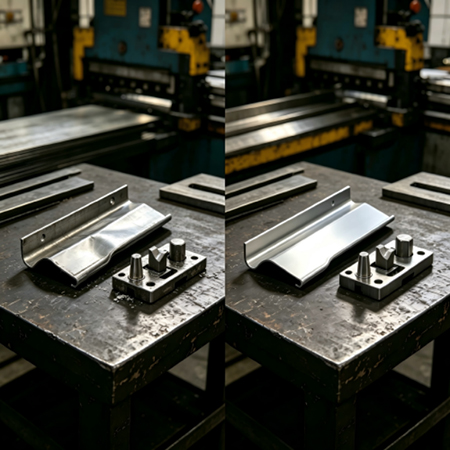
24
Sep’2026How to Choose the Right Bending Tooling: A Guide to Dies, Punches, and Setup
CNC bending can make or break your sheet metal parts. Have you ever received a bent part where the angles were inconsistent, the surface was marred, or the flanges were distorted? The problem often traces back to one critical factor: tooling selection. Press brake tooling—the punches and dies that shape sheet metal—directly determines bend quality, production speed, and tool life. The wrong tooling choice can lead to cracking, springback, excessive wear, and costly rework. Yet many engineers and procurement professionals overlook tooling as a variable until problems arise.
At Lingyufab, we understand that precision bending starts with the right tooling. With over 20 years of precision manufacturing experience since 2003 and certification as a core supplier for Mitsubishi Electric, our CNC bending centers are equipped with a comprehensive range of punches, dies, and accessories to handle diverse material types and thicknesses. This guide explains how to choose the right bending tooling for your sheet metal parts—from die selection to setup best practices.
Why Tooling Selection Matters
Tooling selection affects three critical aspects of sheet metal bending:
Bend quality — The right tooling produces accurate angles, smooth surfaces, and defect-free bends. The wrong tooling causes cracking, wrinkling, and dimensional errors.
Tool life — Proper tooling selection and maintenance extend die and punch life. Mismatched tooling accelerates wear and increases replacement costs.
Production efficiency — Quick-change tooling and standardized setups reduce changeover time. The right tooling also minimizes rework and scrap.
Understanding Press Brake Tooling Basics
Press brake tooling consists of two main components:
Punches (Upper Tool) — The punch applies force to the sheet metal, pressing it into the die. Punches come in various shapes, angles, and lengths.
Dies (Lower Tool) — The die supports the material and provides the shape for the bend. Dies have V-shaped openings that determine the bend radius and angle.
Die Types and Their Applications
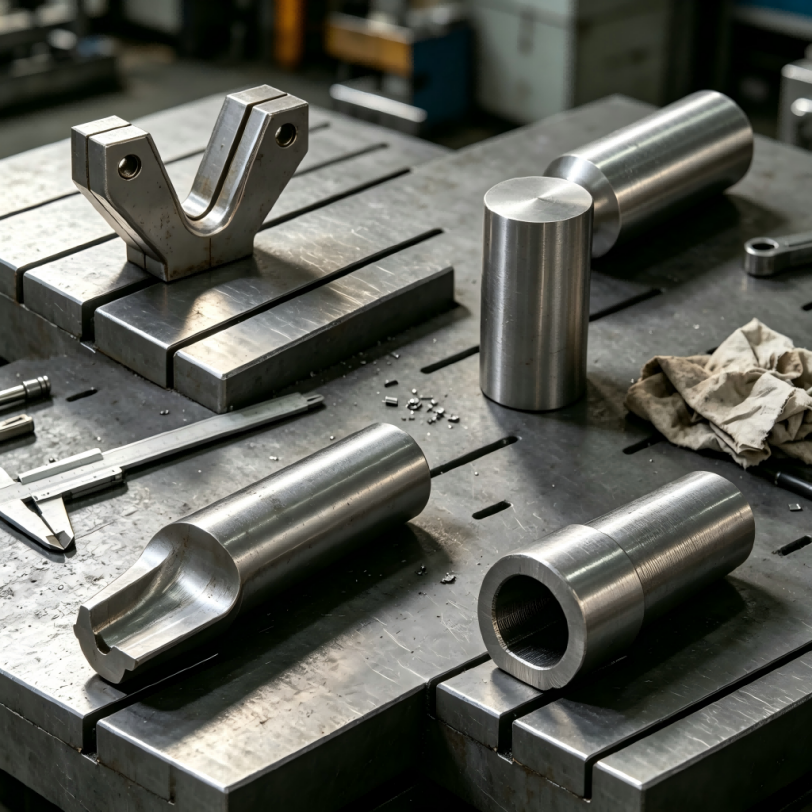
V-Dies (Single-V and Multi-V)
V-dies are the most common type of press brake die, used for air bending, bottom bending, and coining.
Single-V dies have one V-shaped opening and are ideal for high-precision applications where consistent bend angles are critical. They offer excellent repeatability and are often used in aerospace, medical, and automotive applications.
Multi-V dies have multiple V-shaped openings of different sizes. They are versatile and reduce tool change time, making them ideal for job shops and custom fabrication where part geometries vary widely.
Die Opening Size Selection
The V-die opening determines the minimum flange length and the bend radius. Selecting the correct die opening is essential for achieving quality bends and avoiding cracking.
General guideline: The die opening should be approximately six to eight times the material thickness. For example, if you're bending two-millimeter material, a twelve to sixteen-millimeter die opening is appropriate. A good starting point is to use a die with a V-opening of eight times the material thickness.
Too narrow — The material is forced into a tight radius, leading to cracking and excessive tool wear.
Too wide — The material doesn't receive enough support, causing inaccurate angles and potential wrinkling.
Punch Types and Their Applications
Standard Punches Standard punches are versatile and suitable for most bending applications. They provide consistent results across a range of materials and thicknesses.
Sharp Punches Sharp punches have a pointed tip that allows for bending tight radii. They are suitable for applications requiring small inside bend radii and are often used for bending materials like aluminum, where forming a tight radius is critical.
Gooseneck Punches Gooseneck punches have a curved neck that provides clearance for parts with previous bends. They are essential for forming complex shapes without interference.
Radius Punches Radius punches have a rounded tip that produces a consistent bend radius. They are used to form parts that require a specific radius, such as enclosures with precise aesthetic requirements.
Acute Punches Acute punches have a sharp angle tip—thirty degrees or less. They are used for acute angle bending, hemming, and seaming operations.
Material and Coating Considerations
Standard tool steel — Durable and cost-effective. Suitable for most general applications.
Carbide — Offers superior wear resistance for high-volume production. Carbide tooling maintains dimensional accuracy over millions of cycles.
Coated tooling — Tungsten carbide coatings reduce friction and extend tool life, improving part quality and reducing maintenance costs. They are ideal for bending high-strength steels and difficult alloys.
Tooling Setup Best Practices
Inspect tooling before installation — Check for wear, damage, or contamination. Clean and lubricate as needed.
Select proper die opening — Use the six to eight times rule as a starting point.
Align tooling correctly — Misalignment causes inconsistent bends and accelerates tool wear.
Use proper clamping and crowning — Ensure even force distribution across the workpiece to prevent twisting and maintain bend angle consistency.
Lingyufab: Your Trusted Sheet Metal Partner for Precision Bending
Lingyufab is a professional sheet metal fabrication manufacturer and sheet metal supplier based in Shanghai, China, with over 20 years of precision manufacturing experience since 2003. We follow strict Japanese quality standards and are a certified core supplier for Mitsubishi Electric.
What sets Lingyufab apart as a sheet metal supplier is our comprehensive approach to bending. Our CNC bending centers feature real-time angle monitoring and dynamic crowning systems that ensure consistent accuracy across every part.
Our in-house capabilities include: CNC bending — Precision bending with consistent accuracy and springback compensation. Laser cutting — High-precision fiber laser cutting with optimized parameters for clean edges. Laser welding — High-speed, low-distortion welding with minimal heat input. Sheet metal fabrication — Complete assembly, surface treatment, and fastener installation. ISO 9001, ISO 14001, and TÜV CE certified. Full material traceability with Mill Test Certificates.
One supplier, full responsibility. From laser cutting and CNC bending to welding, surface treatment, and fastener installation, we handle everything under one roof. This integration ensures consistent quality, shorter lead times, and a single point of accountability for your entire project.
If you are unsure which tooling is right for your project, our engineering team is available to review your requirements and provide a free consultation. If you are looking for a reliable sheet metal fabrication supplier, please don't hesitate to contact us.
Quick Bending Tooling Selection Checklist for Buyers
| What to Check | What to Consider |
|---|---|
| Material thickness | Select die opening based on material thickness |
| Bend angle | Choose punch and die combination to achieve the required angle |
| Inside bend radius | Verify die opening and punch radius produce the desired radius |
| Tooling compatibility | Ensure punch and die are compatible with your press brake |
| Tooling condition | Inspect for wear, damage, or contamination |
| Setup accuracy | Verify alignment, clamping, and crowning |
FAQs
Q1: How do I choose the right die opening for my material? As a general rule, the die opening should be approximately six to eight times the material thickness. For example, two-millimeter material requires a twelve to sixteen-millimeter die opening. A good starting point is a V-opening of eight times the material thickness.
Q2: What type of punch should I use for bending tight radii? Sharp punches are suitable for bending tight radii in materials like aluminum. For most applications, a standard punch provides consistent results. Radius punches produce a consistent radius for parts with aesthetic requirements.
Q3: Why do my bends crack or show excessive tooling marks? Cracking is often caused by a die opening that is too narrow for the material thickness, or insufficient lubrication. Tooling marks are typically caused by worn or dirty tooling, or insufficient lubrication. Inspect tooling, clean and lubricate, and verify die opening selection.
Q4: What is the difference between air bending, bottom bending, and coining? Air bending is the most flexible method with the smallest tool contact area—it requires less tonnage but relies more on springback compensation. Bottom bending drives the punch into the die until the material matches the tooling angle, minimizing springback. Coining applies the highest force to eliminate springback entirely and delivers the most precise results.
Q5: How do I prevent tooling marks on pre-finished materials? Use protective urethane tape or non-marking dies for pre-painted, polished, or anodized surfaces. Ensure tooling is clean and free of burrs. Proper lubrication also helps reduce friction and marking.
Q6: Can Lingyufab help me select the right tooling for my project? Yes. Lingyufab's engineering team can review your requirements and recommend the optimal tooling selection based on your material, thickness, bend angle, and production volume.