+8613003178786
  sales@lingyufab.com



From CAD to Finished Part: The Complete Sheet Metal Fabrication Process Explained
28
Sep’2026From CAD to Finished Part: The Complete Sheet Metal Fabrication Process Explained
Sheet metal fabrication is one of the most versatile manufacturing processes in modern industry, transforming flat sheets of metal into functional three-dimensional components that power everything from electronics enclosures to industrial machinery. But for many buyers, engineers, and procurement professionals, the journey from a CAD file to a finished part remains something of a black box. Understanding this process is essential for making informed decisions about design, material selection, and supplier selection.
Have you ever submitted a design for fabrication and wondered what actually happens after you hit send? Or perhaps you have received parts that didn't quite match your expectations—and couldn't understand why? The gap between digital design and physical reality is bridged by a series of carefully orchestrated manufacturing steps. This guide walks you through the complete sheet metal fabrication process, from your initial design to the final finished part—so you can understand exactly what goes into making your parts and how to optimize your designs for better results.
At Lingyufab, we manage this entire process in-house every day. With over 20 years of precision manufacturing experience since 2003 and certification as a core supplier for Mitsubishi Electric, we provide end-to-end sheet metal fabrication services—from design review to delivery. This guide explains each stage of the process and what it means for your project.
Stage 1: Design and Engineering Review
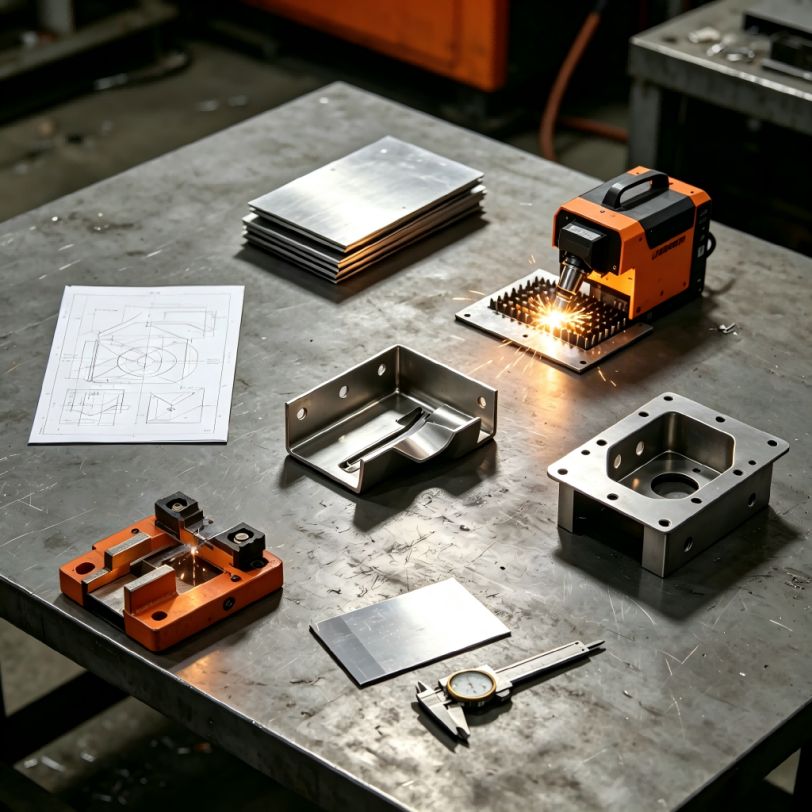
Everything begins with your design—typically a 3D CAD file in STEP, IGES, or SolidWorks format, accompanied by 2D drawings with critical dimensions and tolerances. At this stage, the fabrication partner reviews your design for manufacturability through a Design for Manufacturability (DFM) analysis.
What happens: Engineers examine your design for potential manufacturing issues: bend radii that might cause cracking, hole placements too close to bends, unrealistic tolerances, or features that are difficult to fabricate. This is where problems are caught before they reach production, preventing costly delays and rework later.
What to provide: 3D CAD files (STEP, IGES, SolidWorks), 2D drawings (PDF, DWG, DXF), material specifications, and tolerance requirements.
What to expect: A well-structured DFM review can reduce manufacturing time and prevent costly mistakes. Lingyufab provides free DFM reviews on every project, catching issues before they become problems.
Stage 2: Material Selection and Procurement
Once the design is validated, the next step is selecting and sourcing the right material for your application. Material choice affects everything from strength and weight to corrosion resistance and cost.
What happens: The fabrication partner selects the appropriate material grade, thickness, and finish based on your application requirements. Materials are procured from certified suppliers with full traceability—each batch comes with a Mill Test Certificate (MTC) confirming material composition and properties.
Common materials: Stainless steel for corrosion resistance, aluminum for lightweight applications, carbon steel for cost-effective structural parts, and copper/brass for electrical conductivity.
What to expect: Standard materials are typically in stock and ready for production. Custom or exotic grades may require additional lead time. Lingyufab maintains a comprehensive inventory of common materials to support fast turnaround.
Stage 3: Laser Cutting — Creating the Flat Pattern
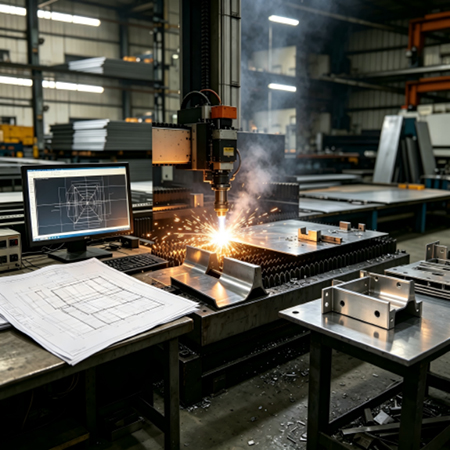
The first manufacturing step is laser cutting—transforming flat sheet metal into the flat pattern shape of your part. This is where the 2D geometry from your design is cut from the metal sheet using a high-power fiber laser.
What happens: The flat pattern is generated from your 3D model, accounting for bend allowances and material springback. The laser follows the programmed path to cut the outline, internal cutouts, and holes with exceptional precision. Modern fiber laser systems achieve tolerances of ±0.13mm, with precision features down to ±0.05mm.
Key considerations: Edge quality matters—parts cut with nitrogen assist gas produce oxide-free edges that are ready for welding and coating without secondary grinding. Lingyufab uses advanced fiber laser systems (10kW to 60kW+) with AI-assisted nesting to maximize material utilization and minimize waste.
What to expect: After cutting, parts are deburred and checked for dimensional accuracy before moving to the next stage. Laser cutting produces minimal heat-affected zones, preserving material properties and ensuring consistent quality.
Stage 4: CNC Bending — Forming 3D Shapes
Once the flat parts are cut, they move to the bending department where they are formed into their final three-dimensional shapes. CNC bending is the critical bridge between flat patterns and finished components.
What happens: The flat part is placed on a press brake with a CNC-controlled backgauge that positions the sheet precisely for each bend. A punch presses the metal into a V-die, forming it to the programmed angle. Real-time angle monitoring systems dynamically measure the angle during the stroke and automatically adjust for material variations.
Key considerations: Springback compensation is essential—different materials require different overbend amounts to achieve the final angle. Lingyufab's CNC bending centers feature real-time angle monitoring and dynamic crowning systems that ensure consistent accuracy across all parts.
What to expect: Parts with multiple bends require careful bend sequencing to avoid collisions and distortion. The bend sequence is planned to minimize repositioning and ensure clearance for all bends.
Stage 5: Welding and Assembly — Joining Components
For parts that require joining—such as enclosures with multiple components or assemblies with brackets and frames—welding and assembly are the next steps. This is where individual fabricated parts are permanently joined into complete assemblies.
What happens: Components are positioned and clamped using custom fixtures to maintain alignment during welding. The appropriate welding process is selected based on material type, thickness, and requirements—TIG welding for stainless steel, MIG welding for general fabrication, or laser welding for high-speed, low-distortion applications.
Key considerations: Proper joint design and heat management are essential for preventing distortion. Laser welding's minimal heat input makes it ideal for thin sheet metal applications. Lingyufab offers TIG, MIG, and laser welding capabilities to meet diverse application requirements.
What to expect: After welding, the assembly is inspected for weld quality, dimensional accuracy, and flatness.
Stage 6: Surface Treatment and Finishing
With the part or assembly fully formed, the next step is surface treatment—enhancing appearance, corrosion resistance, and durability through various finishing processes.
What happens: The appropriate surface treatment is applied based on your requirements—powder coating for durable, colored finishes; anodizing for aluminum corrosion protection; electroplating for conductivity and appearance; or polishing for a smooth, reflective finish.
Key considerations: Surface preparation is critical for finish adhesion. Proper cleaning and pretreatment ensure consistent, durable results. Lingyufab provides in-house powder coating, anodizing, electroplating, and polishing services, eliminating the need to outsource finishing.
What to expect: Finished parts are inspected for appearance, coating thickness, and adhesion before moving to the next stage.
Stage 7: Quality Inspection and Packaging
Before shipment, every part undergoes final quality inspection to ensure it meets your specifications. This is the last opportunity to catch any issues before parts reach your assembly line.
What happens: Critical dimensions are verified, surface finish and weld quality are inspected, and parts are cleaned and prepared for packaging. Inspection documentation is prepared and ready for shipment.
Key considerations: Packaging is designed to protect parts during transit—especially important for finished surfaces and assemblies. Lingyufab provides custom packaging to ensure scratch-free delivery.
What to expect: Parts are securely packaged with clear labeling and documentation, ready for shipment to your facility.
How Lingyufab Delivers End-to-End Sheet Metal Fabrication
Lingyufab is a professional sheet metal fabrication manufacturer and sheet metal supplier based in Shanghai, China, with over 20 years of precision manufacturing experience since 2003. We follow strict Japanese quality standards and are a certified core supplier for Mitsubishi Electric.
What sets Lingyufab apart as a sheet metal supplier is our integrated approach—we handle every step of the process in-house, eliminating coordination gaps and ensuring consistent quality from start to finish.
Our in-house capabilities include: Sheet metal fabrication — Complete end-to-end manufacturing from design review to delivery. Laser cutting — High-precision fiber laser cutting with optimized parameters for clean edges and minimal burrs. CNC bending — Precision bending with consistent accuracy and springback compensation. Laser welding— High-speed, low-distortion welding with minimal heat input. ISO 9001, ISO 14001, and TÜV CE certified. Full material traceability with Mill Test Certificates.
One supplier, full responsibility. From laser cutting and CNC bending to welding, surface treatment, and fastener installation, we handle everything under one roof. This integration ensures consistent quality, shorter lead times, and a single point of accountability for your entire project.
If you are planning a sheet metal project and want to ensure a smooth process from design to delivery, our engineering team is available to review your requirements and provide a free consultation. If you are looking for a reliable sheet metal fabrication supplier, please don't hesitate to contact us.
Quick Process Checklist for Buyers
| What to Check | What to Consider |
|---|---|
| Design review | Has your design been reviewed for manufacturability? |
| Material selection | Is the material specification clear and available? |
| Cutting | Are edge quality and tolerance requirements specified? |
| Bending | Are bend radii and angles realistic for the material? |
| Welding | Is the joint design appropriate for the welding process? |
| Surface finish | Is the finishing specification clear and achievable? |
| Quality inspection | Are inspection criteria and documentation requirements defined? |
FAQs
Q1: How long does the sheet metal fabrication process typically take?
Lead time depends on part complexity, material availability, and quantity. Simple parts can be produced in 3-5 business days. Complex assemblies with multiple operations and finishing typically take 2-4 weeks. Lingyufab's in-house capabilities and integrated workflow help minimize overall lead time.
Q2: What file formats are needed for sheet metal fabrication?
3D CAD files in STEP (.stp), IGES (.igs), or SolidWorks (.sldprt) formats are ideal for automated DFM analysis and flat pattern generation. 2D drawings in PDF, DWG, or DXF formats are helpful for critical dimensions, tolerances, and thread specifications.
Q3: How does DFM review help my project?
DFM review catches potential manufacturing issues before production begins—preventing costly rework and delays. It identifies problems like unrealistic tolerances, features that are difficult to fabricate, and opportunities to simplify geometry and reduce cost.
Q4: What is the difference between laser cutting and CNC bending?
Laser cutting creates the flat pattern of your part from sheet metal. CNC bending forms the flat part into its final three-dimensional shape. Both processes are essential for most sheet metal parts.
Q5: Can Lingyufab handle both prototypes and mass production?
Yes. Lingyufab supports everything from single prototypes to 100-piece pilot runs to full mass production. Our flexible manufacturing approach, combined with modern equipment and integrated capabilities, allows us to scale production up or down based on your needs.
Q6: What is a Mill Test Certificate and why does it matter?
A Mill Test Certificate (MTC) is a document from the material manufacturer confirming the chemical composition and mechanical properties of the metal. It ensures you are getting the material you specified, not a cheaper substitute. Lingyufab provides MTCs for every batch of raw materials.