
 +8613003178786
 sales@lingyufab.com
Sheet Metal & Fastener Manufacturer: Map Your Total Cost
The Hidden Costs of Separating Sheet Metal and Fastener Sourcing
When sourcing custom metal parts, many procurement managers compare quotes for sheet metal fabrication and fasteners from separate vendors. On the surface, this approach seems logical—find the lowest price for each component. However, this fragmented strategy often hides significant downstream costs in logistics, assembly, quality control, and project management. A low initial quote from one supplier can quickly be overshadowed by the expense of coordinating multiple vendors, managing an extra assembly step, and absorbing the cost of parts that fail inspection due to tolerance stack-up between separately sourced components.
The real risk lies in overlooking the total cost of ownership. What happens when a batch of sheet metal brackets from Supplier A doesn't align perfectly with the PEM nuts from Supplier B? The issue may not be a defect in either part, but a mismatch in tolerance interpretation. Your team is now responsible for the rework, the delays, and the financial impact. A unified Global Custom Sheet Metal Fabrication Service that also manages fastener integration eliminates these variables. At Lingyufab, we see this challenge frequently. As an integrated sheet metal and fastener manufacturer, we take single-point responsibility for the final assembly, ensuring every component fits and functions as designed from the start.
Mapping Total Cost of Ownership: Split vs. Integrated Suppliers
To make an informed sourcing decision, you must look beyond the per-piece price and map the entire cost structure. A Total Cost of Ownership (TCO) model reveals the financial benefits of partnering with a vertically integrated supplier. Our in-house fabrication and assembly processes typically reduce overall project costs by 15-20% by eliminating these hidden expenses.
Consider the following cost breakdown when comparing quotes from separate suppliers versus an integrated partner like Lingyufab:
| Cost Component | Split Sourcing (Separate Suppliers) | Integrated Sourcing (Lingyufab) |
|---|---|---|
| Sheet Metal Part Cost | Quoted price from fabricator. | Bundled price, often lower due to streamlined workflow. |
| Fastener Hardware Cost | Quoted price from fastener distributor. | Included in assembly cost; benefits from bulk purchasing power. |
| Logistics & Shipping | Two sets of shipping costs: fabricator to your facility, plus fastener supplier to your facility. Potential for expedited freight if one is delayed. | One shipment for the completed assembly. No intermediary logistics. |
| Assembly & Insertion Labor | In-house or third-party assembly cost. Includes machine setup, operator time, and process validation. | Absorbed into the supplier’s manufacturing process. No separate line item for you. |
| Scrap & Rework | Higher risk. If parts don't fit, you absorb the cost of rejected metal parts, wasted fasteners, and additional labor. | Supplier's responsibility. Lingyufab guarantees fit and function; we absorb costs for any manufacturing defects. |
| Quality Inspection | Requires two incoming inspections (parts and fasteners) plus a final assembly inspection. | One incoming inspection for the finished Sheet Metal Assemblies. We perform 100% dimensional and visual checks before shipment. |
| Project Management | Time spent managing multiple POs, tracking two suppliers, and resolving cross-vendor issues. | Single point of contact. Simplified communication and accountability. |
This model makes it clear: the lowest component price does not guarantee the lowest final cost. An integrated approach transforms multiple variable expenses into a single, predictable cost.
Ensuring Assembly Integrity: A Quality Control Perspective
As Quality Assurance Director, my primary focus is mitigating risk and ensuring every part we ship meets the client's exact specifications. When sheet metal fabrication and fastener installation are handled by a single, certified partner, quality control becomes far more effective.
At Lingyufab, our status as a Mitsubishi Electric certified core supplier means we operate under the rigorous expectations of Japanese quality standards. This philosophy is embedded in our integrated manufacturing process. We control every variable, from raw material selection to the final assembly torque of a Socket Head Cap Screw.
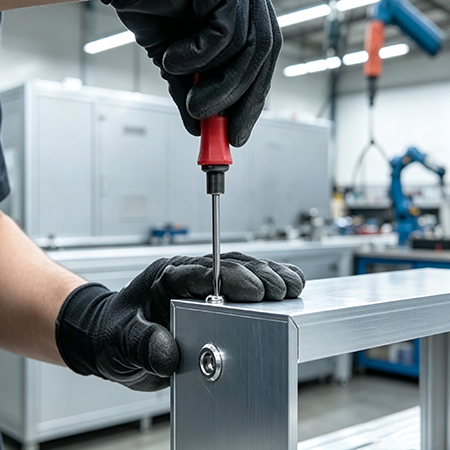
Key Pillars of Our Integrated Quality Assurance:
Unified Tolerance Management: The most common failure point in split-sourcing is tolerance stack-up. We fabricate sheet metal parts with precision down to ±0.05mm and install fasteners within the same controlled environment. This eliminates guesswork and ensures perfect alignment between holes, bends, and hardware.
Full Material Traceability: Our ISO 9001:2015 certified system mandates complete traceability. We provide Mill Test Certificates (MTC) for every batch of sheet metal (e.g., carbon steel, stainless steel 304/316, aluminum) and full documentation for all installed fasteners. You have a complete quality record for the entire assembly.
Process-Integrated Inspection: Instead of a single final inspection, we conduct checks at critical stages: after laser cutting, post-CNC bending, and following fastener insertion. This allows us to catch any deviation early, long before it becomes a costly assembly-level problem. Our final 100% dimensional and visual inspection is a verification step, not a fault-finding mission.
Single-Point Accountability: If a quality issue arises, there is no ambiguity. As the sole manufacturer of the assembly, we take full responsibility. Our policy is simple: if a defect is due to our manufacturing process, we provide free replacement or repair. This removes the risk of disputes between separate part and fastener suppliers.
Buyer's Checklist for Evaluating Integrated Manufacturing Partners
When preparing your next Request for Quote (RFQ) for a project involving both sheet metal and fasteners, use this checklist to properly evaluate potential partners. This will help you identify a supplier capable of delivering not just parts, but a complete, reliable solution.
Essential Evaluation Criteria:
☐ In-House Capabilities: Does the supplier perform laser cutting, CNC bending, welding, and fastener installation in-house? Verify they are not simply outsourcing one part of the process. Outsourcing reintroduces the multi-vendor risks you are trying to avoid.
☐ Quality Certifications: Are they certified to ISO 9001:2015 for quality management? Additional certifications like ISO 14001 (environmental) and TÜV CE demonstrate a mature operational framework.
☐ Experience with Assemblies: Ask for examples of similar Enclosure Chassis Assemblies or complex brackets they have produced. A parts fabricator may not have the expertise for efficient assembly.
☐ Tolerance Capability: Can they commit to the required tolerances in writing? For complex assemblies, tolerances of ±0.05mm are often necessary. Request their standard tolerance specifications.
☐ Material & Fastener Sourcing: How do they ensure the quality of raw materials and fasteners? Ask about their supplier vetting process and if they provide MTCs and Certificates of Conformance (CoC) for all components.
☐ Prototyping and Scalability: Do they support your project from the R&D phase? A partner with zero MOQ for prototypes shows commitment to growing with your product. Also, confirm their production capacity—Lingyufab, for example, delivers over 8,000 assemblies monthly, showcasing our ability to scale.
☐ Warranty & Quality Guarantee: What is their policy on manufacturing defects? A clear guarantee of free replacement or repair provides critical commercial protection.
From Prototype to Production: How a Single Partner Streamlines Scaling
Product development is rarely a linear path. It moves from initial concept, to functional prototype, to pilot run, and finally to mass production. Managing this journey with separate suppliers for sheet metal and fasteners adds unnecessary complexity at every stage. Each design iteration requires re-coordination, re-quoting, and re-alignment between vendors.
An integrated manufacturing partner simplifies this entire lifecycle. At Lingyufab, we are structured to support your product's growth. Our approach provides key advantages for scaling:
Seamless Prototyping: We have a policy of zero MOQ for the prototyping stage. Whether you need a single enclosure for fit-testing or a dozen brackets for a proof-of-concept build, we apply the same rigorous quality standards as we do for full production runs. Our typical lead time of 7-10 days for samples allows your engineering team to iterate quickly.
Flexible Production (HMLV): We specialize in OEM/ODM solutions and are adept at managing High-Mix, Low-Volume (HMLV) production schedules. Our flexible production lines and mature supply chain allow us to adapt quickly to changes in demand or design without significant retooling costs or delays.
Scalable Capacity: As your product gains market traction, your production needs will grow. With a proven capacity of delivering over 8,000 fastener and metal sheet assemblies monthly, we have the infrastructure to scale with you. This eliminates the need to vet and onboard a new, larger supplier once you move into mass production, saving you months of qualification time.
Design for Manufacturability (DFM) Feedback: Because we handle both fabrication and assembly, our engineers can provide holistic DFM feedback. We can suggest changes to a bend radius, material type, or fastener choice that might improve manufacturability, reduce cost, and enhance the final product's reliability—insights that are impossible to get from siloed suppliers.
By partnering with a single source from the beginning, you establish a relationship with a team that understands your product's technical requirements and commercial goals. This continuity is invaluable for long-term success.
Ready to simplify your supply chain and uncover your true total cost of ownership? Submit your technical drawings to our engineering team for a detailed quote and DFM analysis.

