+8613003178786
  sales@lingyufab.com



Bending Sequence Optimization: How to Reduce Setup Time and Improve Efficiency
10
Oct’2026Bending Sequence Optimization: How to Reduce Setup Time and Improve Efficiency
Bending sequence determines how efficiently a sheet metal part moves through production. Have you ever watched a press brake operator spend more time flipping, rotating, and repositioning a part than actually bending it? Or perhaps you have received a quote where the bending cost seemed disproportionately high for a simple part? The sequence in which bends are performed directly affects production speed, tool wear, part quality, and overall cost. A poorly planned sequence can double or triple manufacturing time, increase scrap rates, and create unnecessary stress on both equipment and operators.
At Lingyufab, we understand that efficient bending starts with intelligent sequence planning. With over 20 years of precision manufacturing experience since 2003 and certification as a core supplier for Mitsubishi Electric, our CNC bending centers are programmed with optimized bend sequences that minimize handling, reduce setup time, and ensure consistent quality across every part. This guide explains the principles of bending sequence optimization and provides practical strategies to improve efficiency.
Why Bending Sequence Matters
The order in which bends are made affects three critical aspects of sheet metal fabrication:
Production time — A poorly planned sequence requires multiple part repositionings, tool changes, and operator interventions. Each additional handling step adds time. A well-optimized sequence can reduce bending time by 20–50%.
Part quality — Incorrect sequencing can cause collisions between the part and the machine, marking or distorting previously bent features. It can also create stress concentrations that lead to cracking or warping.
Tool wear — Frequent tool changes and improper sequencing accelerate wear on punches, dies, and machine components, increasing maintenance costs and downtime.
The Fundamentals of Bending Sequence Planning
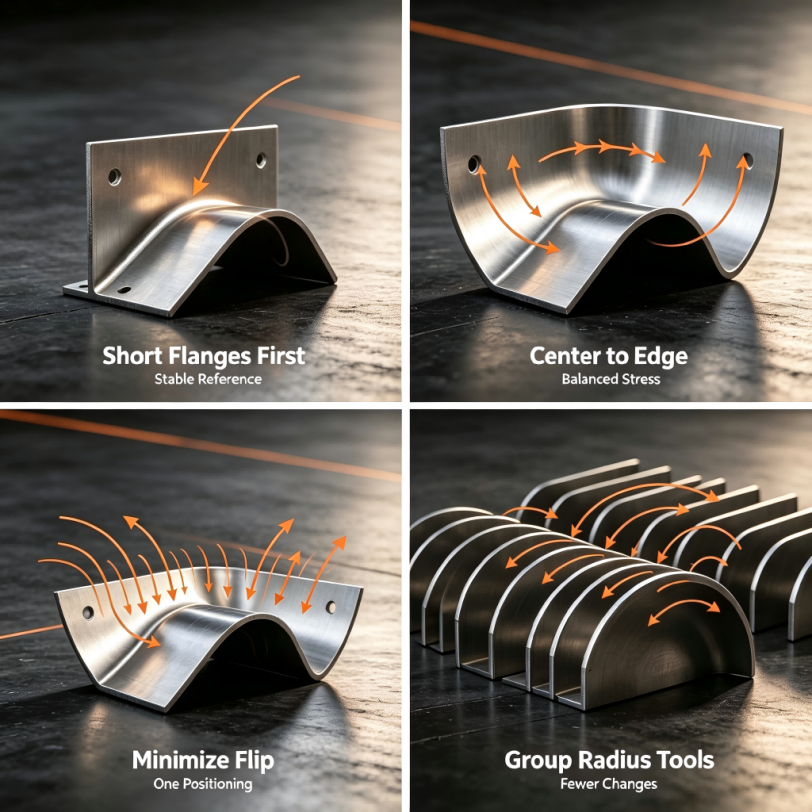
Bend the Shortest Flanges First
Short flanges require less material movement and are easier to position accurately. Bending them first establishes a stable reference for subsequent bends. This approach also minimizes the risk of collision with previously bent features.
Bend from the Center Outward
For parts with multiple bends, start with bends near the center of the part and work outward. This distributes stress evenly and prevents distortion from accumulating at the edges. Bending from the center outward also allows the operator to maintain better control over part positioning.
Consider Tooling Interference
Before committing to a sequence, consider whether the part will collide with the punch, die, or machine frame at any stage. Parts with flanges that wrap around or long flanges that extend beyond the die opening are particularly prone to interference. Use simulation software or test runs to identify potential issues.
Limit Part Flipping and Rotation
Every time the operator flips or rotates the part, time is lost. When possible, design the sequence to perform all bends with the part in a single orientation. If flipping is unavoidable, group bends that require the same orientation together to minimize handling.
Minimize Tool Changes
Different bend radii require different tooling. Each tool change takes time and introduces the possibility of setup errors. Group bends with similar radii together. When designing the part, use consistent bend radii across all flanges to reduce tool changes.
Use Offset and Relief Features
Incorporate offset bends or relief cuts into the design to simplify the bending sequence. Offset bends allow complex geometries to be formed with fewer operations. Relief cuts prevent material tearing and improve formability.
Common Bending Sequence Mistakes
Bending Long Flanges First Long flanges are difficult to control and position accurately. Bending them first often leads to interference with subsequent bends and increases the risk of distortion.
Ignoring Springback Accumulation Springback varies with bend angle and material properties. Bending in an order that concentrates springback in one area can cause cumulative distortion. Alternate bends on opposite sides of the part to balance springback forces.
Overlooking Part Orientation Parts with directional features—such as grain direction or surface finish requirements—may need to be bent in a specific order to preserve orientation. Ignoring this can compromise product quality.
Not Using Simulation Manual sequence planning is prone to error. Simulation software can identify collisions, stress points, and inefficiencies before production begins. The cost of software and training is quickly recovered through reduced scrap and increased throughput.
Practical Tips for Engineers and Buyers
Design for Efficient Sequencing
When designing parts, consider the bending sequence as early as possible. Consistent bend radii, adequate clearance, and simple geometries make sequencing easier and more cost-effective.
Provide Clear Documentation
Include bending sequence instructions in the engineering drawing. This reduces the risk of miscommunication and ensures that the operator executes the sequence as intended.
Communicate with Your Fabricator
Discuss bending sequence with your fabricator before production. They may have suggestions for improving efficiency based on their specific equipment and experience.
How Lingyufab Optimizes Bending Sequences
Lingyufab is a professional sheet metal fabrication manufacturer and sheet metal supplier based in Shanghai, China, with over 20 years of precision manufacturing experience since 2003. We follow strict Japanese quality standards and are a certified core supplier for Mitsubishi Electric.
What sets Lingyufab apart as a sheet metal supplier is our systematic approach to bending sequence optimization. Using advanced offline programming software, our engineers simulate the entire bending process before any metal is cut. This allows us to identify potential collisions, optimize tool selection, and minimize handling time—ensuring efficient production from the first part to the last.
Our in-house capabilities include:
CNC bending — Precision bending with optimized sequences and springback compensation.
Laser cutting — High-precision fiber laser cutting with optimized parameters for clean edges.
Laser welding — High-speed, low-distortion welding with minimal heat input.
Sheet metal fabrication — Complete assembly, surface treatment, and fastener installation.
ISO 9001, ISO 14001, and TÜV CE certified.
Full material traceability with Mill Test Certificates.
One supplier, full responsibility. From laser cutting and CNC bending to welding, surface treatment, and fastener installation, we handle everything under one roof. This integration ensures consistent quality, shorter lead times, and a single point of accountability for your entire project.
If you are looking to improve bending efficiency in your sheet metal parts, our engineering team is available to review your requirements and provide a free consultation. If you are looking for a reliable sheet metal fabrication supplier, please don't hesitate to contact us.
Quick Bending Sequence Checklist for Buyers
| What to Check | What to Consider |
|---|---|
| Shortest flanges first | Are the shortest flanges bent before longer ones? |
| Center-outward sequence | Are bends starting from the center and working outward? |
| Tooling interference | Has the sequence been checked for potential collisions? |
| Part flipping | Is flipping minimized? Are similar orientations grouped? |
| Tool changes | Are bends with similar radii grouped to minimize changes? |
| Simulation | Has the sequence been verified using simulation software? |
FAQs
Q1: What is the most important rule in bending sequence planning?
Bend the shortest flanges first and work from the center of the part outward. This establishes a stable reference and minimizes the risk of collision and distortion.
Q2: How much time can optimized sequencing save?
A well-optimized bending sequence can reduce bending time by 20–50% compared to an unplanned sequence. The savings come from reduced handling, fewer tool changes, and fewer interruptions for collision avoidance.
Q3: What happens if the bending sequence is wrong?
Incorrect sequencing can cause the part to collide with the machine, mark or distort previously bent features, create stress concentrations leading to cracking, and increase production time significantly. In severe cases, the part may need to be scrapped.
Q4: Can simulation software really help?
Yes. Simulation software can identify collisions, stress points, and inefficiencies before production begins. The cost of software and training is quickly recovered through reduced scrap and increased throughput.
Q5: Does Lingyufab use simulation for bending sequence planning?
Yes. Lingyufab uses advanced offline programming and simulation software to optimize bending sequences before production begins. This ensures efficient production from the first part to the last.
Q6: How can I design parts for more efficient bending? Use consistent bend radii across all flanges to reduce tool changes. Provide adequate clearance for tooling. Consider the bending sequence during the design phase and include sequence instructions in the engineering drawing. Discuss sequence planning with your fabricator early in the process.