+8613003178786
  sales@lingyufab.com



The Future of Sheet Metal Fabrication: How Automation and Digitalization Are Transforming the Industry
12
Oct’2026The Future of Sheet Metal Fabrication: How Automation and Digitalization Are Transforming the Industry
Sheet metal fabrication is undergoing a fundamental transformation. Have you ever waited weeks for a simple sheet metal prototype, only to receive parts that required rework because of inconsistent quality? Or perhaps you have struggled to find a supplier who can handle both small-batch prototypes and high-volume production without compromising quality or delivery times? These are common frustrations faced by procurement professionals, design engineers, and product managers. The good news is that the sheet metal fabrication industry is changing—and it is changing everything about how parts are made, inspected, and delivered.
The sheet metal fabrication industry is experiencing rapid growth, driven by the accelerating adoption of automation and Industry 4.0 technologies. From AI-powered quality inspection to fully automated bending cells, the factory floor of tomorrow is already taking shape today.
At Lingyufab, we are part of this transformation. With over 20 years of precision manufacturing experience since 2003 and certification as a core supplier for Mitsubishi Electric, we have invested in modern equipment and digital processes to deliver consistent quality, shorter lead times, and greater flexibility. This guide explores the key trends shaping the future of sheet metal fabrication and what they mean for buyers and engineers.
Why Automation Matters in Sheet Metal Fabrication
Sheet metal fabrication has traditionally been a labor-intensive industry. Skilled operators manually loaded sheets into laser cutters, positioned parts on press brakes, and inspected finished components by eye. This approach worked for decades, but it has significant limitations:
Inconsistent quality — Human operators introduce variability. Even the best workers have off days, and fatigue affects precision.
Labor shortages — Skilled fabricators are increasingly difficult to find and retain. The industry faces a growing skills gap.
Slow changeovers — Switching between different parts requires manual setup, tooling changes, and recalibration—all of which take time.
Limited scalability — Manual processes cannot easily scale up or down to meet fluctuating demand.
Automation addresses each of these challenges. It reduces variability, compensates for labor shortages, accelerates changeovers, and enables flexible production. The result is higher quality, faster delivery, and more consistent pricing.
Trend 1: Automated Laser Cutting and Material Handling
Laser cutting has long been the backbone of sheet metal fabrication, but the machines themselves are becoming smarter and more autonomous. Modern fiber laser systems are faster, more precise, and more energy-efficient than their predecessors. Fiber lasers now offer significantly higher electrical efficiency than CO₂ lasers, and high-power sources are expanding the thickness range that can be cut economically.
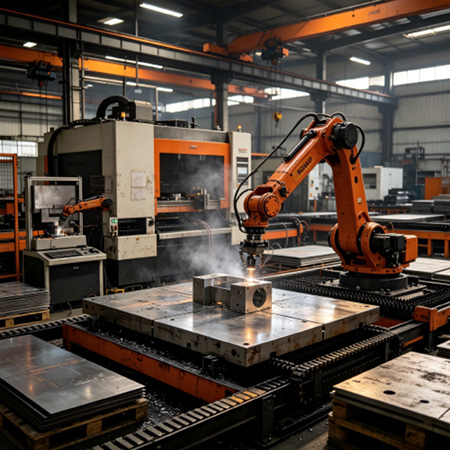
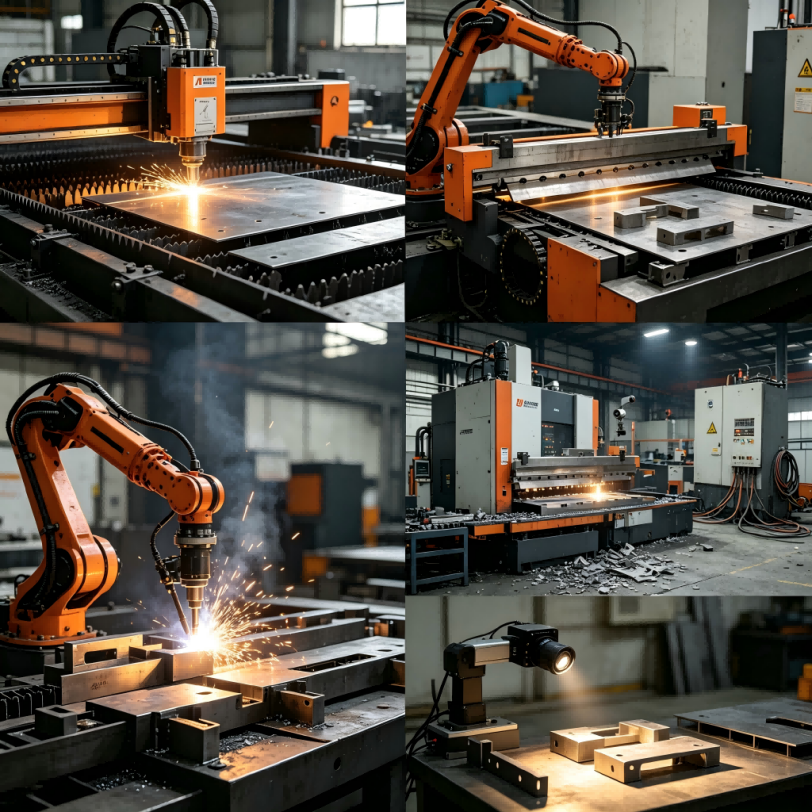
But the real transformation is happening around the machine—not just inside it. Automated material handling systems now manage the entire flow of sheet metal from storage to cutting to sorting. Automated loading and unloading systems feed sheets into the laser cutter and remove finished parts. Vision-based sorting systems identify and separate parts by shape and size. Smart storage systems track inventory in real time and automatically replenish materials when supplies run low.
What this means for buyers: Faster cutting speeds and automated material handling translate directly to shorter lead times. Consistent machine operation means consistent part quality across batches. And automated nesting software maximizes material utilization, reducing waste and lowering costs.
Trend 2: Automated Bending and Forming
Bending has traditionally been one of the most difficult processes to automate. Unlike cutting, which follows a straightforward path, bending requires precise positioning, tool selection, and angle control—all of which were traditionally done by skilled operators.
That is changing. Automated bending cells now combine CNC press brakes with robotic arms that load, position, and unload parts. The entire bending workflow—from sheet handling and positioning to bending and stacking—is automated with minimal operator intervention. Advanced software calculates the optimal bend sequence and tooling setup, reducing setup time significantly. Vision systems verify bend angles in real time and automatically adjust parameters to compensate for material variation.
What this means for buyers: Faster setup means smaller batch sizes become economically viable. Automated bending cells can switch between different parts in minutes rather than hours, making it practical to produce small batches without the traditional cost penalty. Consistent, repeatable bending means fewer rejected parts and less rework.
Trend 3: Robotic Welding and Assembly
Welding is another area where automation is making significant inroads. Robotic welding systems can work 24/7 with consistent quality, reducing the reliance on skilled welders. Advanced vision systems guide robots to the exact weld location, compensating for part variation and ensuring consistent weld quality.
The integration of cutting, bending, and welding into a single automated production cell is also becoming more common. These cells can take flat sheet metal and produce finished welded assemblies with minimal human intervention.
What this means for buyers: Robotic welding delivers consistent, repeatable weld quality—no more worrying about whether the welder had a good day. Automated cells reduce lead times by eliminating the delays between processes. And because robots can work continuously, capacity is more predictable and scalable.
Trend 4: Digital Twins and Smart Factory Integration
One of the most exciting developments in sheet metal fabrication is the rise of digital twins—virtual replicas of physical production processes. A digital twin allows manufacturers to simulate production runs, identify bottlenecks, and optimize processes before any metal is cut.
Smart factory systems connect every machine on the shop floor, collecting real-time data on production status, machine utilization, and quality metrics. This data enables predictive maintenance—machines that tell operators when they need service before they break down. It also enables real-time production tracking, giving buyers visibility into their order status without phone calls or emails.
What this means for buyers: Faster response to problems means fewer delays. Real-time visibility means you always know where your order stands. And optimized production planning means your parts are manufactured in the most efficient sequence, reducing overall lead time.
Trend 5: AI-Powered Quality Inspection
Perhaps the most transformative trend is the use of artificial intelligence for quality inspection. Traditional quality control relies on human inspectors checking parts manually—a process that is slow, subjective, and prone to error.
AI-powered vision systems can now inspect parts at production speed, detecting defects that human eyes would miss. AI-enabled quoting can analyze CAD files, material thickness, bend complexity, and tolerances to accelerate estimates. Machine learning supports smarter nesting, predictive maintenance, tool wear monitoring, and weld-quality inspection. AI-based monitoring systems diagnose and analyze the entire process, from material input to finished product.
What this means for buyers: 100% inspection becomes practical—every part can be checked, not just a sample. Defects are caught immediately, not days later in assembly. Consistent, objective quality standards eliminate the variability of human judgment. And the data collected by AI systems helps manufacturers continuously improve their processes.
What These Trends Mean for You
If you are sourcing sheet metal parts, these trends offer significant advantages:
Shorter lead times — Automation reduces setup time and accelerates production. What used to take weeks can now take days.
Consistent quality — Automated processes eliminate the variability that comes with human operators. Parts are more consistent from batch to batch.
Greater flexibility — Automated cells can switch between different parts quickly, making small batches and prototypes more economical.
Better visibility — Digital systems give you real-time insight into your order status and production progress.
Lower costs — Reduced waste, fewer rejects, and faster production all contribute to lower overall costs.
Lingyufab: Your Trusted Sheet Metal Partner for the Future
Lingyufab is a professional sheet metal fabrication manufacturer and sheet metal supplier based in Shanghai, China, with over 20 years of precision manufacturing experience since 2003. We follow strict Japanese quality standards and are a certified core supplier for Mitsubishi Electric.
What sets Lingyufab apart as a sheet metal supplier is our commitment to investing in modern equipment and digital processes that deliver consistent quality and shorter lead times. Our ultra-high-power fiber laser cutting systems feature AI-assisted nesting for maximum material utilization. Our CNC bending centers feature real-time angle monitoring and dynamic crowning systems. Our laser welding capabilities deliver high-speed, low-distortion welding with minimal heat input.
Our in-house capabilities include:
Laser cutting — High-precision fiber laser cutting with optimized parameters for clean edges and minimal burrs.
CNC bending — Precision bending with consistent accuracy and springback compensation.
Laser welding — High-speed, low-distortion welding with minimal heat input.
Sheet metal fabrication — Complete assembly, surface treatment, and fastener installation.
ISO 9001, ISO 14001, and TÜV CE certified.
Full material traceability with Mill Test Certificates.
One supplier, full responsibility. From laser cutting and CNC bending to welding, surface treatment, and fastener installation, we handle everything under one roof. This integration ensures consistent quality, shorter lead times, and a single point of accountability for your entire project.
If you are looking for a sheet metal fabrication supplier that combines precision manufacturing with modern processes, our engineering team is available to review your requirements and provide a free consultation. Please don't hesitate to contact us.
Conclusion
The sheet metal fabrication industry is undergoing a fundamental transformation driven by automation, digitalization, and artificial intelligence. Automated laser cutting and material handling, robotic bending cells, digital twins, and AI-powered quality inspection are reshaping how parts are made, inspected, and delivered. For buyers and engineers, these trends mean shorter lead times, more consistent quality, greater flexibility, and lower costs.
Working with a supplier that embraces these trends—like Lingyufab, who combines precision manufacturing with modern equipment and digital processes—helps you stay competitive in an increasingly demanding market.
FAQs
Q1: What is driving automation in sheet metal fabrication?
The primary drivers are labor shortages, the need for consistent quality, and the demand for faster delivery. Automation reduces reliance on skilled labor, eliminates variability, and accelerates production.
Q2: How does automation affect lead times?
Automated systems reduce setup time and enable faster production. Changeovers that used to take hours can now take minutes. This translates directly to shorter lead times for buyers.
Q3: What is a digital twin in sheet metal fabrication?
A digital twin is a virtual replica of a physical production process. It allows manufacturers to simulate production runs, identify bottlenecks, and optimize processes before any metal is cut, reducing waste and improving efficiency.
Q4: How does AI improve quality inspection?
AI-powered vision systems can inspect parts at production speed, detecting defects that human eyes would miss. This enables 100% inspection of every part, not just sampling, and catches defects immediately rather than days later.
Q5: What is the typical setup time reduction with automated bending?
Automated bending cells can reduce setup time significantly compared to traditional manual setup, enabling faster changeovers and making small batches and prototypes more economical to produce.
Q6: Can Lingyufab handle both prototypes and high-volume production?
Yes. Lingyufab supports everything from single prototypes to 100-piece pilot runs to full mass production. Our flexible manufacturing approach, combined with modern equipment, allows us to scale production up or down based on your needs.