
 +8613003178786
 sales@lingyufab.com
Custom Mounting Brackets: Compare Quote Cost Drivers
Why two bracket quotes for the same drawing can differ by a wide margin
The sourcing risk is simple: you approve the lowest unit price, then discover it assumed a different process, a different material yield, or a tooling charge that was never itemized. By then the PO is placed and the comparison is no longer apples to apples.
Most custom mounting brackets are priced from the same few inputs. Suppliers weight them differently and often show only one blended number. If you cannot see the inputs, you cannot tell whether a quote is cheap because the design is efficient or because something was left out.
Lingyufab (Shanghai Lingyu Industry) has made sheet metal parts and fasteners since 2003. Our work on brackets runs through Global Custom Sheet Metal Fabrication Service lines: laser cutting, CNC bending, stamping, TIG/MIG welding and surface finishing, all under one roof. Brackets, mounting plates and the Internal Structural Function Components around them belong to that family. This article explains how we separate the cost, so you can hold any quote, ours included, to the same standard.
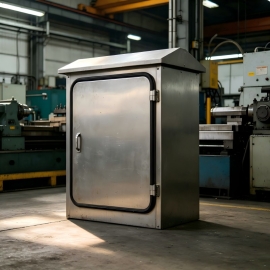
A quote-cost model that separates yield, process, setup, tooling, secondary operations and volume
If you want to know what affects custom bracket pricing, split the quote into six lines. A supplier who can fill in all six has actually costed the part. One who offers a single number may not have.
| Cost component | What it covers | How it moves with volume | What to ask on the quote |
|---|---|---|---|
| Material yield | Sheet or bar consumed per part, including nesting scrap and offcuts. Grade matters too: 304 or 316 stainless costs more than carbon steel or aluminum. | Improves as nesting gets denser on larger runs. A single part never nests well. | Sheet size, nesting utilization, grade, thickness |
| Process selection | Laser cut and bend, stamped, welded, or machined from solid. | Machine time per part is roughly constant. Process choice sets the floor price. | Which process was quoted, and why |
| Setup | Programming, press brake tooling selection, fixtures, first-article time. | Spread across the batch, so it dominates at 1-50 pieces and fades at 1,000+. | Setup charge shown as its own line |
| Tooling | Stamping or progressive dies, dedicated welding jigs, special bend tools. | One-time cost. It only pays back when volume is high and the design is stable. | Tooling price, ownership, expected life, maintenance terms |
| Secondary operations | Deburring, tapping, hardware insertion, welding, plating, powder coating, passivation. | Mostly per-piece. Often grows faster than cutting and bending cost. | Itemized list with finish specification |
| Volume breakpoints | Price steps at quantity tiers, where setup and tooling amortize. | Steepest drop between prototype and first production tier. | Unit prices at three quantities, not one |
Conclusion: compare quotes line by line, not by total. Reasoning: a low unit price built on high-volume nesting and amortized tooling will not hold if your real order is 200 pieces. Limit: this model suits formed and fabricated parts. Machined parts add stock size and cycle time as the dominant lines, and tooling plays a minor role.
Process by volume: where sheet metal bracket pricing and machined pricing cross over
The same bracket geometry can be made several ways. The right route depends on quantity, tolerance, and how likely the design is to change. The table below is a qualitative guide. Actual numbers depend on your drawing.
| Process route | Typical fit | Setup / tooling burden | Unit cost trend | Watch for |
|---|---|---|---|---|
| Laser cutting + press brake bending | 1 to several thousand pieces, flat-formed geometry | Low setup, no hard tooling | Moderate and fairly flat across volumes | Bend relief, hole-to-bend distance |
| Stamping / progressive die | High, stable volume | High up-front bracket tooling cost | Lowest per piece at scale | Design changes after die release are expensive |
| Fabricated and welded | Gussets, multi-piece frames, heavy brackets | Fixture cost, welding time | Higher per piece, labor-driven | Distortion, weld finishing |
| CNC machined from solid | Thick, 3D-shaped parts needing tight local features | Programming and fixturing | High, and it falls slowly with volume | Stock waste, cycle time |
CNC machined bracket cost stays high at volume because every part still pays for machine time and wasted stock. Sheet metal gets cheaper as nesting and setup amortize. A bracket that is basically a bent plate with holes seldom justifies machining. A bracket with a thick boss, a pocket, or a 3D mating surface sometimes does. We should be clear about scope here: our core capability is sheet metal fabrication and fasteners. If your design needs full solid-block machining, treat the comparison above as a way to judge any quote, not as a statement of what we offer.
For early builds, sheet metal prototyping keeps up-front cost low because no hard tooling is needed. Once the design freezes and volumes rise, punching and stamping can lower the unit price. Whether the die cost is justified depends on your annual quantity, so ask for a breakeven figure in pieces.
Design levers that reduce custom mounting bracket cost
Redesign usually saves more than renegotiation. These changes are worth checking before you send an RFQ.
Use one thickness across the family. Reason: nesting improves and material purchasing consolidates. Fits: product lines with several similar brackets. Limit: structural parts may genuinely need thicker stock.
Set tolerances only where they matter. We can hold ±0.05mm, but applying it to every dimension adds inspection and rework time. Reserve it for hole patterns that locate mating parts. Limit: if the whole part is a datum-critical interface, the extra cost is justified.
Replace welded joints with a bent flange. Reason: one forming step is cheaper than cutting, fixturing and finishing a weld. Limit: very large or multi-plane structures may still need welding. Our press brake forming team can check whether a flange works.
Use self-clinching or pre-installed hardware instead of separate screws and nuts. Reason: it cuts assembly steps and loose parts on your line. Limit: the sheet must be thick and hard enough for the insert.
Choose finish to match the environment. Reason: stainless 304 may need no coating, while carbon steel needs plating or powder coat. Limit: marine or chemical exposure may call for 316.
Avoid tight bend radii and holes close to bends. Reason: they cause cracking, distortion and scrap. Limit: none worth the risk; fix it in the drawing.
Worked example: one bracket, three quote scenarios
Take an illustrative 3mm 304 stainless L-bracket with four mounting holes and one bend. The scenarios are hypothetical, and they show how the cost lines move rather than real prices.
10 pieces for validation. Setup and programming dominate. Material is a rounding error. Laser cut and bend is the sensible route, since no die is justified.
500 pieces for a pilot run. Setup spreads thin and nesting improves. A dedicated bend fixture may pay back. Secondary operations such as deburring and finishing now make up a large share of the unit price.
20,000 pieces a year. Tooling enters the discussion. A progressive die may beat laser cutting on unit price, but only if the design is frozen and the tooling price is quoted separately with ownership terms.
The same drawing gives three different "cheapest" routes. That is why one blended price tells you little about custom mounting brackets, and why a quote should come with quantity-tiered pricing.
Supplier fit: what we can support and where terms still need agreement
Here is what is documented, so you can judge fit without guessing.
Quality system: ISO 9001:2015, ISO 14001 and TÜV CE certified. We are a Mitsubishi Electric certified core supplier and work to Japanese quality standards.
Precision: tolerances down to ±0.05mm on suitable features. Ask us to confirm this against your specific geometry and material.
Quantities: zero MOQ in the prototyping phase, whether 1 piece or 100. The same team can move to mass production as your design matures.
Lead time: typically 7-10 days for samples and 20-30 days for bulk. Urgent orders can sometimes be turned in 48 hours, depending on the part and workload.
Inspection and traceability: 100% dimensional and visual inspection before shipment, plus Mill Test Certificates for every batch.
Remedy: free replacement or repair when a quality issue comes from a manufacturing defect.
Cost structure: in-house cutting, forming, welding, finishing and assembly reduce the number of vendors involved. This has lowered overall cost by 15-20% in comparison with multi-vendor sourcing.
Some matters are agreed per project, not fixed in advance: tooling ownership, finish specification, acceptance criteria, packaging, and the quantity tiers on which pricing is based. Settle them in writing before the PO. For stainless brackets, name the grade (304 or 316) and confirm that the MTC will be supplied with each shipment. If a bracket is part of a larger build, we can also quote the surrounding sheet metal assemblies.
Checklist for comparing bracket quotes before approval
Is the unit price shown at three quantities?
Are setup and tooling listed as separate lines?
Is the material grade, thickness and sheet utilization stated?
Does the quote name the process (laser and bend, stamp, weld, machine)?
Are secondary operations and finish specified by standard or callout?
Which tolerances were assumed, and are they inspected?
Who owns the tooling, and what happens to it after the project ends?
Are MTCs, inspection reports and defect remedies included?
Common mistakes: comparing a stamped quote to a laser-cut one without asking about tooling, tightening every tolerance by default, and approving a price built on a volume you will not reach.
To get a quote you can compare line by line, send your drawings (STEP or DXF plus PDF), material grade, finish, and expected quantities at prototype, pilot and production stage. Request a quote from our engineering team and we will return a quote split into the six cost lines above, with design suggestions where they lower the price.