+8613003178786
  sales@lingyufab.com



Dissimilar Metal Laser Welding: Challenges and Solutions for Stainless Steel, Aluminum, and Copper
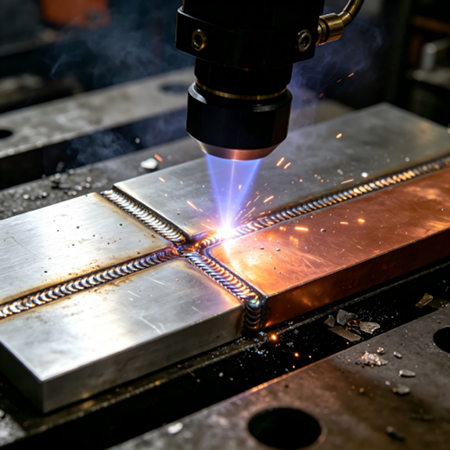
29
Sep’2026Dissimilar Metal Laser Welding: Challenges and Solutions for Stainless Steel, Aluminum, and Copper
Laser welding has become an essential joining technology in modern manufacturing, prized for its precision, speed, and ability to produce high-quality welds with minimal distortion. Among its most critical applications is the joining of dissimilar metals—a process that is technically demanding but strategically vital in industries ranging from electric vehicles and aerospace to medical devices and electronics.
The ability to join different metals allows engineers to combine the best properties of each: high-strength steel or stainless steel for load-bearing and corrosion resistance, aluminum for lightweighting, and copper for superior electrical and thermal conductivity. The growing demand for lightweight structures, cost-effective designs, and multifunctional components has made dissimilar metal joining a strategic priority. However, the process presents significant metallurgical and process challenges that must be carefully managed.
At Lingyufab, we have extensive experience in laser welding dissimilar metals for demanding applications across automotive, electronics, and renewable energy sectors. With over 20 years of precision manufacturing experience since 2003 and certification as a core supplier for Mitsubishi Electric, our advanced fiber laser welding systems are equipped with the latest beam-shaping and process-control technologies to overcome the unique challenges of joining dissimilar materials. This guide explains the key challenges and proven solutions for welding stainless steel, aluminum, and copper—the most common combinations in modern manufacturing.
Why Dissimilar Metal Laser Welding Is Challenging
When two different metals are welded together, several issues arise that are less severe when welding the same base metal:
Melting point and thermal conductivity mismatches — One metal may melt or soften significantly earlier, or conduct heat away more rapidly, making weld-pool control difficult. For example, aluminum has a much lower melting point than steel, requiring precise control to prevent burn-through while achieving adequate penetration.
Different coefficients of thermal expansion — On heating and cooling, metals expand and contract at different rates, creating stresses, distortion, or cracking at the joint. This is particularly problematic in assemblies with long weld seams where cumulative stress can be significant.
Formation of brittle intermetallic compounds (IMCs) — When metals such as aluminum and steel are joined, their molten pools mix and form brittle compounds at the interface. These intermetallic compounds have poor toughness and can significantly reduce joint strength. In laser welding of aluminum to steel, IMC layer thickness can be controlled to within 3–6.5 μm, which is critical for achieving joint strengths above 130 MPa. The formation of IMCs depends on heat input, which can be controlled through laser beam modulation.
Dilution and alloying effects — When molten pools mix, the metals may intermix chemically. Excessive dilution can lead to undesirable phases, hot cracking, or weakened joints.
High reflectivity — Copper and aluminum are highly reflective to laser light, making them difficult to weld with conventional laser systems. Older CO₂ lasers are particularly susceptible to back-reflection damage. Fiber lasers, with their shorter wavelength, absorb more efficiently into these reflective metals.
Why Laser Welding Is the Preferred Solution
Laser welding offers several distinct advantages that make it uniquely suited for dissimilar metal joining:
High power density and narrow heat source — The laser beam delivers concentrated energy in a focused spot, resulting in a narrow weld pool and rapid cooling. This reduces the size of the heat-affected zone and limits the volume of mixed molten material—and therefore the thickness of any brittle IMC layer.
Precise control of energy input — Laser power, beam size, and scanning patterns (oscillation, wobble) can be modulated to tailor heat input and mixing, minimizing undesirable phases. Research has shown that controlled heat input in the range of 80–110 J/mm can achieve joint strengths above 130 MPa.
Minimal dilution and small molten zones — Some laser processes allow joining via very shallow melt or partial fusion, lowering the dilution of one metal into the other and limiting inter-metal mixing.
Automation and repeatability — Laser welding is highly automatable, ensuring consistent weld quality across thousands of production units.
Laser Welding Stainless Steel to Aluminum
Joining stainless steel to aluminum is one of the most common and challenging dissimilar metal combinations. The primary challenge is the formation of brittle intermetallic compounds (IMCs), particularly Fe₂Al₅ and FeAl₂, which significantly reduce joint strength. Research has demonstrated that with optimized parameters, IMC layer thickness can be controlled, and joint strengths exceeding 130 MPa can be achieved.
The key to success is managing heat input — too much heat creates excessive IMCs; too little fails to achieve proper fusion. Advanced techniques such as beam shaping and wobble parameters allow precise control of heat distribution. The use of oscillating laser welding with optimized wobble amplitude, frequency, and patterns can suppress weld defects and reduce porosity.
Lingyufab's fiber laser systems, combined with our engineering expertise in parameter optimization, enable us to weld stainless steel to aluminum reliably for applications requiring lightweight structures with high structural integrity. We also offer pre-weld DFM review to identify potential issues and optimize joint design before production begins.
Laser Welding Copper to Steel
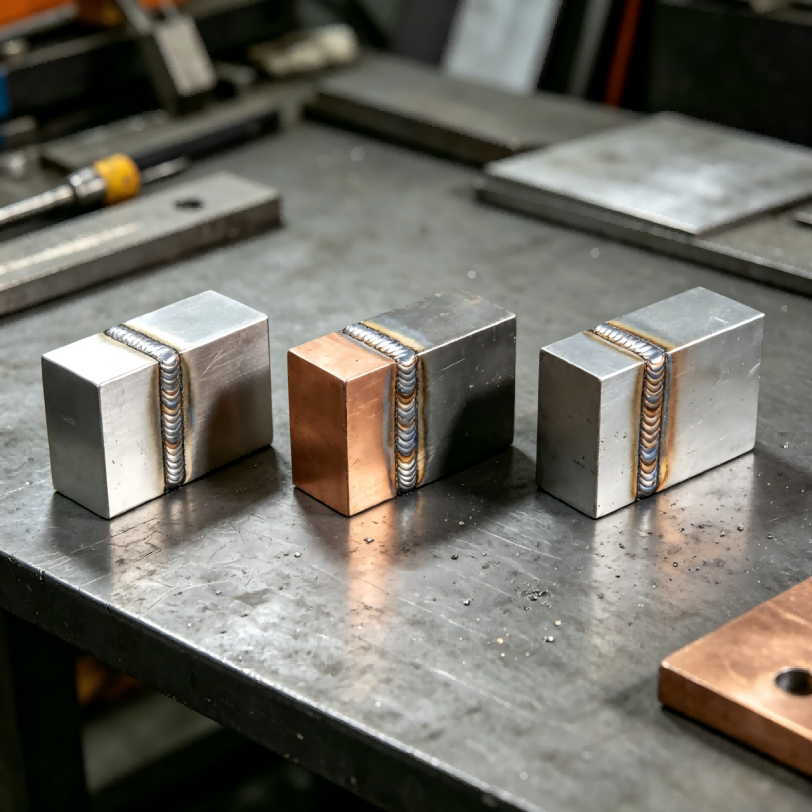
Copper-to-steel welding is increasingly important in battery manufacturing, power electronics, and electric vehicle applications where copper's superior electrical conductivity must be combined with steel's structural strength. In modern battery packs, thousands of individual copper-aluminum and copper-steel tab-to-terminal joints are required per vehicle, making reliable dissimilar metal welding essential for production efficiency. Replacing copper with aluminum tabs can reduce weight by up to 70% and cut costs by approximately 60%. However, welding copper to steel presents unique challenges: copper's high reflectivity and thermal conductivity require careful laser parameter selection. Advanced techniques such as nickel plating on the copper surface can improve weldability. Non-uniform laser sources can be used to meet the different heat requirements of the two materials. Applying rolling force during welding can improve bonding strength and suppress cracking. Copper interlayers can be used to join steel to aluminum, acting as a buffer layer to control IMC formation.
Lingyufab's fiber laser systems feature high peak-power optics that reliably overcome the initial optical reflectivity of copper surfaces. Our welding engineers select the appropriate laser power, focus position, and wobble parameters for each copper-to-steel application to ensure consistent, high-quality joints.
Laser Welding Aluminum to Copper
Aluminum-to-copper welding is critical for battery tab-to-busbar connections, power electronics, and electrical connectors where both lightweighting and high conductivity are required. This combination is particularly challenging because both metals are highly reflective, and the formation of Al-Cu intermetallic compounds can be severe. Laser welding with spiral or wobble contours can reduce the formation of brittle IMCs and improve mechanical strength. Copper interlayers can be used to inhibit the growth of brittle Fe-Al compounds. Pulsed laser welding modes with optimized peak power and frequency can control heat input and minimize the heat-affected zone. Proper joint design—lap joints are often preferred over butt joints for dissimilar metal welding.
Lingyufab's fiber laser systems offer precise control over power, pulse duration, and beam movement, enabling us to produce high-strength aluminum-to-copper joints with minimal IMC formation.
How Lingyufab Solves Dissimilar Metal Welding Challenges
Lingyufab is a professional sheet metal fabrication manufacturer and sheet metal supplier based in Shanghai, China, with over 20 years of precision manufacturing experience since 2003. We follow strict Japanese quality standards and are a certified core supplier for Mitsubishi Electric.
What sets Lingyufab apart as a sheet metal supplier is our systematic approach to dissimilar metal welding:
Process optimization — Our welding engineers select the right laser power, focus position, wobble parameters, and shielding gas for each material combination
Joint design review — We evaluate joint configuration (lap, butt, or fillet) and recommend the optimal design for your application
Parameter control — Our fiber laser systems offer precise control over power, pulse duration, and beam movement
Quality inspection — We perform non-destructive testing and visual inspection to verify weld quality
Material expertise — Our team understands the metallurgical behavior of dissimilar metal combinations
Our in-house capabilities include: Laser welding — High-speed, low-distortion welding with minimal heat input, capable of joining stainless steel, aluminum, copper, and other metals. Laser cutting — High-precision fiber laser cutting with optimized parameters for clean edges. CNC bending — Precision bending with consistent accuracy and springback compensation. Sheet metal fabrication — Complete assembly, surface treatment, and fastener installation. ISO 9001, ISO 14001, and TÜV CE certified. Full material traceability with Mill Test Certificates.
One supplier, full responsibility. From laser cutting and CNC bending to welding, surface treatment, and fastener installation, we handle everything under one roof. This integration ensures consistent quality, shorter lead times, and a single point of accountability for your entire project.
If you are considering dissimilar metal laser welding for your project, our engineering team is available to review your requirements and provide a free consultation. We'll help you identify the optimal approach for your material combination and application. If you are looking for a reliable sheet metal fabrication supplier, please don't hesitate to contact us.
Quick Dissimilar Metal Welding Checklist for Buyers
| What to Check | What to Consider |
|---|---|
| Material combination | Are the metals compatible? What are their melting points and thermal expansion rates? |
| Joint design | Lap, butt, or fillet? Which design minimizes stress and IMC formation? |
| Laser parameters | Has the supplier optimized power, speed, focus, and wobble for your materials? |
| Surface preparation | Are the surfaces clean and free of oxide layers? |
| Shielding gas | Is the correct gas being used for your material combination? |
| Quality inspection | Will the supplier perform NDT and visual inspection? |
FAQs
Q1: What is the biggest challenge in dissimilar metal laser welding?
The biggest challenge is the formation of brittle intermetallic compounds (IMCs) at the joint interface, particularly when welding aluminum to steel or aluminum to copper. These compounds significantly reduce joint strength and toughness. Controlling heat input through optimized laser parameters is the key to minimizing IMC formation.
Q2: Can stainless steel be laser welded to aluminum?
Yes. Laser welding can successfully join stainless steel to aluminum with optimized parameters. The key challenges are managing IMC formation and thermal mismatch. With proper parameter control—including wobble amplitude, frequency, and beam shaping—crack-free joints with minimal IMC layers (less than 10 μm) can be achieved.
Q3: What is the best joint design for dissimilar metal welding?
Lap joints and butt joints are the most frequently used in lightweight design. The optimal design depends on the material combination, thickness, and application requirements. Lingyufab's engineering team can recommend the best design for your specific project.
Q4: Why are fiber lasers better for welding copper and aluminum?
Fiber lasers have a shorter wavelength that is absorbed more efficiently by reflective metals like copper and aluminum. Older CO₂ lasers are susceptible to back-reflection damage when cutting or welding these materials. Fiber lasers also offer superior beam quality and energy efficiency.
Q5: What is the typical joint strength for laser-welded dissimilar metals?
Joint strength depends on the material combination, thickness, and process parameters. For aluminum-to-steel welding, joint strengths above 130 MPa have been achieved with IMC layer thickness controlled to 3–6.5 μm. The specific strength will vary based on your application requirements.
Q6: Can Lingyufab weld dissimilar metals for my application?
Yes. Lingyufab has extensive experience in dissimilar metal laser welding for automotive, electronics, and renewable energy applications. Our engineering team can review your requirements and recommend the optimal approach for your specific material combination.