
 +8613003178786
 sales@lingyufab.com
Evaluate Sheet Metal Fabrication Services by Process Handoffs
About the Author: Sarah Wang is the Quality Assurance Director at Lingyufab, with over 12 years of experience in manufacturing quality systems. As an ISO 9001 Lead Auditor, she is an expert in material traceability, tolerance analysis, and implementing the rigorous QC processes that ensure every component meets Japanese quality standards.
The Sourcing Risk Hiding Behind a Low Initial Quote
When evaluating sheet metal fabrication services, a low price on a quote can be misleading. That initial number often conceals the hidden costs and risks of a fragmented supply chain. If a potential partner subcontracts cutting to one shop, bending to another, and welding to a third, you are not working with a single fabricator. You are managing a chain of independent vendors, and every handoff between them introduces a point of failure for quality, lead time, and accountability.
The true cost emerges in project delays, inconsistent quality, and the communication overhead required to coordinate multiple suppliers. A dimensional error in the bending stage might only be discovered during final assembly, leading to disputes over which vendor is responsible for the rework. This is why understanding a supplier's control over their process handoffs is not just a technical detail—it's a critical factor in mitigating risk and ensuring your project stays on schedule and on budget. At Lingyufab, our integrated Global Custom Sheet Metal Fabrication Service is designed to eliminate these failure points entirely.
Why Fragmented Fabrication Workflows Increase Your Risk
From my perspective as a Quality Assurance Director, the most significant risks in sheet metal manufacturing arise when a part is physically moved from one vendor's facility to another's. Each transfer, or "handoff," is a potential break in the chain of custody and quality control. Here are the specific problems that a multi-subcontractor model creates:
Diluted Accountability: When an issue occurs, finger-pointing is common. The welder might blame the bender for an incorrect angle, who in turn blames the cutter for a dimensional inaccuracy. With no single owner of the end-to-end process, resolving these issues costs you time and money.
Compounded Lead Times: A vertically integrated manufacturer moves a part from the laser cutter to the press brake in minutes. A fragmented model adds days at each step for packaging, transportation, receiving, and queueing at the next supplier's facility. A project that should take two weeks can easily stretch to over a month.
Inconsistent Quality Standards: Your primary contact may be ISO 9001 certified, but are their subcontractors? Each vendor in the chain may have different equipment calibration schedules, inspection methods, and operator skill levels, leading to unpredictable variations in quality from batch to batch.
Broken Material Traceability: Maintaining full material traceability is difficult when raw materials pass through multiple unaffiliated shops. Mill Test Certificates (MTCs) can be misplaced, or worse, materials from different batches can be mixed. We provide full MTC traceability for every batch, a promise that becomes difficult to keep in a subcontracted workflow.
A Comparison Matrix: Evaluating Control at Each Process Handoff
To make an informed decision, you must analyze how a potential supplier manages the transitions between core manufacturing stages. A truly integrated partner maintains full control, while a fragmented model outsources it. Use this matrix to compare the two approaches when vetting sheet metal fabrication services.
| Fabrication Stage & Handoff | Single Integrated Supplier (e.g., Lingyufab) | Multi-Subcontractor Model |
|---|---|---|
| 1. Cutting to Bending | Process is managed under one roof. The same engineering team and quality system oversee both steps, ensuring cut parts meet precise specs for the press brake. Tolerance control is unified. | Handoff #1. Parts are shipped to a second vendor. Risk of transport damage, lost parts, and dimensional errors from the first vendor impacting the second. |
| 2. Bending to Welding | Leading Sheet Metal Bending Service Manufacturer expertise ensures formed parts fit perfectly in our in-house welding jigs. Immediate feedback loop if adjustments are needed. | Handoff #2. Formed parts are shipped to a third vendor. Delays and fit-up issues are common if the bending tolerances don't match the welding fixture requirements. |
| 3. Welding to Finishing | Seamless transition. Weld quality (spatter, undercuts) is controlled to meet the requirements for powder coating or painting, reducing surface preparation time and cost. | Handoff #3. Welded assemblies are shipped to a fourth vendor (a paint or powder coat shop). Poor weld quality can require costly rework by the finisher, leading to disputes. |
| 4. Finishing to Final Assembly | In-house assembly and fastener installation. We control finish thickness to ensure holes for fasteners are not obstructed and parts fit together correctly. Final QC check is comprehensive. | Handoff #4. Finished parts are shipped to a fifth vendor (or back to the primary contact) for assembly. Mismatched parts or finish defects are discovered late in the process. |
| Overall Cost & Lead Time | Overall costs are reduced by 15-20% by eliminating multiple markups and logistics fees. Lead times are predictable (typically 20-30 days for bulk) as there are no external transport delays. | Each subcontractor adds their own profit margin and shipping costs. Lead time is extended by days or weeks due to multiple transit and queue times. |
A Buyer's Checklist for Vetting Fabrication Partners
During your next RFQ process, go beyond the price and capabilities list. Use these questions to probe a supplier's operational model and determine if they are a truly integrated manufacturer or a coordinator of subcontractors.
Questions to Ask Potential Suppliers:
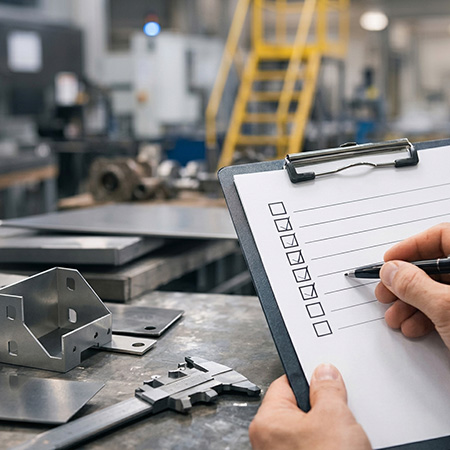
Process Ownership: "Which specific processes on my drawing—from cutting and bending to welding and finishing—do you perform in-house at your facility?" (An integrated partner will confirm they own the entire core fabrication workflow.)
Material Traceability: "Can you provide a single set of Mill Test Certificates (MTCs) that traces all raw materials used in my final assembly back to the source?" (This confirms a robust, unbroken chain of custody for materials.)
Tolerance Management: "How do you manage tolerance accumulation across multiple manufacturing steps to ensure the final assembly meets spec?" (A capable partner will discuss their quality control points and engineering oversight. We achieve tolerances as tight as ±0.05mm by controlling every step.)
Project Accountability: "Who is my single point of contact, and are they responsible for the project's quality and delivery from start to finish?" (This determines if you will have a dedicated project manager or be passed between departments or companies.)
Quality Assurance Process: "What is your procedure for addressing a non-conformance? If a defect is found, do you offer free replacement or repair?" (This clarifies their commitment to quality. At Lingyufab, we provide free replacement or repair for any issues arising from manufacturing defects.)
The answers to these questions will reveal the supplier's true operational structure. A partner who can confidently answer "yes" and provide clear details is likely to have the in-house control necessary to deliver consistent results.
The Tangible Benefits of In-House Vertical Integration
Choosing a supplier with complete in-house fabrication capabilities translates directly to measurable business advantages. By eliminating handoffs, you gain more than just peace of mind; you gain a competitive edge.
1. Significant Cost Reduction
Our vertical integration model eliminates the layers of markups from multiple subcontractors. There are no extra logistics fees for shipping parts between different facilities. This streamlined efficiency allows us to reduce overall project costs for our clients by an average of 15-20% compared to fragmented supply chains.
2. Faster and More Reliable Lead Times
With all processes under one roof, we control the production schedule completely. There is no waiting for an outside vendor to finish their queue. This enables us to offer rapid turnaround times, with samples typically delivered in 7-10 days and urgent orders possible in as little as 48 hours. This control is also key to our ability to support High-Mix, Low-Volume (HMLV) production for clients with diverse product portfolios.
3. Uncompromising and Consistent Quality
As a Mitsubishi Electric certified core supplier, we operate under a single, unified quality management system compliant with ISO 9001:2015. This system governs every process, from raw material intake to final 100% dimensional and visual inspection. Adhering to strict Japanese quality standards across the entire production line ensures that all Sheet Metal Assemblies we produce are consistent, reliable, and precisely manufactured to your drawings.
To ensure quality and reduce costs on your next project, submit your technical drawings for an integrated fabrication quote.