+8613003178786
  sales@lingyufab.com



Laser Cutting Parameters: A Practical Guide to Optimizing Power, Speed, Focus, and Gas
08
Oct’2026Laser Cutting Parameters: A Practical Guide to Optimizing Power, Speed, Focus, and Gas
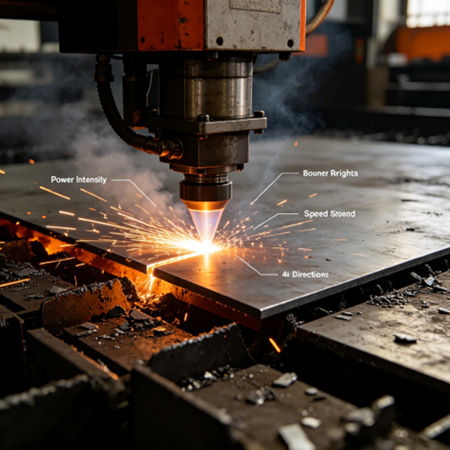
Laser cutting delivers exceptional precision and speed, but achieving consistently high-quality cuts depends on one critical factor: parameter optimization. The quality of a laser-cut edge depends on a combination of correctly set parameters—power, frequency, duty cycle, feed rate, assist gas, laser beam alignment, and focus adjustment. Even on a high-performance machine, poor parameter settings can lead to burrs, excessive slag, unstable piercing, or inconsistent edge quality. Have you ever received a batch of laser-cut parts where the edges were rough, the holes were tapered, or the surfaces were covered in dross? These issues often trace back to one thing: suboptimal cutting parameters.
At Lingyufab, we understand that precision cutting starts with the right parameters. With over 20 years of precision manufacturing experience since 2003 and certification as a core supplier for Mitsubishi Electric, our advanced fiber laser cutting systems deliver consistent quality across a wide range of materials and thicknesses. This guide explains the key parameters that affect laser cutting quality and provides practical strategies for optimization.
The Core Parameters of Laser Cutting
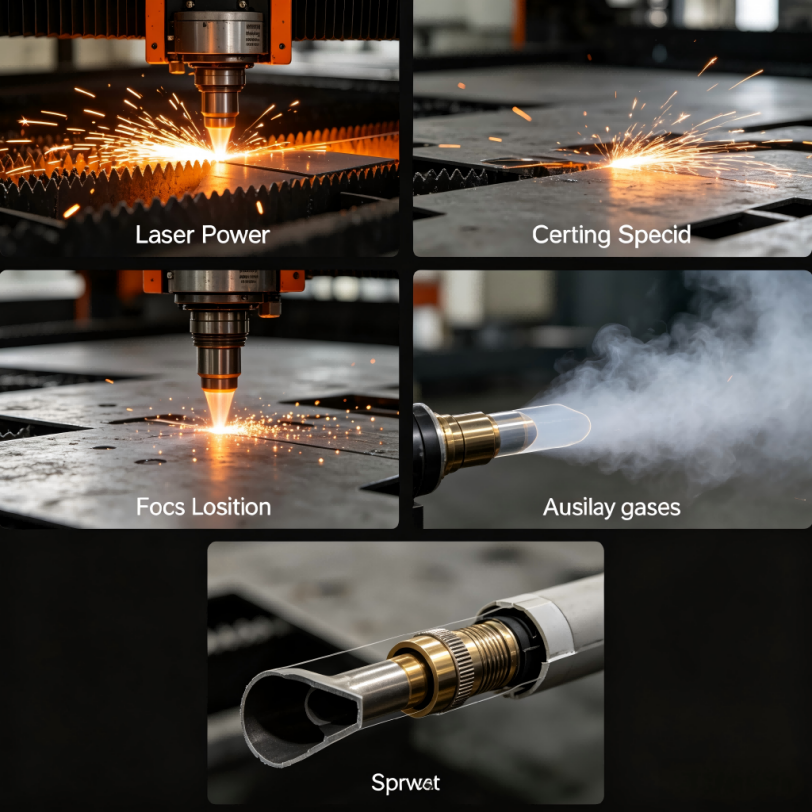
Laser cutting quality is influenced by several interdependent parameters: laser power, cutting speed, focus position, assist gas type and pressure, and nozzle selection. Understanding how these parameters interact is the first step to achieving optimal results.
Laser Power
Laser power determines the energy available for cutting. Higher power enables faster cutting speeds and the ability to cut thicker materials. However, more power is not always better—excessive power can cause burning, charring, or rough edges.
The general rule: Power must be matched to material type, thickness, and desired cut quality. For highly reflective materials like aluminum, more power is needed because more energy is reflected away. For materials with high thermal conductivity, higher power is also required to maintain cutting temperatures. As a typical reference, cutting 6mm mild steel with a 3kW fiber laser often uses full power.
Cutting Speed
Cutting speed directly affects edge quality and productivity. Studies show that the relationship between cutting speed and surface roughness follows a U-shaped curve—there is an optimal speed where the cut surface is smoothest. For a given power, the maximum cutting speed decreases as material thickness increases.
Too fast — The laser doesn't have enough time to penetrate the material, resulting in incomplete cuts, rough edges, or burning. A key indicator of excessive speed is the presence of curved drag lines on the cut surface. For oxygen-assisted carbon steel cutting, bent drag marks suggest the cutting speed is too high. Cutting speed is inversely proportional to material density and thickness.
Too slow — Excessive heat input causes melting, dross formation, and a wider heat-affected zone, degrading edge quality. Spherical dross on the bottom edge indicates insufficient cutting speed or low oxygen purity.
Focus Position
The focus position determines where the laser beam reaches its smallest spot size, directly affecting the energy density at the material surface. Even small changes in focus position can significantly affect cut quality.
Positive focus (above surface) — The beam is concentrated above the material. This produces a wider top kerf and narrower bottom kerf, with a rough lower edge. Not recommended for carbon steel cutting.
Zero focus (on surface) — The beam waist is exactly on the material surface. This produces a straight cut with a smooth edge and is best for thin sheet metal (under 5mm).
Negative focus (below surface) — The beam waist is below the material surface. This produces a slightly wider kerf with uniform thickness and is recommended for carbon steel thicker than 3mm. For 6mm carbon steel, a negative focus in the range of -1.5mm is a typical starting point.
General focus guidelines: For thin sheets (3mm or less), a zero or slightly negative focus is recommended. For medium thickness (3–8mm), a negative focus of -0.5 to -2.0mm is typical. For thick plates (over 8mm), a strong negative focus of -2.0 to -4.0mm is needed.
Test method: Cut a series of lines at different focus offsets and select the one with the narrowest kerf and cleanest bottom edge.
Assist Gas
Assist gas serves two critical roles: removing molten material from the cut and shielding the cutting zone from unwanted reactions. The choice of gas affects cut quality, speed, and post-processing requirements.
Nitrogen — The most widely used laser cutting assist gas, especially for fiber laser applications. Nitrogen creates an inert atmosphere that prevents oxidation, producing bright, oxide-free edges. It is preferred for stainless steel, aluminum, non-ferrous metals, and high-quality visible components. Nitrogen purity typically needs to be 99.9% or higher. For 2mm stainless steel, typical parameter ranges include power around 2kW, speed around 4.0 m/min, and nitrogen pressure around 15 bar.
Oxygen — Oxygen triggers an exothermic reaction that adds heat to the cutting process, enabling faster cutting speeds on thicker materials. It is suitable for cutting carbon steel, where the Fe-O₂ reaction provides most of the energy. However, oxygen oxidizes the cut edge, leaving a dark oxide layer that may require additional post-processing. For cutting 6mm mild steel, typical parameter ranges include negative focus around -1.5mm, speed around 2.2 m/min, pressure around 10 bar, and oxygen purity of 99.5% or higher.
Compressed air — A faster, more cost-effective option for less demanding applications where edge appearance is not critical. However, because air contains approximately 21% oxygen, it cannot deliver the same edge quality as nitrogen. Suitable for parts that will be painted or welded, and cost-sensitive production environments.
Nozzle Selection and Alignment
The nozzle directs the assist gas and protects the lens. Nozzle diameter should be matched to material thickness.
| Material Thickness | Recommended Nozzle Diameter | Gas Pressure |
|---|---|---|
| 1–2 mm | 1.0–1.2 mm | 5–7 bar |
| 3–4 mm | 1.2–1.5 mm | 7–9 bar |
| 5–6 mm | 1.5–1.8 mm | 9–11 bar |
| 8–10 mm | 2.0–2.5 mm | 11–14 bar |
| 12–16 mm | 2.5–3.0 mm | 14–16 bar |
Note: Values above are general recommendations. Specific requirements may vary depending on equipment, material, and quality standards.
Nozzle alignment is critical — If the nozzle is not centered with the beam, the gas flow becomes uneven, causing slag on one side of the cut but not the other. The effect is minimal for thin sheets under 3mm but significant for thicker materials.
A Systematic Approach to Parameter Optimization
A structured tuning process helps ensure consistency and minimize trial-and-error:
Start with baseline parameters — Use established internal values or machine-provided databases as your initial configuration.
Perform a short test cut — Observe piercing stability, spark direction, molten metal removal, and kerf width. A 3–5 second cut can reveal whether adjustments are required.
Evaluate cut quality — Check for burrs, slag, discoloration, rough surfaces, and incomplete penetration.
Adjust one parameter at a time — Small, isolated changes help identify the true cause of quality improvements.
Re-test and fine-tune — High-power machines react strongly to minor changes in focus, speed, or gas pressure. Iterate until results stabilize.
Save the final settings — Store optimized parameters by material and thickness to improve future consistency.
How Lingyufab Delivers Precision Laser Cutting
Lingyufab is a professional sheet metal fabrication manufacturer and sheet metal supplier based in Shanghai, China, with over 20 years of precision manufacturing experience since 2003. We follow strict Japanese quality standards and are a certified core supplier for Mitsubishi Electric.
What sets Lingyufab apart as a sheet metal supplier is our systematic approach to parameter optimization. Our advanced fiber laser cutting systems feature automated parameter control, dynamic beam adjustment to counter material micro-variance, and AI-assisted nesting for maximum material utilization. Our engineering team reviews your drawings before production, identifying potential issues and optimizing parameters for your specific material and thickness.
Our in-house capabilities include:
Laser cutting — High-precision fiber laser cutting with optimized parameters for clean edges and minimal burrs.
CNC bending — Precision bending with consistent accuracy and springback compensation.
Laser welding — High-speed, low-distortion welding with minimal heat input.
Sheet metal fabrication — Complete assembly, surface treatment, and fastener installation.
ISO 9001, ISO 14001, and TÜV CE certified.
Full material traceability with Mill Test Certificates.
One supplier, full responsibility. From laser cutting and CNC bending to welding, surface treatment, and fastener installation, we handle everything under one roof. This integration ensures consistent quality, shorter lead times, and a single point of accountability for your entire project.
If you are unsure which laser parameters are right for your project, our engineering team is available to review your requirements and provide a free consultation. If you are looking for a reliable sheet metal fabrication supplier, please don't hesitate to contact us.
Quick Parameter Optimization Checklist for Buyers
| What to Check | What to Look For |
|---|---|
| Burrs or dross | Rough edges or resolidified metal—indicates incorrect power or speed |
| Edge roughness | Serrated or jagged edges—indicates incorrect speed or focus |
| Heat-affected zone | Discoloration or oxidation along the cut edge—indicates incorrect gas or focus |
| Hole quality | Tapered, oversized, or oval holes—indicates incorrect focus or speed |
| Dimensional accuracy | Overall dimensions match drawing within specified tolerance |
| Cut surface | Vertical, fine striations with no slag—indicates optimal parameters |
FAQs
Q1: What is the most important parameter in laser cutting?
All parameters are interdependent, but focus position is often the most critical because it determines energy density at the material surface. An incorrect focus can cause rough edges, tapered holes, and excessive dross, regardless of power or speed settings.
Q2: How do I know if my cutting speed is too fast?
Curved drag lines on the cut surface indicate the cutting speed is too high. For oxygen-assisted carbon steel cutting, bent drag marks are a clear sign. The cut edge will also appear rough and may have incomplete penetration.
Q3: What causes burrs in laser cutting?
Burrs are typically caused by incorrect cutting parameters—improper laser power, incorrect cutting speed, or incorrect focus position. Worn consumables and poor material quality can also contribute.
Q4: Why is nitrogen preferred for cutting stainless steel?
Nitrogen creates an inert atmosphere that prevents oxidation, producing bright, oxide-free edges. This is essential for stainless steel because oxidized edges can compromise corrosion resistance and require additional post-processing.
Q5: What is the difference between oxygen and nitrogen cutting?
Oxygen triggers an exothermic reaction that adds heat to the cutting process, enabling faster speeds on thicker carbon steel but leaving an oxidized edge. Nitrogen is inert—it removes molten material purely through the gas stream, producing cleaner, oxidation-free edges but at slower speeds.
Q6: Can Lingyufab help me optimize parameters for my specific material?
Yes. Lingyufab's engineering team can review your requirements and recommend the optimal parameters based on your material type, thickness, and quality requirements. We also provide free DFM reviews to catch potential issues before production begins.