+8613003178786
  sales@lingyufab.com



The Complete Guide to Sheet Metal Bending: Tooling, Springback, and Precision Control
30
Jul’2026The Complete Guide to Sheet Metal Bending: Tooling, Springback, and Precision Control
Have you ever received a batch of sheet metal parts where the bends were off by a few degrees, the flanges didn't align, or the part simply wouldn't fit into its assembly? Or perhaps you have designed a part that looked perfect in CAD, only to find that the actual bent part was warped, cracked, or dimensionally incorrect? These are among the most common and costly frustrations faced by design engineers, procurement professionals, and quality managers. Unlike laser cutting, where quality issues are often visible on the cut edge, bending quality issues tend to be dimensional. A bend that is off by just one degree can render an entire assembly unusable.
At Lingyufab, we understand that bending is one of the most critical steps in sheet metal fabrication. With over 20 years of precision manufacturing experience since 2003 and certification as a core supplier for Mitsubishi Electric, we have developed the expertise and equipment to deliver consistent, high-quality CNC bending for a wide range of materials and part geometries. This guide explains what sheet metal bending is, how it works, the key factors that affect bend quality, and what to look for when choosing a bending partner.
What Is Sheet Metal Bending?
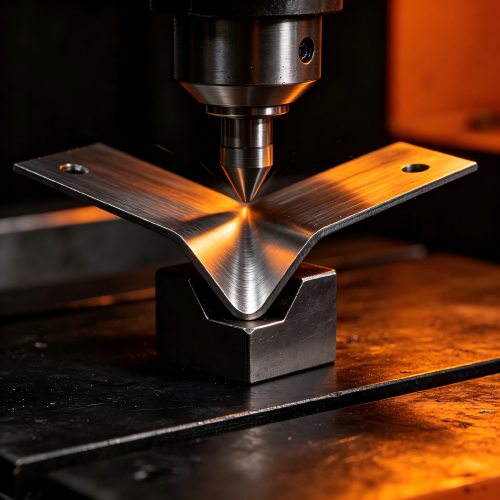
Sheet metal bending is a cold-forming manufacturing process used to deform flat sheet metal into specific angles, curves, or complex shapes without cutting or welding. The process involves placing a flat metal blank between a punch and a die, then applying force to bend the material beyond its yield strength, causing permanent plastic deformation. In modern fabrication, this is typically done on CNC press brakes, computer-controlled machines that can achieve precise, repeatable bends across thousands of parts.
For OEM buyers and engineers, CNC bending is much more than a forming method. It directly affects part accuracy, production efficiency, consistency across batches, assembly fit, and overall fabrication cost. The right bending setup helps buyers move from flat patterns to finished formed parts with minimal rework.
How Does Sheet Metal Bending Work?
The CNC bending process involves several key stages, from design to finished part. Understanding this workflow helps buyers and engineers make informed decisions about their projects.
Design and Unfolding
The process begins with the product design. Engineers create 3D models and unfold the part into a flat pattern, accounting for bend allowances and springback. Proper unfolding ensures that the final bent part matches the design dimensions. Key concepts include the neutral axis, the theoretical line within the material that neither stretches nor compresses during bending, and the k-factor, which represents the ratio of the neutral axis position to material thickness.
Tooling Selection
Selecting the right punch and die tooling is critical for achieving accurate bends. The punch is the upper tool that presses the sheet into the die. The die is the lower tool with a V-shaped opening that supports the material during forming. The choice depends on material thickness, bend angle, bend radius, and the specific bending method used. A common rule of thumb for air bending steel is to select a V-opening of 6 to 8 times the material thickness.
Bending Method
There are three primary bending methods, each with different characteristics.
Air bending is the most flexible method. The punch presses the material into the die, but the material does not fully contact the bottom of the die. It has the smallest contact area with the tooling and relies more on springback compensation. It requires less tonnage but is less precise.
Bottom bending drives the punch into the die until the metal matches the tooling angle. It produces repeatable bends because it minimizes springback, but it demands three to five times the tonnage of air bending.
Coining applies even more force to plastically deform the material completely, eliminating springback entirely. It requires the highest tonnage but delivers the most precise results.
Springback Compensation
Springback is one of the most persistent challenges in sheet metal bending. When the bending force is released, the material naturally tries to return to its original shape due to its elastic properties. The three bending methods differ significantly in how they handle this challenge. Air bending experiences the most springback because the material is only partially deformed. Bottom bending minimizes springback by forcing the material to conform to the die angle. Coining effectively eliminates springback through extreme plastic deformation. The higher the material strength and the larger the bend radius, the greater the springback effect. According to industry analysis, bending 304 stainless steel typically produces 2 to 3 degrees of springback.
To compensate for springback, manufacturers use several techniques.
Overbending means intentionally bending the part past the target angle so it springs back to the correct position.
Tool angle compensation means using tooling with slightly sharper angles to account for springback.
Heat-assisted bending means heating the bend zone to lower the material's elastic modulus and reduces springback dramatically. The recommended temperature ranges are 200-300°C for steel and 150-250°C for aluminum.
Programming means the bending program is created using CNC software. The programmer defines the bend sequence, tooling positions, backgauge settings, and ram depth for each bend. Proper programming minimizes tool changes, optimizes material handling, and ensures efficient production.
Bending Operation means the operator loads the flat sheet onto the press brake table. The CNC-controlled backgauge positions the sheet accurately for each bend. The ram descends, pressing the punch into the sheet and forcing it into the die to create the bend.
Quality Inspection means after bending, parts are inspected to verify bend angles, flange lengths, and overall dimensions. Critical dimensions are measured to ensure they fall within specified tolerances.
Key Factors That Affect Bend Quality
Several factors influence the quality of a bent part. Understanding these helps buyers communicate effectively with their fabricator.
Material Type and Properties Different materials behave differently during bending. Stainless steel, aluminum, and carbon steel each have unique springback characteristics, yield strengths, and formability limits. Material thickness varies, and a setup tuned for thinner stock leaves no room for extra material. Material grain direction also matters. Bending perpendicular to the grain is safer, as the fibers stretch more uniformly.
Bend Radius The bend radius determines how tightly the material can be bent without cracking. A tight radius concentrates stress, increasing the risk of fracture. The minimum bend radius depends on material type, thickness, and temper. A commonly used guideline is to match the inside bend radius to the material thickness for general applications.
Tooling Condition Press brake dies represent a substantial capital investment, and mismatched or worn tooling is the fastest way to compromise quality. Worn tools produce inconsistent bends, increased burrs, and higher rejection rates. Regular tool maintenance and proper selection are essential for consistent quality.
Bend Sequence The order in which bends are made dramatically affects the final part quality. A well-optimized sequence limits the number of part flips, rotations, or tool changes. The general best practice is to bend the shortest flanges first, followed by the longer ones, ensuring sufficient clearance for finishing the remaining bends.
Common Bending Defects and How to Prevent Them
Angle Deviation The bend does not match the drawing angle. Caused by incorrect springback compensation, improper tooling, or inconsistent material properties. Prevention methods include proper springback compensation, verification of tooling selection, and trial bends to adjust parameters.
Cracking at the Bend Cracks appear on the outside of the bend when the tensile stress exceeds the material's elongation limit. Caused by a bend radius that is too tight for the material thickness, bending against the grain direction, or using low-ductility materials. Prevention methods include adopting larger bend radii, bending perpendicular to grain direction, and selecting ductile materials.
Surface Marks and Tooling Marks Visible marks or indentations along the bend. Caused by worn tooling, incorrect tooling selection, or insufficient lubrication. Prevention methods include regular tool maintenance, proper tool selection, and reasonable lubrication.
Warping and Twisting Parts bow or twist due to uneven stress distribution. Caused by incorrect bend sequence, insufficient machine calibration, or excessive heat input. Prevention methods include optimized bend sequences, proper fixturing, and stable process parameters.
When Bending Quality Matters Most
Bending quality is critical across a wide range of applications.
Electronics and Electrical Equipment Enclosures and cabinets require precise bends for proper assembly, door alignment, and equipment mounting. Any deviation can affect sealing or component fit.
Medical Devices Medical equipment demands precise bends and clean, sanitary surfaces. Stainless steel components require careful bending to maintain corrosion resistance and cleanability.
Automotive and Electric Vehicles Modern vehicles contain numerous bent components including brackets, chassis reinforcements, battery enclosures. Consistency and repeatability are essential for automotive applications.
Industrial Equipment Machine guards, equipment frames, and structural brackets rely on precise bending for proper fit and reliable performance.

Lingyufab: Your Trusted Sheet Metal Supplier for Precision Bending
Lingyufab is a professional sheet metal fabrication manufacturer and supplier based in Shanghai, China, with over 20 years of precision manufacturing experience since 2003. We follow strict Japanese quality standards and are a certified core supplier for Mitsubishi Electric.
As a leading sheet metal supplier, Lingyufab offers comprehensive in-house bending capabilities.
CNC bending — Precision bending with consistent accuracy across all parts and batches, with springback compensation programmed for each material and thickness Laser cutting — High-precision cutting for accurate flat patterns, clean edges, and minimal material waste Welding — TIG welding for stainless steel, MIG welding for general fabrication, and spot welding for thin sheet connections Assembly — Complete assembly of fabricated components into finished products and sub-assemblies Surface treatment — In-house powder coating, anodizing, electroplating, and polishing Fastener installation — Direct installation of our own manufactured SEMS fasteners, bolts, nuts, and self-clinching fasteners
Our bending quality commitment.
Precision equipment — We use modern CNC bending centers integrated with our laser cutting processes to achieve one-step forming for complex parts. Our equipment is regularly calibrated to maintain consistent bend angles and dimensions.
Experienced operators — Our team has decades of combined experience in CNC bending. They understand how different materials respond to bending, how to compensate for springback, and how to optimize bend sequences to minimize distortion.
Comprehensive tooling inventory — We maintain a wide range of tooling to accommodate different material thicknesses, bend radii, and part geometries.
Rigorous quality inspection — Every bending project undergoes inspection at multiple stages, including first-article inspection, in-process checks, and final dimensional verification. We measure bend angles, flange lengths, and overall dimensions to ensure every part meets your specifications.
Material traceability — Every batch of raw materials comes with a Mill Test Certificate (MTC), ensuring full traceability and compliance with your material requirements.
One supplier, full responsibility. From laser cutting and CNC bending to welding, surface treatment, and fastener installation, we handle everything under one roof. This integration ensures consistent quality, shorter lead times, and a single point of accountability for your entire project. We operate under ISO 9001, ISO 14001, and TÜV CE certifications, with quality control covering the complete manufacturing process from raw material inspection to finished product inspection.
If you are unsure about your bending requirements or want to ensure your parts are designed for manufacturability, our engineering team is available to review your drawings and provide a free consultation. If you are looking for a reliable sheet metal fabrication supplier, please do not hesitate to contact us.
Quick Bending Quality Checklist for Buyers
Before approving bent parts, review this checklist. Note: All tolerance values listed are general reference values. Specific requirements should be confirmed against your drawing and agreed with your supplier.
| What to Check | What to Look For |
|---|---|
| Bend angle accuracy | Angles match drawing within ±0.5° or as specified on drawing |
| Flange length consistency | All flanges of same length match within tolerance |
| Bend radius | Consistent radius across all bends |
| Surface quality | No cracks, excessive tooling marks, or scratches |
| Flatness | Part sits flat with no visible warp or twist |
| Hole position | Holes near bends are not distorted or shifted |
| Part-to-part consistency | All parts in batch are dimensionally identical |
Conclusion
Sheet metal bending is a critical process that transforms flat sheets into functional three-dimensional components. By understanding the key factors that affect bend quality including material properties, tooling selection, springback compensation, bend sequence, and process control, you can make informed decisions that ensure your parts fit, function, and perform as intended.
Working with an experienced partner like Lingyufab who combines precision equipment, skilled operators, comprehensive tooling, rigorous quality control, and integrated fabrication services helps you avoid costly mistakes and get parts that meet your specifications every time.
FAQs
Q1: What is the difference between air bending, bottom bending, and coining?
Air bending is the most flexible method with the smallest tool contact area. It requires less tonnage but relies more on springback compensation. Bottom bending minimizes springback but requires three to five times the tonnage. Coining applies the highest force to eliminate springback entirely and delivers the most precise results. Your choice depends on the required precision, material type, and available press capacity.
Q2: What causes springback in sheet metal bending?
Springback occurs when metal returns slightly toward its original shape after bending due to its elastic properties. The higher the material strength and the larger the bend radius, the greater the springback effect. For example, bending 304 stainless steel typically produces 2 to 3 degrees of springback. Manufacturers compensate for this through overbending, tool angle compensation, or heat-assisted bending.
Q3: What is the typical tolerance for CNC bending?
Typical CNC bending tolerances are ±0.5° for bend angles and ±0.15mm for flange lengths. Tighter tolerances are possible but may increase cost. Always specify tolerances on your drawing and discuss with your supplier.
Q4: How can I prevent cracking at the bend?
Use a larger bend radius. A tight radius concentrates stress. Bend perpendicular to the grain direction whenever possible. Switch to a more ductile alloy if your current material cannot handle the pressure. A commonly used guideline is to match the inside bend radius to the material thickness.
Q5: What materials can Lingyufab CNC bend?
Lingyufab CNC bends stainless steel, aluminum, carbon steel, and galvanized steel. We adjust tooling, bend radius, and forming parameters based on material type and thickness to ensure quality.
Q6: What file formats do you accept for bending quotes?
We accept 3D files in STEP (.stp), IGS (.igs), and SolidWorks (.sldprt) formats for material weight calculation and bend unfolding. We accept 2D drawings in PDF, DWG, and DXF formats for tolerances, surface finishes, and thread specifications. If you do not have drawings, we offer reverse engineering services from physical samples。