+8613003178786
  sales@lingyufab.com



The Critical Role of Precision Sheet Metal in Server and Networking Chassis Manufacturing
01
Sep’2026The Critical Role of Precision Sheet Metal in Server and Networking Chassis Manufacturing
What Is Precision Sheet Metal in Server and Networking Chassis?
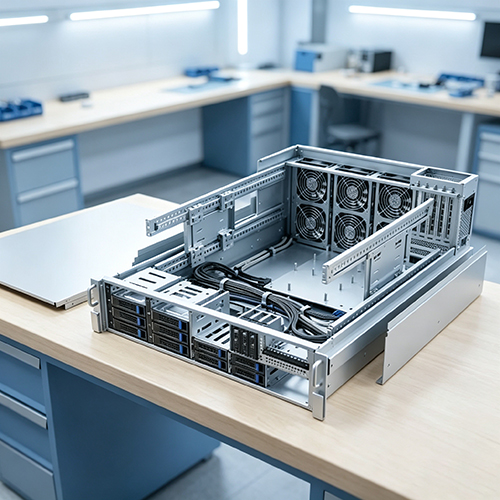
A server or networking chassis is the physical enclosure that houses compute components, power supplies, networking modules, and cooling systems in data center equipment. These chassis are typically manufactured from sheet metal—cold-rolled steel, galvanized steel, stainless steel, or aluminum alloys—formed through processes like laser cutting, CNC bending, and welding.
The term "precision" matters here because server and networking chassis must conform to strict industry standards. The most common standard is the EIA 19-inch rack specification, which defines chassis heights in rack units (1U = 1.75 inches or 44.45mm). A 1U chassis must fit within this vertical space while accommodating all internal components, meaning every bend, hole, and fastener location must be accurate to within fractions of a millimeter.
Lingyufab manufactures these precision chassis as part of our comprehensive sheet metal fabrication services, delivering custom solutions for server, storage, and networking equipment that meet the rigorous demands of modern data centers.
Why Precision Sheet Metal Matters for Server and Networking Chassis
Precision in sheet metal fabrication directly impacts three critical areas: component fit, thermal performance, and electromagnetic compatibility.
Component Fit and Assembly – Server chassis must accommodate printed circuit boards, power supplies, hard drives, and I/O panels with exacting clearances. A misaligned standoff by 0.1mm can cause a PCB to sit at an angle, leading to cracked solder joints or failed electrical connections. Precision CNC bending, with tolerances held to ±0.005 inches, ensures that every hole and hardware insert aligns perfectly.
Thermal Performance – Data center equipment generates significant heat. Chassis designs incorporate ventilation patterns, fan mounting points, and airflow baffles to direct cooling air across components. Poorly aligned fan trays or imprecise vent cutouts can create air recirculation zones, reducing cooling efficiency and shortening component life. Precision laser cutting enables complex louver and perforation patterns that maximize airflow while maintaining structural integrity.
EMI Shielding – Networking equipment operates at high frequencies and must meet FCC and CE emissions standards. Sheet metal chassis provide the primary barrier against electromagnetic interference (EMI). Gaps between panels, poorly fitted seams, or inconsistent material thickness can allow EMI leakage. Precision fabrication ensures tight seams and proper overlaps, while features like EMI gaskets and conductive finishes are applied with consistent quality.
Design Considerations for Precision Sheet Metal Chassis
Designing a server or networking chassis requires balancing multiple, often competing, requirements.
Form Factor Compliance – Chassis must conform to standard rack dimensions. A 19-inch rack chassis has a nominal width of 482.6mm, but the actual mounting hole spacing (EIA standard) specifies centers at 465mm. The chassis ears and mounting holes must be positioned exactly to these specifications.
Accessibility and Serviceability – Field service technicians need to access internal components quickly. Designs often incorporate tool-less latches, captive screws, and modular panels that can be removed without special tools. The choice between top-removable lids, front-accessible bays, or slide-out chassis trays affects the fabrication complexity and the hardware required.
Internal Layout and Cable Management – Component placement within the chassis affects airflow, cable routing, and service access. Sheet metal chassis can be formed with internal features like cable management channels, mounting bosses for PCBs, and structural ribs that add rigidity without adding weight.
Material Selection for Server and Networking Chassis
The choice of material affects cost, weight, thermal performance, and corrosion resistance. Common materials for server and networking chassis include:
| Material | Key Properties | Typical Applications |
|---|---|---|
| Cold-rolled steel (SPCC) | High strength, cost-effective | Standard server chassis, internal brackets |
| Galvanized steel (SGCC) | Corrosion-resistant, good grounding | Control boxes, power distribution units |
| Stainless steel (304, 316L) | Excellent corrosion resistance, non-magnetic | Harsh environments, outdoor enclosures |
| Aluminum (5052-H32, 6061-T6) | Lightweight, good thermal conductivity | High-density chassis, heat sinks |
Aluminum is increasingly popular for high-density compute applications where weight and thermal management are critical. However, steel remains the dominant material for standard rack-mount chassis due to its strength, cost-effectiveness, and excellent EMI shielding properties.
Manufacturing Processes for Precision Sheet Metal Chassis
The production of server and networking chassis typically follows this sequence:
Laser Cutting – High-power fiber lasers cut the sheet metal blanks with precision. Modern laser cutting can achieve tolerances of ±0.03mm, producing clean edges that minimize deburring. Advanced lasers can cut reflective materials like aluminum without back-reflection damage.
CNC Bending – CNC press brakes form the flat blanks into three-dimensional shapes. Multi-axis back gauges ensure consistent bend angles and positions. Typical bend tolerances are held to ±0.005 inches, with critical features like I/O panel cutouts maintained to even tighter limits.
Hardware Insertion and Fastener Installation – After forming, fasteners like PEM studs, standoffs, and rivet nuts are installed. Automated CNC insertion presses apply calibrated force, ensuring hardware seats correctly without distorting the surrounding sheet metal. Lingyufab specializes in custom stud-welded sub-assemblies and custom self-clinching integrated components, delivering ready-to-use chassis with fasteners pre-installed.
Welding and Assembly – For complex chassis designs, components are joined using robotic MIG/TIG welding or spot welding. Weld quality is critical for structural integrity and EMI shielding continuity.
Surface Finishing – Powder coating provides corrosion resistance and a durable finish. For aluminum chassis, anodizing offers both protection and aesthetic options. Some applications require conductive finishes for EMI grounding.
Thermal Management and Ventilation in Sheet Metal Chassis
Thermal management is arguably the most critical performance factor in server and networking chassis design. As compute density increases, so does the heat generated per rack unit.
Ventilation Design – Sheet metal chassis incorporate ventilation features at the design stage. Common approaches include:
Louvered panels that allow airflow while maintaining EMI shielding
Perforated sections with precisely sized holes (typically 4-6mm diameter)
Cutouts for fan trays and power supply ventilation
Airflow baffles that direct cooling air to specific components
Fan Mounting – Fan trays must be mounted securely with minimal vibration transfer. Sheet metal designs often feature PEM nuts or captive fasteners that allow tool-less fan replacement. Fan cutouts must align with the airflow path to avoid turbulence and recirculation.
Heat Sink Integration – In high-performance designs, sheet metal heat sinks are formed from aluminum or copper. Features like fins, pins, and channels are created through CNC machining or stamping, with flat contact surfaces ensuring good thermal transfer to active components.
EMI Shielding and Grounding in Networking Chassis
Networking equipment operates in crowded electromagnetic environments. Chassis designs must provide effective EMI shielding while also ensuring proper electrical grounding.
Seam and Joint Design – EMI leakage occurs through gaps in the chassis enclosure. Precision fabrication ensures tight seams between panels, and designs often incorporate overlapping joints that create continuous conductive paths. The use of precision electrical-control-box assembly techniques ensures that seams and joints maintain EMI integrity throughout the product life.
Gaskets and Conductive Interfaces – EMI gaskets (often conductive elastomers or metal finger stock) are installed at panel interfaces to fill gaps. The chassis design must include precise grooves or channels for gasket retention. CNC machining holds these features to tight tolerances so gaskets compress consistently.
Grounding Paths – Chassis grounding is critical for safety and EMI performance. Paint and powder coating are insulating, so grounding points must be masked or installed with special hardware. Threaded inserts, studs, and grounding tabs are often added to create reliable ground paths from PCBs to the chassis frame.
Quality Control for Precision Sheet Metal Components
Server and networking chassis require thorough quality control to ensure fit, function, and reliability.
Dimensional Inspection – Coordinate Measuring Machines (CMM) verify critical dimensions, hole locations, and bend angles. Automated Optical Inspection (AOI) systems check for surface defects, burrs, and hardware placement accuracy.
Material Traceability – Every batch of material is supplied with a Mill Test Certificate (MTC) confirming grade, thickness, and mechanical properties. Lingyufab supports third-party laboratory analysis for additional verification.
First Article Inspection (FAI) – For new designs, a complete First Article Inspection report documents all dimensions, materials, and finishes. This ensures the production process matches the engineering specification before full-scale manufacturing begins.
Process Control – Statistical Process Control (SPC) monitors manufacturing variations, allowing early detection of trends that could lead to out-of-tolerance conditions. This reduces scrap and ensures consistent quality.
Common Applications for Server and Networking Chassis
1U, 2U, and 4U Server Chassis – Standard rack-mount servers are the most common application. Chassis must provide precise mounting for motherboards, power supplies, storage drives, and I/O panels within the height constraint.
Network Switches and Routers – These chassis often incorporate mid-plane or backplane designs with multiple module slots. The sheet metal frame provides structural rigidity and precise module alignment. Outdoor electrical enclosures with enhanced sealing are sometimes required for equipment installed in uncontrolled environments.
Storage Enclosures – High-density storage chassis accommodate dozens of hard drives or SSDs. The chassis design must support drive backplanes, provide adequate cooling, and allow tool-less drive replacement.
Telecom and Edge Computing Enclosures – Equipment installed at cell towers or edge locations requires NEMA-rated enclosures with environmental sealing. These chassis are fabricated with seam welding, gasket channels, and corrosion-resistant finishes.
Lingyufab: Precision Sheet Metal Fabrication Supplier in China
Lingyufab brings over 20 years of precision sheet metal experience to server and networking chassis manufacturing. As a certified core supplier for Mitsubishi Electric, we understand the quality and delivery standards required by demanding data center applications.
Our integrated manufacturing capabilities span the entire chassis production cycle. We operate high-precision laser cutting systems for accurate blanks, CNC bending centers for precise forming, and automated hardware insertion equipment for fasteners. Our in-house fastener production means we can deliver complete sub-assemblies with studs, standoffs, and self-clinching hardware pre-installed—eliminating the need for secondary sourcing and reducing your supply chain complexity.
We operate under the ISO 9001:2015 quality management system, with rigorous inspection at every stage from raw material to final delivery. Whether you need prototypes for a new server design or full production runs for data center deployments, we apply the same consistent standards to ensure your chassis meet your exact specifications.
Ready to discuss your server or networking chassis project? Contact Lingyufab today with your design files—STEP, IGS, or SolidWorks for 3D geometry, and PDF, DWG, or DXF for tolerances and finishes. Our engineering team will review your requirements and provide a competitive quote within 24 hours.
Frequently Asked Questions About Server and Networking Chassis
What is the standard width for a rack-mount server chassis?
The EIA standard for 19-inch racks specifies a chassis width of 482.6mm (19 inches), with mounting hole spacing of 465mm center-to-center. These dimensions ensure interoperability with standard server racks.
What sheet metal thickness is typical for server chassis?
Server chassis typically use sheet metal from 0.8mm to 1.2mm (22 gauge to 18 gauge) for structural panels, with heavier material used for load-bearing components like mounting ears and chassis frames.
What's the difference between 1U, 2U, and 4U chassis?
U stands for "rack unit," where 1U = 1.75 inches (44.45mm) in height. A 1U chassis is one rack unit tall, 2U is two rack units, and so on. Taller chassis provide more internal space for components and cooling.
Can Lingyufab manufacture custom chassis designs?
Yes. We manufacture custom chassis based on customer drawings and specifications. We handle everything from prototyping to mass production, with a range of materials, finishes, and hardware options available.
What materials does Lingyufab recommend for server chassis?
Cold-rolled steel (SPCC) is the most common choice for cost-effective, high-strength chassis. For applications requiring lighter weight or better thermal performance, aluminum alloys (5052-H32 or 6061-T6) are excellent options. We can help you select the optimal material for your specific requirements.