 +8613003178786
 sales@lingyufab.com
Verify Sheet Metal Fabricator Capacity Before You Buy
Verify Sheet Metal Fabricator Capacity Before You Buy
Beyond the Quote: How to Assess a Fabricator's Real Production Capability
Choosing a sheet metal fabrication partner based on a low quote alone is a significant sourcing risk. A supplier might produce a perfect prototype, but can they deliver 1,000 identical units on a tight schedule without quality degradation? This gap between initial samples and full-scale production is where supply chains fail. The real challenge for procurement managers and engineers is to verify a potential partner’s claimed capacity against their actual, operational reality.
An inability to scale, inconsistent quality, and missed deadlines can derail a product launch and inflate costs. True capacity isn't just about owning equipment; it's about process control, material management, and a quality system that ensures repeatability. As a Mitsubishi Electric certified core supplier, we understand that adhering to strict Japanese quality standards is fundamental to delivering consistent parts. This means having documented processes for every step, from material intake to final inspection. When vetting a partner, you must look for evidence of this operational discipline. A supplier's ability to provide a Global Custom Sheet Metal Fabrication Service depends on these underlying systems, not just a list of machines on their website.
A Buyer's Evidence Matrix: Validating Core Fabrication Claims
Vague claims of "high quality" or "advanced equipment" are not actionable data. To make an informed decision, you need to request specific proof that validates a supplier's core competencies. Use this matrix as a checklist during your qualification process to move from marketing claims to verifiable facts. Each capability should be backed by documentation or tangible evidence.
| Capability Claimed | Critical Questions to Ask | Evidence to Request (The Proof) |
|---|---|---|
| High-Precision Laser Cutting | What is your machine's repeatable tolerance? What is the maximum thickness you process for stainless steel, carbon steel, and aluminum? Can you provide nesting reports to show material efficiency? | Request a sample part cut from your specified material. Ask for the machine's model and specification sheet. A credible supplier should be able to hold tolerances down to ±0.05mm and provide a first article inspection (FAI) report to prove it. |
| Complex CNC Bending & Forming | What is your maximum bending length and tonnage? How do you ensure angle consistency across a batch? What is your process for complex multi-bend geometries? | Submit a drawing with a challenging bend sequence. Request photos or videos of their press brakes and tooling library. Ask for a process control plan that details how they measure and adjust bend angles during production. |
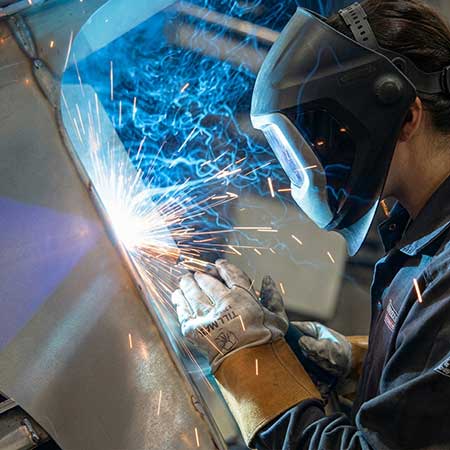
| Structural TIG/MIG Welding | Are your welders certified? How do you prevent material distortion during welding? Do you use custom fixtures for batch consistency? Can you perform leak testing or other NDT? | Request welder certifications (e.g., AWS). Ask for cross-section photos of previous weld samples to inspect for penetration. For cosmetic parts, review their weld finishing and polishing procedures. |
| Integrated Fastener Installation | What types of fasteners can you install (e.g., self-clinching studs, nuts, standoffs)? What is your process for verifying push-out and torque-out forces? | Look for specialized equipment like Haeger presses. Request a sample part with installed Fasteners. Ask for their quality control checklist for fastener installation, which should include force testing data. |
| Quality Control & Inspection | What is your standard inspection process (e.g., first-off, in-process, final)? What metrology equipment do you use (CMM, calipers, height gauges)? Can you provide full material traceability? | Request a sample inspection report. Ask for calibration records for their key measurement tools. A robust supplier will offer 100% dimensional and visual inspection and provide Mill Test Certificates (MTC) for all raw materials. |
Assessing Scalability: From Prototype to High-Volume Production
A supplier’s value is measured by their ability to support your product throughout its entire lifecycle. The needs for a 1-piece prototype are vastly different from a 10,000-piece production run. A truly capable partner demonstrates flexibility, accommodating both rapid R&D and stable, high-volume manufacturing. This is especially important for businesses that rely on a High-Mix, Low-Volume (HMLV) production model.
From my experience managing OEM projects, a key indicator of a supplier's scalability is their policy on minimum order quantities (MOQ). A supplier focused on long-term partnership will not penalize the crucial prototyping phase with high MOQs. At Lingyufab, we have zero MOQ for prototyping, allowing your engineers to iterate designs without financial barriers. We aim to grow with your product, applying the same rigorous quality standards whether we're making one part or one thousand.

Here’s a checklist to evaluate a potential supplier's scalability:
Prototyping Support: Do they offer a dedicated process for rapid prototyping? Look for promises of fast turnarounds (e.g., 7-10 days for samples) and a willingness to provide design for manufacturability (DFM) feedback. This collaborative approach is a hallmark of a good Leading Sheet Metal Prototyping Manufacturer.
Pilot Run Capability: How do they transition from prototype to a small-batch pilot run (e.g., 50-100 pieces)? This stage is critical for finalizing tooling and process controls before mass production. Ask about their process for developing jigs and fixtures that ensure consistency.
Mass Production Capacity: What is their demonstrated monthly output? Vague answers are a red flag. Look for concrete numbers. For example, our facility consistently delivers over 8,000pcs of fasteners and metal sheet assemblies monthly. Ask for evidence of their production scheduling system (e.g., ERP/MES) and how they manage raw material inventory for large orders.
Surge Capacity: How do they handle unexpected increases in demand? A mature supplier will have flexible production lines and a cross-trained workforce that can be reallocated to meet urgent orders, sometimes increasing output by 30-50% in a short period.
The Financial Impact of Vertically Integrated Manufacturing
When you source a complex sheet metal assembly, the final price is more than the sum of its parts. Sourcing from multiple vendors—one for cutting, another for bending, a third for welding, and a fourth for finishing and assembly—introduces hidden costs and risks. Each handoff adds project management overhead, transportation fees, and a new potential point of quality failure.
A vertically integrated manufacturer eliminates these inefficiencies. By consolidating all processes under one roof, from raw material preparation to final assembly, you gain significant advantages. Our in-house capabilities in laser cutting, CNC bending, stamping, welding, and surface finishing allow us to control the entire production chain. This direct oversight is how we can reduce overall project costs for our clients by 15-20% compared to a fragmented supply chain.
Consider the total cost of ownership (TCO) when comparing quotes:
Multi-Vendor Sourcing (The Hidden Costs)
Multiple POs & Invoices: Administrative overhead for managing several suppliers.
Inter-Factory Logistics: Costs and delays for shipping semi-finished parts between vendors.
Quality Accountability Issues: When a defect is found, who is responsible? The cutter, the bender, or the welder? This leads to costly disputes and delays.
Increased Project Management Time: Your team spends more time coordinating schedules and resolving issues between suppliers.
Compounded Lead Times: Each supplier's lead time adds up, extending your overall time-to-market.
Single-Source Integrated Manufacturing
One Point of Contact: Simplified communication and project management.
Eliminated Logistics Waste: No costs or delays from shipping parts between facilities.
Single-Point Accountability: The manufacturer is fully responsible for the final part's quality, from raw material to finished assembly.
Reduced Overall Lead Time: A streamlined workflow leads to faster delivery. Standard bulk orders are typically fulfilled in 20-30 days.
Lower TCO: The 15-20% cost reduction comes from eliminating redundant overhead and logistical waste.
By choosing a partner with a One Stop Sheet Metal Manufacturing Service, you are not just buying a part; you are buying a more efficient and reliable production process.

How Quality Systems Predict Production Reliability
A supplier’s certifications are more than just logos on a website; they are proof of a commitment to process-driven manufacturing. For any OEM, production reliability is paramount, and a robust Quality Management System (QMS) is the best predictor of a supplier's ability to deliver consistent parts at volume. Without a strong QMS, capacity is meaningless.
Certifications like ISO 9001:2015 demonstrate that a manufacturer has established and follows strict procedures for every aspect of their operation, from order entry to shipping. This system ensures that if they make a part correctly once, they have the documented processes to make it correctly thousands of times. Furthermore, certifications like ISO 14001 show a commitment to environmental responsibility, while a TÜV CE mark indicates compliance with European safety standards—critical for clients in the EU market.
When evaluating a supplier, dig deeper than the certificate itself:
Ask for their Quality Manual: This document outlines their entire QMS. Review their procedures for handling non-conforming parts and implementing corrective actions.
Inquire about Material Traceability: Can they trace a finished part back to the specific raw material batch it came from? We provide Mill Test Certificates (MTC) for every batch to ensure full traceability and material compliance.
Understand their Inspection Protocol: Is inspection a final step, or is it integrated throughout production? In-process checks are vital for catching deviations early and preventing large-scale scrap or rework. Our 100% dimensional and visual inspection before shipment is our final guarantee of compliance.
Clarify their Warranty/Guarantee: A confident manufacturer will stand behind their work. We offer free replacement or repair for any quality issues arising from manufacturing defects, providing our clients with peace of mind.
Ultimately, a supplier with a mature and certified QMS is a lower-risk partner. It signals that their claimed capacity is built on a stable foundation of repeatable processes, making them a reliable choice for your long-term production needs.
To ensure your next project is built on a foundation of verified capacity and quality, submit your drawings for a DFM review and detailed quote from our engineering team.