+8613003178786
  sales@lingyufab.com



Custom Metal Components for Server and Networking Chassis
12
Aug’2026Custom Metal Components for Server and Networking Chassis
Server and networking chassis represent one of the most demanding applications in precision sheet metal fabrication. Have you ever wondered how data centers pack hundreds of servers into a single rack while maintaining reliable cooling, signal integrity, and structural stability? The answer lies in the precision-engineered metal components that form the backbone of these systems—chassis that must meet exacting standards for dimensional accuracy, electromagnetic compatibility, thermal management, and mechanical strength.
At Lingyufab, we specialize in custom sheet metal components for server and networking equipment. With over 20 years of precision manufacturing experience since 2003 and certification as a core supplier for Mitsubishi Electric, our sheet metal fabrication capabilities—combining laser cutting, CNC bending, welding, and assembly—are engineered to meet the rigorous demands of the data center and telecommunications industries. This guide explains what goes into custom metal components for server and networking chassis, the key manufacturing processes, critical quality requirements, and how to choose the right partner for your project.
What Are Custom Metal Components for Server and Networking Chassis?
Server and networking chassis are the structural enclosures that house critical IT equipment—servers, switches, routers, storage devices, and power supplies. While the basic function of a chassis is to provide physical protection and mounting for electronic components, modern server chassis are far more than simple metal boxes.
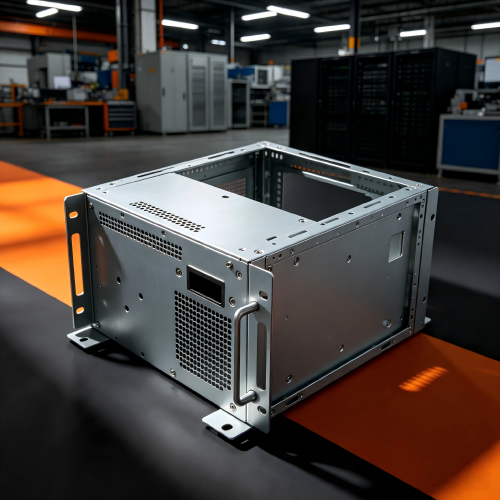
A complete server chassis assembly typically consists of multiple fabricated components: a base plate that provides structural rigidity and motherboard mounting, front and rear panels with cutouts for I/O ports and ventilation, side panels that enclose the system and provide EMI shielding, internal mounting brackets for drives, power supplies, and expansion cards, and rack ears that allow the chassis to be securely mounted into a standard 19-inch rack. Additional components often include top covers with ventilation patterns, EMI gaskets and finger stock for electromagnetic interference shielding, and custom brackets for cable management and component retention.
These components must work together to meet a range of performance requirements. Dimensional accuracy is paramount—server chassis must conform to the EIA-310-D standard for 19-inch rack mounting. The base plate requires exceptional flatness, typically within 0.3mm across the entire surface to eliminate PCB mounting stress. EMI shielding must meet FCC and CE compliance standards, with shielding effectiveness of 70dB or more at 1GHz. Thermal management requires carefully designed ventilation patterns to ensure proper airflow, and structural rigidity must support the weight of heavy components without flexing or distorting.
How Are Custom Server Chassis Components Manufactured?
The journey from raw sheet metal to finished chassis components involves a carefully orchestrated sequence of manufacturing steps, each critical to the final performance and reliability of the product.
Design and Engineering Review. The process begins with a thorough engineering review of your 3D CAD models and 2D drawings. Our engineering team assesses the design for manufacturability (DFM), identifying potential issues with material selection, bend radii, tolerances, and assembly sequence. For server chassis, critical considerations at this stage include compliance with EIA-310-D rack mounting standards, flatness requirements for motherboard mounting, EMI shielding features such as gasket grooves and finger stock mounting surfaces, ventilation patterns for optimal airflow, and hardware mounting points for drives, power supplies, and expansion cards.
Material Selection. Material choice is critical for server chassis performance. Common materials include cold-rolled steel (SPCC/SECC) for cost-effective structural rigidity, galvanized steel for enhanced corrosion resistance, aluminum alloys (5052, 6061) for lightweight applications requiring good thermal conductivity, and stainless steel (304, 316) for demanding environments. The typical material thickness for server chassis ranges from 1.0mm to 1.2mm for steel components.
Laser Cutting and Material Preparation. High-precision fiber laser cutting is used to create the flat patterns for each chassis component—base plates, side panels, front panels, rear panels, and internal brackets. For server chassis, the accuracy of cutouts for I/O ports, ventilation openings, and mounting holes directly affects assembly fit and system performance. Critical dimensions are typically held to ±0.1mm tolerances.
CNC Bending and Forming. After cutting, flat blanks are formed into their final 3D shapes using CNC bending. For server chassis, precision bending ensures that mounting flanges, rack ears, and internal brackets are formed to exact angles and dimensions. The 19-inch rack mounting width (482.6mm) is a critical dimension that must be held precisely for compatibility with standard racks.
Welding and Assembly. For chassis requiring permanent joins—such as reinforcing brackets or multi-piece enclosures—welding is used to join components. Depending on the design and material, TIG welding for stainless steel, MIG welding for general fabrication, or spot welding for thin sheet connections may be employed. Welding must be carefully controlled to prevent distortion that could affect flatness or dimensional accuracy. For assemblies where disassembly is required for maintenance, hardware fasteners are used instead.
Hardware and Fastener Installation. Server chassis require numerous hardware attachments: standoffs for motherboard mounting, PEM nuts and studs for secure fastening, rack ears for 19-inch rack mounting, drive bay guides and retention mechanisms, cable management brackets and clips, and EMI shielding gaskets and finger stock. Accurate installation of these hardware components is essential for proper assembly and field serviceability.
Surface Treatment and Finishing. The finished chassis undergoes surface treatment to enhance corrosion resistance, appearance, and durability. Common finishes include powder coating for durable, professional finishes, zinc plating for corrosion protection of steel components, anodizing for aluminum parts requiring corrosion resistance and aesthetic appeal, and passivation for stainless steel components. The finishing process must be carefully controlled to ensure that critical mating surfaces, grounding points, and EMI shielding surfaces are not affected.
Key Quality Requirements for Server and Networking Chassis
Achieving high-quality server chassis components requires attention to several critical factors:
Dimensional accuracy. Server chassis must conform to the EIA-310-D standard for 19-inch rack mounting. Critical dimensions include rack ear spacing (482.6mm), overall depth, and vertical height (measured in rack units, or "U"). Flatness of the base plate is essential—typically within 0.3mm across the entire surface to eliminate PCB mounting stress. Critical assembly dimensions are typically held to ±0.1mm tolerances.
EMI shielding. Server chassis must provide effective electromagnetic interference shielding to ensure FCC and CE compliance. Shielding effectiveness of 70dB or more at 1GHz is typically required. Key design features include continuous metal-to-metal contact between panels, EMI gaskets and finger stock at seams and joints, shielded ventilation openings, and proper grounding paths.
Thermal management. Server chassis must be designed for efficient airflow to cool internal components. Ventilation patterns must balance airflow with EMI shielding requirements. Strategic placement of cutouts for intake and exhaust fans, as well as proper spacing between components, is essential for thermal performance.
Structural rigidity. The chassis must support the weight of internal components—motherboards, power supplies, drives, and expansion cards—without flexing or distorting. Material thickness, strategic reinforcements, and proper joining methods all contribute to structural integrity.
Material traceability. For quality assurance and compliance, all raw materials must be traceable. Every batch of material should come with a Mill Test Certificate (MTC) confirming material composition and properties. For applications requiring specific certifications (such as UL or RoHS compliance), material documentation is essential.
Common Applications for Custom Server and Networking Components
Custom metal components for server and networking chassis are essential across a wide range of applications:
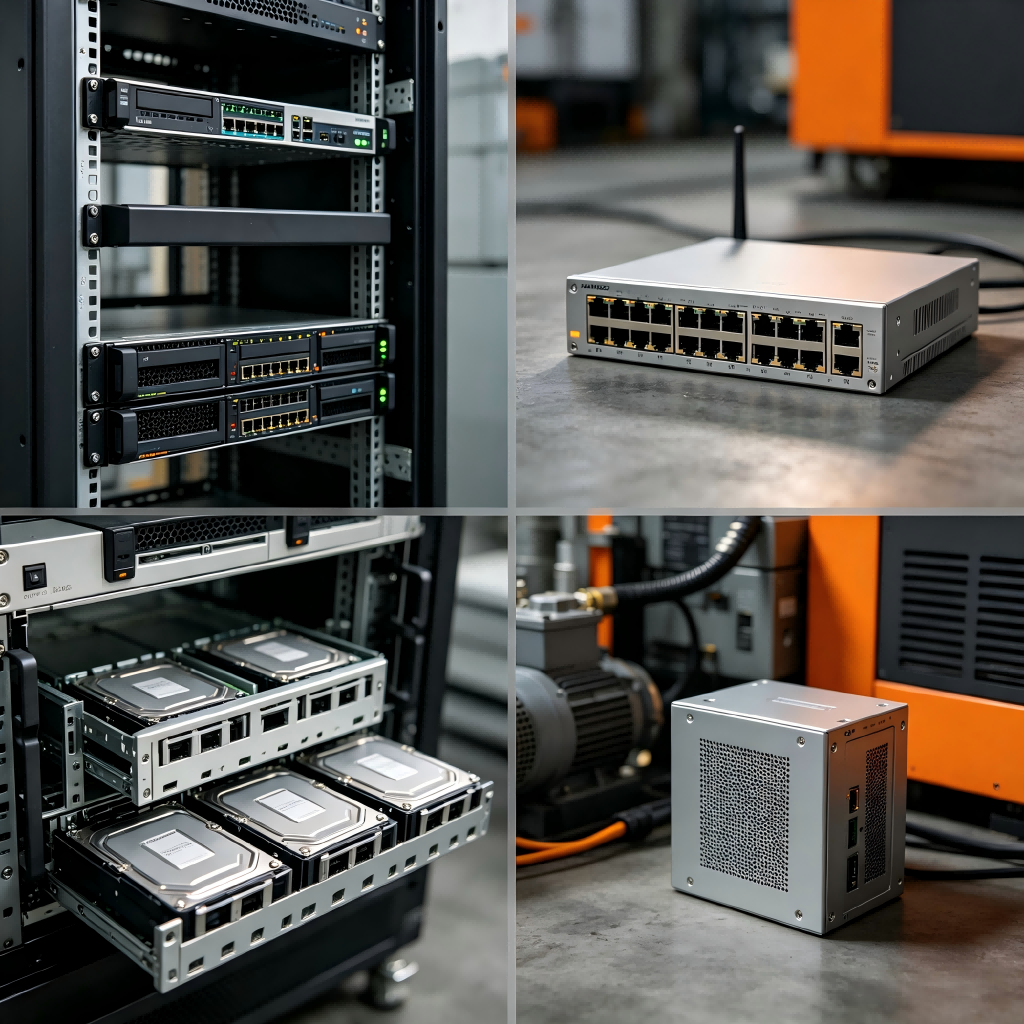
Data Center Servers. Rack-mount servers (1U, 2U, 4U, and custom heights) require precision chassis components that meet EIA-310-D rack mounting standards. These components must balance structural rigidity, thermal management, and EMI shielding while supporting heavy internal components.
Network Switches and Routers. Networking equipment requires chassis with precise I/O panel cutouts, effective EMI shielding, and proper ventilation for high-speed data processing. Card cage fan enclosures and rack-mount cooling systems are common examples.
Storage Arrays. High-density storage systems require chassis with precise drive bay configurations, vibration damping features, and efficient cooling for multiple drives.
Telecommunications Equipment. Telecom chassis often require enhanced environmental protection, including gasket channels for dust and moisture sealing, ruggedized construction for outdoor or harsh environments, and compliance with industry-specific standards.
Edge Computing and IoT Gateways. Compact, rugged chassis for edge computing applications require durable construction, effective thermal management, and flexible mounting options.
How Lingyufab Delivers Custom Server and Networking Components
Lingyufab is a professional sheet metal fabrication manufacturer and sheet metal supplier based in Shanghai, China, with over 20 years of precision manufacturing experience since 2003. We follow strict Japanese quality standards and are a certified core supplier for Mitsubishi Electric.
What sets Lingyufab apart as a sheet metal supplier is our integrated approach to server and networking chassis manufacturing. We handle every step of the process in-house—from laser cutting and CNC bending to welding, assembly, and surface treatment—ensuring consistent quality, shorter lead times, and single-point accountability.
Our in-house capabilities include:
Laser cutting — High-precision fiber laser cutting for accurate flat patterns, clean edges, and minimal material waste.
CNC bending — Precision bending with consistent accuracy and springback compensation.
Laser welding — High-speed, low-distortion welding with minimal heat input.
Sheet metal fabrication — Complete assembly, surface treatment, and fastener installation.
Surface treatment — In-house powder coating, anodizing, electroplating, and polishing.
ISO 9001, ISO 14001, and TÜV CE certified — Full material traceability with Mill Test Certificates.
One supplier, full responsibility. From laser cutting and CNC bending to welding, surface treatment, and fastener installation, we handle everything under one roof. This integration ensures consistent quality, shorter lead times, and a single point of accountability for your entire project.
If you are developing custom metal components for server or networking chassis, our engineering team is available to review your requirements and provide a free consultation. We'll help you optimize your design for manufacturability and cost-effectiveness. If you are looking for a reliable sheet metal fabrication supplier for your next data center or telecommunications project, please don't hesitate to contact us.
Quick Server Chassis Component Checklist for Buyers
Before starting your chassis project, review this checklist:
| What to Check | What to Consider |
|---|---|
| Rack compatibility | Does the design comply with EIA-310-D 19-inch rack standards? |
| Material selection | Steel, aluminum, or stainless steel—each has different weight, cost, and performance properties |
| Flatness requirements | Is base plate flatness specified for PCB mounting (typically ≤0.3mm)? |
| EMI shielding | Are shielding requirements (FCC, CE) defined? Are gasket grooves and grounding points included? |
| Thermal management | Are ventilation patterns optimized for airflow? |
| Tolerances | Are critical dimensions (rack ears, mounting holes) clearly specified? |
FAQs
Q1: What materials are commonly used for server chassis components?
Cold-rolled steel (SPCC, SECC) is the most common material for cost-effective structural rigidity. Aluminum alloys (5052, 6061) are used for lightweight applications. Stainless steel (304, 316) is preferred for demanding environments requiring corrosion resistance. Typical material thickness ranges from 1.0mm to 1.2mm for steel components.
Q2: What is the EIA-310-D standard?
EIA-310-D is the standard that defines the dimensions for 19-inch rack-mount equipment. It specifies the mounting hole pattern, width (482.6mm), and vertical height measurement in rack units (U). Compliance with this standard ensures compatibility with standard data center racks.
Q3: Why is flatness important for server chassis base plates?
The base plate must be flat to eliminate stress on the motherboard during PCB mounting. Excessive flatness deviation can cause PCB warping, solder joint failure, and intermittent electrical connections. Typical flatness requirements are within 0.3mm across the entire base.
Q4: What EMI shielding performance is typically required?
Server chassis typically require shielding effectiveness of 70dB or more at 1GHz to meet FCC and CE compliance standards. Design features include continuous metal-to-metal contact, EMI gaskets at seams, shielded ventilation openings, and proper grounding paths.
Q5: What is the typical tolerance for critical chassis dimensions?
Critical assembly dimensions—such as rack ear spacing, mounting hole positions, and I/O panel cutouts—are typically held to ±0.1mm tolerances. This ensures proper fit during assembly and compatibility with standard rack systems.
Q6: What file formats do you accept for chassis projects?
We accept 3D files in STEP (.stp), IGS (.igs), and SolidWorks (.sldprt) formats, and 2D drawings in PDF, DWG, and DXF formats. For chassis projects, we also need material specifications, tolerance requirements, and any specific compliance or performance requirements.