+8613003178786
  sales@lingyufab.com



Design for Manufacturability: Optimizing Precision Fan Case Assemblies for Cost and Performance
02
Sep’2026Design for Manufacturability: Optimizing Precision Fan Case Assemblies for Cost and Performance
What Are Precision Fan Case Assemblies?
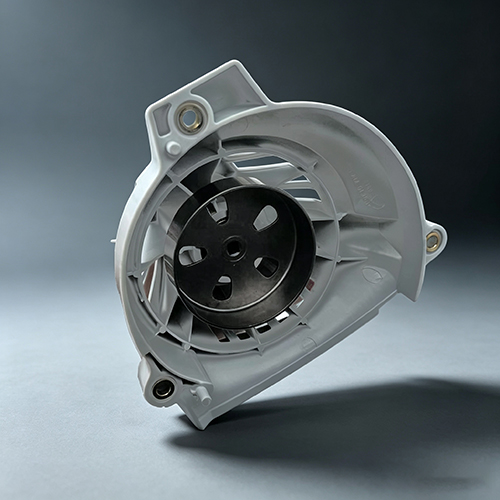
A precision fan case assembly is a fabricated metal enclosure designed to house a cooling fan, direct airflow, and provide structural mounting points within an electronic or mechanical system. These assemblies typically consist of a sheet metal housing, mounting flanges, ventilation features, and integrated fasteners that allow the fan to be securely attached to the surrounding equipment.
In electronics cooling applications, precision fan case assemblies serve several critical functions:
Airflow Direction – The housing channels air through the fan, ensuring that cooling airflow is directed precisely where it is needed. Poorly designed housings can create turbulence or recirculation, drastically reducing cooling efficiency.
Structural Support – The assembly provides mounting points for the fan motor, connectors, and the surrounding system. It must maintain its shape under vibration, thermal cycling, and physical loads.
Protection – The housing shields the fan's internal components from dust, moisture, and accidental contact, while also containing electromagnetic emissions in sensitive equipment.
Vibration Dampening – The assembly must absorb and dissipate vibration generated by the rotating fan to prevent noise and extend the service life of both the fan and the surrounding components.
Lingyufab is a professional China-based OEM specializing in high-quality custom build-to-print fabrication of fan case assemblies. As a direct manufacturer, we transform technical drawings into precision customized fan housings, cooling modules, and integrated ventilation frames for high-density server racks and industrial power systems. Our dedicated facility ensures every custom assembly accurately matches your specifications through rigorous full-process inspection, providing the vibration resistance and structural stability needed for your final assembly.
What Is Design for Manufacturability in Precision Fan Case Assembly?
Design for Manufacturability (DFM) is the engineering practice of designing products in a way that makes them easier, faster, and less expensive to manufacture without compromising quality or performance. In the context of precision fan case assemblies, DFM means designing sheet metal components that can be efficiently fabricated using standard processes like laser cutting, CNC bending, welding, and surface finishing.
The core principle of DFM is simple: simplify the design to simplify the process. Every unnecessary bend, complex feature, or tight tolerance adds cost and increases the risk of defects. DFM helps engineers identify opportunities to reduce part count, eliminate secondary operations, and standardize materials and hardware.
For precision fan case assemblies, DFM considerations typically address:
The thickness and type of sheet metal
Bend radius and flange design
Hole placement and spacing
Fastener selection and placement
Ventilation pattern design
Assembly sequence and joining methods
By applying DFM principles early in the design phase, manufacturers can significantly reduce per-unit costs, shorten lead times, and improve product consistency.
Key DFM Principles for Precision Fan Case Assemblies
Several fundamental DFM principles apply directly to the design of precision fan case assemblies:
Minimize Part Count – Reducing the number of components in an assembly lowers procurement costs, simplifies inventory management, and speeds up assembly. This can be achieved through integrated features like self-locating tabs and slots, or by combining multiple parts into a single stamped or formed component.
Design for Standard Processes – Using standard sheet metal fabrication processes (laser cutting, CNC bending, welding) keeps costs predictable and reduces the need for specialized equipment. Complex features that require custom tooling or multiple setups should be avoided unless absolutely necessary.
Avoid Unnecessary Tolerances – Specifying tighter tolerances than required increases inspection costs and scrap rates. Critical features like fan mounting holes should have tighter tolerances, while non-functional surfaces can be specified with more generous tolerances.
Simplify Geometry – Simple shapes with consistent bend radii and uniform material thickness are cheaper to produce and less prone to distortion than complex designs with multiple bends and varying features.
Design for Assembly – Consider how the fan case assembly will be assembled into the final product. Features like chamfered edges, guide pins, and self-locating tabs can simplify alignment and reduce assembly time.
Material Selection and Its Impact on Manufacturability
Material selection is one of the most critical decisions in the design of precision fan case assemblies. The choice affects not only performance but also manufacturability, cost, and lead time.
| Material | Key Properties | Manufacturing Impact |
|---|---|---|
| SPCC (cold-rolled steel) | High strength, cost-effective, good formability | Easy to laser cut and bend; consistent springback; excellent weldability |
| SGCC (galvanized steel) | Corrosion-resistant, good grounding properties | Similar to SPCC; welding requires zinc removal or special techniques |
| Aluminum (5052-H32, 6061-T6) | Lightweight, excellent thermal conductivity | More prone to distortion during welding; requires larger bend radii; softer |
| Stainless steel (304, 316L) | Excellent corrosion resistance, high strength | More difficult to form; requires more press tonnage; harder on tooling |
For precision fan case assemblies, aluminum is increasingly popular for high-density electronics applications due to its thermal conductivity. A typical 1.5mm aluminum sheet can reduce weight by approximately 65% compared to a 1.2mm steel sheet.
Key manufacturability considerations for material selection:
Bend Radius: Each material has a minimum bend radius. For 1.5mm SPCC steel, the recommended internal bend radius is 0.5mm; for aluminum, the minimum radius is approximately 2 times material thickness.
Hole Placement: In general, holes and cutouts should be placed at least 1.5× material thickness away from the edge to prevent distortion during bending.
Material Cost vs. Performance: While aluminum offers thermal advantages, steel provides higher strength at lower material cost. The choice often depends on the application's specific requirements for weight, heat dissipation, and budget.
Design Guidelines for Sheet Metal Fan Case Assemblies
Applying proven design guidelines ensures that precision fan case assemblies are both functional and manufacturable.
Bend and Flange Design
Minimum flange height should be at least 3× material thickness (for 1.5mm steel, this is approximately 4.5mm).
Bend relief cuts are required at the ends of bends to prevent tearing. For 90° bends, the relief width is typically 1.5× material thickness.
Consistent bend radii throughout the design simplify tooling setup and reduce scrap.
Hole and Cutout Design
For laser cutting, the minimum hole diameter should be at least the material thickness. For 1.5mm steel, this means holes should be at least 1.5mm in diameter.
Ventilation holes and louvers should be arranged to balance airflow and structural integrity. Dense hole patterns can cause localized deformation during cutting or bending.
Slots should have a width of at least 1.0× material thickness to avoid burrs and excessive heat input during cutting.
Fan Mounting Features
Fan mounting holes should be precisely positioned according to the fan's specification (e.g., 120mm fan typically uses 105mm hole spacing).
PEM nuts or self-clinching fasteners are recommended for fan mounting points to ensure reliable threads and consistent torque retention.
Ventilation and Louvers
Louver design should consider both airflow and manufacturability. Louvers formed in the same direction as the sheet grain are easier to produce and less likely to tear.
Ventilation gaps should prevent accidental contact with fan blades. A gap of 8mm is typically sufficient to provide both airflow and safety.
Weld Design
For welded assemblies, minimize weld length and use intermittent (stitch) welding rather than continuous welding to reduce distortion.
Symmetrical welding patterns help balance heat input and reduce warping.
Cost-Saving Design Strategies for Fan Case Assemblies
DFM is ultimately about reducing cost while maintaining quality. Several specific design strategies can significantly reduce the cost of precision fan case assemblies:
Reduce Material Thickness Where Possible – Using a thinner gauge material is one of the most effective ways to reduce material cost and weight. However, this requires careful analysis to ensure structural integrity. Adding embossed ribs or flanges can increase stiffness without increasing thickness.
Standardize Fasteners – Using a single fastener type and size across the assembly reduces inventory costs and simplifies assembly. For fan case assemblies, this means standardizing on one thread size for fan mounting and one size for chassis attachment.
Design for Nesting Efficiency – Sheet metal parts are typically cut from standard-sized sheets. Arranging parts to maximize material utilization (nesting) can significantly reduce raw material waste. Complex shapes with non-standard proportions can reduce nesting efficiency.
Minimize Surface Finish Requirements – Powder coating adds cost and thickness (60-120μm). If the application does not require a specific finish, consider using pre-galvanized material (SGCC) which provides corrosion protection without additional coating.
Reduce Secondary Operations – Each additional operation (e.g., welding, hardware insertion, painting) adds cost and lead time. Combine operations where possible, and consider whether features can be formed rather than welded.
Batch for Manufacturing – Consider how your design affects batch production. Designs that require extensive manual labor (e.g., complex welding) may be suitable for prototypes but impractical for mass production.
Common DFM Mistakes to Avoid
Engineers designing precision fan case assemblies often make several common DFM mistakes that increase cost and delay production:
Over-Specifying Tolerances – Requiring ±0.05mm on non-critical features adds significant cost without benefit. Only critical features (e.g., fan mounting holes, PCB mounting positions) should have tight tolerances; other features can be ±0.2mm or more.
Ignoring Bend Relief – Failing to add bend relief cuts can cause tearing and cracking during bending, leading to scrap and rework. Relief cuts are essential where bends end at the edge of a part.
Designing for Unavailable Materials – Specifying rarely used material grades or non-standard thicknesses can lead to long lead times and higher costs. Common grades like SPCC, SGCC, and 5052-H32 aluminum are readily available and more cost-effective.
Forgetting About Finishing – Powder coating and painting add thickness to the part, potentially affecting clearances and fit. Designers should account for coating thickness in clearances and hole sizing.
Overlooking Assembly Access – Designing features that require special tools or access points that are difficult to reach during assembly adds cost and labor. Consider how the fan case will be assembled onto the final product.
Placing Holes Too Close to Edges – Holes that are too close to the edge can deform during bending or cause the edge to tear. A minimum distance of 1.5× material thickness is recommended.
Inconsistent Bend Direction – Multiple bends in different directions can complicate tooling and increase setup time. Where possible, design bends to be formed in the same direction.
Professional Custom Fan Case Assembly Fabrication Manufacturer
Lingyufab brings over 20 years of precision sheet metal experience to fan case assembly manufacturing. However, our expertise extends far beyond fan enclosures. As a professional sheet metal assembly and fastener manufacturer in China, we specialize in producing a wide range of mechanical and electronic enclosures, chassis, brackets, and other structural components for industries including automotive, aerospace, medical devices, telecommunications, and industrial automation.
Our integrated manufacturing capabilities cover laser cutting, CNC bending, welding, and surface treatment. We also offer custom stud-welded sub-assemblies and custom self-clinching integrated components, delivering ready-to-install assemblies that simplify production and reduce supply chain complexity. Our workshop features high-precision Laser Cutting Systems, CNC Bending Centers, Stamping Presses, and Cold Heading Machines for bolts and nuts, enabling us to handle everything from single prototypes to mass production with short lead times and consistent quality control.
We operate under the ISO 9001:2015 quality management system and strictly follow Japanese quality management standards, with rigorous inspection at every stage from raw material to final delivery. Our engineering team provides DFM reviews to optimize designs for lower costs and improved manufacturability, helping customers avoid common design mistakes before production begins.
Ready to optimize your fan case assembly design for manufacturability? Contact Lingyufab today with your design files. Our engineering team will review your requirements and provide a competitive quote within 24 hours.
FAQs About DFM for Fan Case Assemblies
What is the minimum bend radius for sheet metal fan housings?
The minimum internal bend radius depends on the material. For SPCC steel (1.5mm thickness), the recommended internal bend radius is approximately 0.5mm. For aluminum, the minimum radius is typically 2× material thickness.
How can I reduce the cost of a precision fan case assembly?
Common strategies include reducing material thickness, standardizing fasteners, minimizing secondary operations, and designing for nesting efficiency. DFM review early in the design process is the most effective way to control costs.
What material should I choose for a fan case assembly?
Steel (SPCC, SGCC) is cost-effective and strong, suitable for most indoor applications. Aluminum is lighter and offers better thermal conductivity, ideal for high-density electronics. Stainless steel provides excellent corrosion resistance for harsh environments.
How do I ensure accurate fan mounting alignment?
Use precise hole spacing (typically specified by the fan manufacturer) and consider using self-clinching fasteners or standoffs for consistent thread placement. Pilot holes or alignment features can also improve assembly accuracy.
Can Lingyufab help with DFM optimization?
Yes. Lingyufab provides DFM reviews during the design phase, helping customers identify potential manufacturing issues and recommend cost-saving design modifications before production begins..