+8613003178786
  sales@lingyufab.com



Laser Cutting vs. Stamping: How to Choose the Right Sheet Metal Process for Your Project
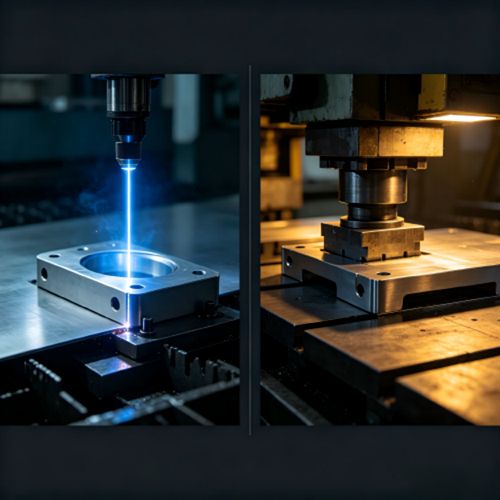
21
Aug’2026Laser Cutting vs. Stamping: How to Choose the Right Sheet Metal Process for Your Project
Have you ever specified a sheet metal part, only to receive quotes with completely different manufacturing approaches—and no clear way to tell which one is right for your project? Or perhaps you have committed to a manufacturing method only to discover later that you could have saved significant time or money with a different process? These are common dilemmas faced by design engineers, procurement professionals, and product managers. The choice between laser cutting and stamping is not just about technology—it directly affects your part quality, cost, lead time, and ability to make design changes down the road.
At Lingyufab, we offer both laser cutting and stamping capabilities in-house. With over 20 years of precision manufacturing experience since 2003 and certification as a core supplier for Mitsubishi Electric, we understand the strengths and limitations of each process. This guide compares laser cutting and stamping across key decision factors to help you choose the right method for your project.
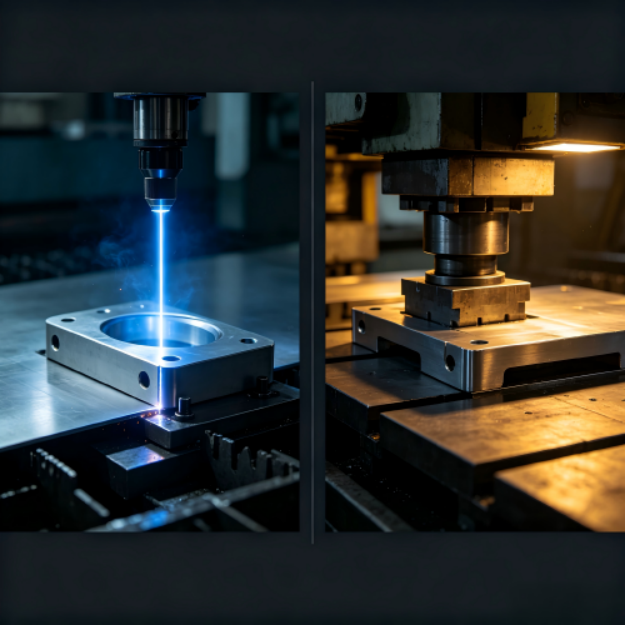
What Is Laser Cutting?
Laser cutting is a thermal process that uses a focused, high-energy laser beam to cut, melt, or vaporize material along a programmed path. The process is CNC-controlled and requires no hard tooling, making it highly flexible for custom designs and design changes.
Key characteristics:
· No tooling cost — no dies or molds required
· High flexibility — easily accommodates design changes and different part geometries
· Precision cutting — achieves tight tolerances with clean edges
· Ideal for thin to medium thickness — typically up to 15mm for aluminum, 3-4mm for stainless steel, and 6mm for carbon steel
· Quick turnaround — from design to first part in hours or days
What Is Metal Stamping?
Metal stamping is a cold-working process that uses dies and presses to form sheet metal into desired shapes. A stamping die is custom-built for each part geometry, and the press applies force to cut, bend, or form the material in a single stroke or progressive sequence.
Key characteristics:
· High tooling cost — dies typically cost tens of thousands to over one hundred thousand dollars
· Low per-unit cost — very economical for high volumes
· High production speed — dozens to over one hundred parts per minute
· Consistent quality — excellent repeatability across high-volume runs
· Long lead time to start — weeks to months for die fabrication
Laser Cutting vs. Stamping: Key Decision Factors
Here is a practical comparison across the factors that matter most to buyers and engineers:
Tooling Cost
Laser cutting: Zero tooling cost. No dies or molds are required. This makes laser cutting ideal for prototypes, new product development, and low-volume production where upfront investment is a concern.
Stamping: High tooling cost. Dies can range from tens of thousands to over one hundred thousand dollars depending on complexity. This upfront investment must be recovered through production volume.
Per-Unit Cost
Laser cutting: Moderate per-unit cost. The cost is driven by cutting time, material thickness, and part complexity. There is no tooling amortization to factor in.
Stamping: Very low per-unit cost once tooling is paid for. For high-volume production, the per-part cost can be significantly lower than laser cutting.
Lead Time to First Part
Laser cutting: Fast—typically hours to days. Upload a CAD file, set up the machine, and start cutting. Ideal for urgent orders and iterative design cycles.
Stamping: Slow—typically weeks to months. Die design and fabrication take significant time before the first part can be produced.
Flexibility and Design Changes
Laser cutting: Highly flexible. Design changes can be implemented by simply updating the CNC program—no new tooling required. This makes laser cutting ideal for prototyping and products that evolve over time.
Stamping: Inflexible. Once a die is made, design changes are costly and time-consuming. Any geometry change typically requires a new die or die modification.
Material Thickness
Laser cutting: Best for thin to medium sheet metal—typically aluminum up to 15mm, stainless steel up to 3-4mm, and carbon steel up to 6mm. Beyond these thicknesses, laser cutting becomes slower and more expensive.
Stamping: Can handle a wide range of thicknesses, from very thin foils to thick plates, depending on press capacity and die design.
Edge Quality and Heat-Affected Zone
Laser cutting: Produces clean edges but introduces a heat-affected zone where the material's properties are altered by the thermal process. This can make edges harder and more difficult to drill, tap, or weld. For applications where edge metallurgy is critical, this is an important consideration.
Stamping: Produces cold-worked edges with no heat-affected zone. The shearing action can create microscopic fractures and stress marks, but overall material properties are not thermally altered.
Production Volume
This is the most important factor in the decision. The economic crossover point typically occurs between several thousand and tens of thousands of parts.
For low-volume production under a few thousand parts, laser cutting is recommended due to no tooling investment and fast turnaround.
For medium-volume production between several thousand and tens of thousands of parts, either process may be suitable—the choice depends on the specific trade-off between tooling cost and per-unit savings.
For high-volume production over tens of thousands of parts, stamping becomes the clear choice as tooling costs are amortized and per-unit costs are significantly lower.
Part Complexity
Laser cutting: Excels at complex geometries, intricate cutouts, and parts with many features. The laser can follow any programmed path, making it ideal for custom shapes and detailed designs.
Stamping: Capable of complex geometries but requires more complex and expensive dies. Progressive stamping can produce parts with multiple features in a single stroke. The complexity of the part directly affects die cost and lead time.
Material Compatibility
Laser cutting: Excellent for most metals—steel, stainless steel, aluminum, brass, and copper. Also works on some plastics. The non-contact nature of laser cutting makes it suitable for materials with sensitive surfaces.
Stamping: Works on most ductile metals. Materials must have sufficient formability to withstand the stamping process without cracking. Ultra-high-strength steel is difficult to stamp and may cause severe die wear or part cracking—consult with your supplier before committing to stamping for such materials.
How to Choose: A Practical Decision Framework
Here is a simple framework to guide your decision:
Choose laser cutting if:
· You are developing a new product or prototype
· Your production volume is under several thousand parts
· Design changes are likely
· You need parts quickly
· You want to avoid large upfront tooling investment
· Your part has complex cutouts or intricate geometry
· You are working with a variety of part designs
Choose stamping if:
· Your production volume exceeds tens of thousands of parts
· The part design is finalized and unlikely to change
· You can absorb the upfront tooling cost
· You need very high production rates
· The part geometry is relatively stable and repeatable
· You want the lowest possible per-unit cost
Note: Ultra-high-strength steel is difficult to stamp and may cause severe die wear or part cracking—consult with your supplier before committing to stamping for such materials.
Still unsure which process fits your project? Lingyufab's engineering team can review your part requirements, volume projections, and budget to recommend the optimal manufacturing approach.
How Lingyufab Supports Both Processes
Lingyufab is a professional sheet metal supplier and fabrication manufacturer based in Shanghai, China, with over 20 years of precision manufacturing experience since 2003. We follow strict Japanese quality standards and are a certified core supplier for Mitsubishi Electric.
What sets Lingyufab apart is our dual capability. We offer both laser cutting and stamping in-house, so we can recommend the right process for your project without bias toward one technology. This flexibility means you don't need to switch suppliers as your production volume grows—we can scale with you.
Our comprehensive in-house capabilities include:
· Laser cutting — high-precision cutting with consistent accuracy, ideal for prototypes and low-to-medium volumes
· Stamping — high-speed production for high-volume runs, with dies designed and fabricated to your specifications
· CNC bending — precision bending with consistent accuracy across all parts and batches
· Welding — TIG welding for stainless steel, MIG welding for general fabrication, and spot welding for thin sheet connections
· Assembly — complete assembly of fabricated components into finished products and sub-assemblies
· Surface treatment — in-house powder coating, anodizing, electroplating, and polishing
· Fastener installation — direct installation of our own manufactured SEMS fasteners, bolts, nuts, and self-clinching fasteners
One supplier, full responsibility. From laser cutting and stamping to CNC bending, welding, surface treatment, and assembly, we handle everything under one roof. This integration eliminates the coordination gaps that often cause problems when working with multiple suppliers. Every batch of raw materials comes with a Mill Test Certificate (MTC), ensuring full traceability and compliance. We operate under ISO 9001, ISO 14001, and TÜV CE certifications, with quality control covering the complete manufacturing process from raw material inspection to finished product inspection.
If you are unsure which process is right for your project, our engineering team is available to review your drawings and provide a free process recommendation. If you are looking for a reliable sheet metal supplier, please don't hesitate to contact us.
Quick Selection Checklist for Buyers
| Decision Factor | Laser Cutting | Stamping |
|---|---|---|
| Upfront tooling cost | None | High (tens to hundreds of thousands of dollars) |
| Per-unit cost | Moderate | Low (at high volume) |
| Lead time to first part | Hours–days | Weeks–months |
| Design change flexibility | High | Low |
| Ideal volume | Under several thousand parts | Over tens of thousands of parts |
| Part complexity | Excellent for complex | Capable with complex dies |
| Heat-affected zone | Yes | No |
| Material thickness | Thin–medium | Wide range |
Conclusion
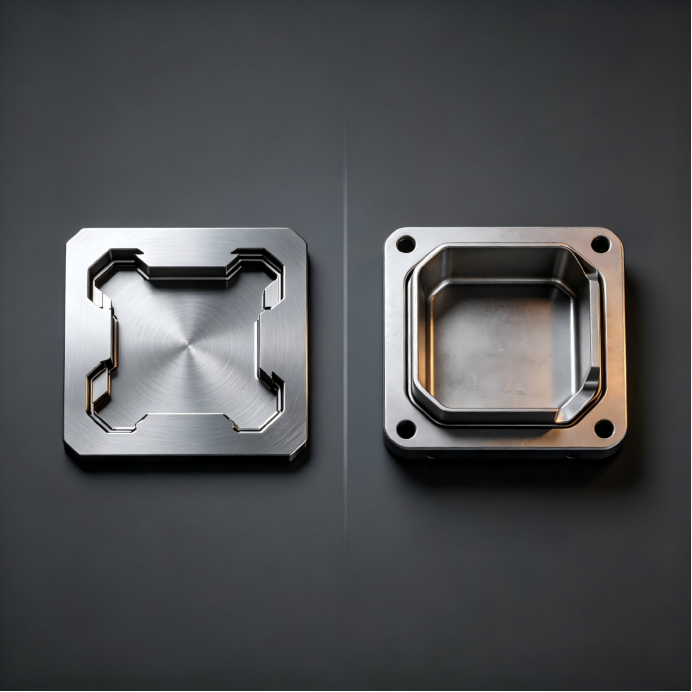
Choosing between laser cutting and stamping is not about which technology is better—it is about which one fits your project requirements. Laser cutting offers flexibility, fast turnaround, and no tooling investment, making it ideal for prototypes, low-volume production, and parts with complex geometries. Stamping delivers high speed, consistent quality, and low per-unit cost at scale, making it the clear choice for high-volume production of stable designs.
By understanding the trade-offs between these processes and working with an experienced partner like Lingyufab—who offers both capabilities in-house—you can make informed decisions that balance cost, quality, and delivery.
FAQs
Q1: What is the difference between laser cutting and stamping?
Laser cutting is a thermal process that uses a laser beam to cut material along a programmed path, with no tooling required. Stamping is a cold-working process that uses custom-built dies and a press to cut, bend, or form material, with high tooling costs but very low per-unit costs at volume.
Q2: Which is cheaper: laser cutting or stamping?
Laser cutting is cheaper for low volumes because there is no tooling cost. Stamping becomes cheaper at high volumes because the tooling cost is amortized across many parts and per-unit costs are very low. The exact crossover point depends on part complexity, material thickness, and tooling cost.
Q3: When should I choose laser cutting over stamping?
Choose laser cutting if you are producing under several thousand parts, developing a new product, expect design changes, need parts quickly, or have complex geometries.
Q4: When should I choose stamping over laser cutting?
Choose stamping if your production volume exceeds tens of thousands of parts, the design is finalized and stable, you can absorb the upfront tooling cost, and you want the lowest possible per-unit cost. Avoid stamping for ultra-high-strength steel without consulting your supplier first.
Q5: Can Lingyufab do both laser cutting and stamping?
Yes. Lingyufab offers both laser cutting and stamping in-house, so we can recommend the right process for your project without bias toward one technology.
Q6: What file formats do you accept for quotes?
We accept 3D files in STEP (.stp), IGS (.igs), and SolidWorks (.sldprt) formats, and 2D drawings in PDF, DWG, and DXF formats. If you don't have drawings, we offer reverse engineering services from physical samples