+8613003178786
  sales@lingyufab.com



Self-Tapping Screws vs. Machine Screws: How to Choose the Right Threaded Fastener for Sheet Metal
15
Sep’2026Self-Tapping Screws vs. Machine Screws: How to Choose the Right Threaded Fastener for Sheet Metal
Have you ever specified a screw for a sheet metal assembly, only to find that it stripped the hole, failed to hold under vibration, or simply wouldn't drive in without pre-drilling? Or perhaps you have received assemblies where the screws were loose, the threads were damaged, or the fasteners simply didn't perform as expected? These are common frustrations for design engineers, procurement professionals, and assembly line managers. The difference between a screw that holds securely and one that fails is not just about size or material—it is about choosing the right type of threaded fastener for your specific sheet metal application.
At Lingyufab, we understand the critical role that fasteners play in sheet metal assemblies. Unlike most sheet metal fabricators who only work with metal parts, we manufacture fasteners in-house and install them directly into your assemblies. With over 20 years of precision manufacturing experience since 2003 and certification as a core supplier for Mitsubishi Electric, we have learned exactly what separates reliable threaded connections from problematic ones. This guide compares the most common threaded fastener types for sheet metal—self-tapping screws and machine screws—to help you choose the right solution for your next project.
Why Threaded Fastener Selection Matters
The threaded fastener you choose determines far more than just how parts are held together. It affects:
Hole preparation requirements — Some fasteners require pre-tapped or pre-drilled holes; others create their own threads during installation. This directly impacts assembly cost and production speed.
Joint strength and reliability — Different thread types and fastener designs provide different levels of pull-out resistance, shear strength, and vibration resistance.
Serviceability — Can the fastener be removed and reinstalled? Or is it a permanent installation that damages the hole upon removal?
Material compatibility — Different fasteners work with different sheet metal thicknesses, hardness levels, and material types.
Assembly cost — Fastener cost is not just the price per piece. Consider hole preparation, installation time, tooling requirements, and rework rates.
Self-Tapping Screws: The Thread-Forming Solution
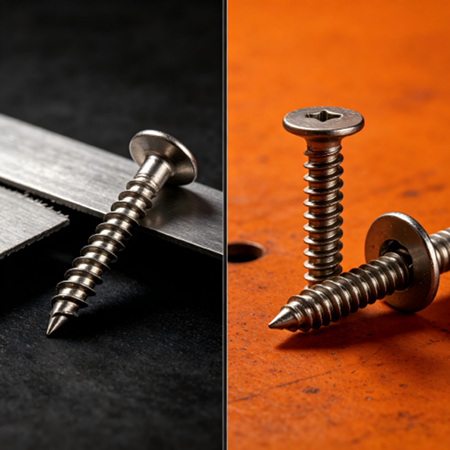
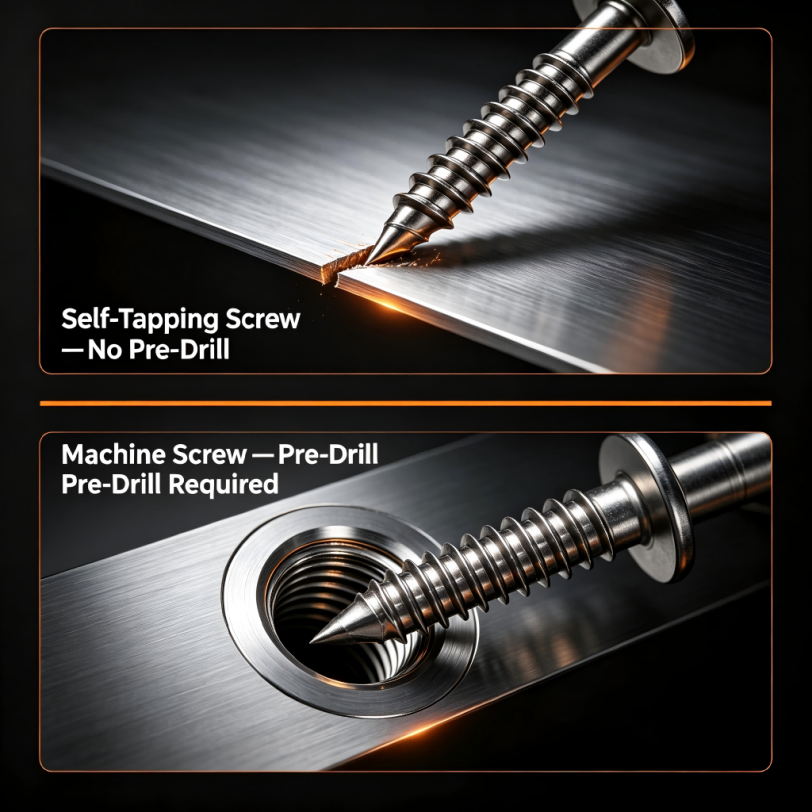
Self-tapping screws are designed to create their own mating threads as they are driven into a pre-drilled hole. Unlike machine screws that require a pre-tapped hole, self-tapping screws form or cut threads directly into the base material, eliminating the need for separate tapping operations.
How they work: Self-tapping screws feature a specially designed tip and thread geometry that allows them to displace or cut material as they are driven in. The screw forms a tight, thread-locking fit that resists loosening under vibration. They are available in two main categories: thread-forming screws (which displace material without removing it) and thread-cutting screws (which remove material to create clearance for the thread).
Key characteristics:
Eliminate the need for pre-tapped holes, reducing assembly steps and costs.
Create a thread-locking fit that resists loosening under vibration.
Available in a wide range of head styles, drive types, and materials.
Require a properly sized pilot hole—too small and the screw may break or strip; too large and it won't hold.
Generally not reusable—removing and reinstalling a self-tapping screw can damage the threads it created.
Typically limited to softer materials and thinner gauges.
When to choose self-tapping screws: Self-tapping screws are best suited for high-volume production where assembly speed is critical, applications where pre-tapping holes would add significant cost, softer sheet metals like aluminum and mild steel, thinner gauges where tapped threads would be too weak, and assemblies that are not intended to be disassembled and reassembled frequently.
Machine Screws: The Precision Fastener
Machine screws are threaded fasteners designed to be used with a pre-tapped hole or a nut. Unlike self-tapping screws, machine screws do not create their own threads—they rely on existing threads in the mating part.
How they work: Machine screws are installed into a pre-tapped hole in the sheet metal or through a clearance hole with a nut on the opposite side. The threads engage with the mating threads to create a secure, load-bearing connection. Machine screws are available in a wide range of thread sizes, pitches, materials, and strength grades.
Key characteristics:
Provide the highest thread quality and load capacity.
Reusable—removing and reinstalling does not damage the threads.
Offer precise thread engagement and consistent torque control.
Available in a wide range of standard sizes and materials.
Require pre-tapped holes, adding an extra manufacturing step.
The tapped hole must be properly sized and threaded—poor tapping leads to weak threads.
Tapping thin sheet metal can be difficult or impossible—threads in thin material have limited strength.
Generally more expensive than self-tapping screws due to the additional tapping operation.
When to choose machine screws: Machine screws are best suited for applications requiring high strength and load capacity, assemblies that need to be disassembled and reassembled multiple times for maintenance, applications with thicker sheet metal where tapping is feasible, situations where consistent torque control and precise thread engagement are critical, and assemblies using nuts on the opposite side of the joint.
Choosing Between Self-Tapping and Machine Screws
Choose self-tapping screws if:
Your assembly requires fast, high-volume production
Hole preparation costs need to be minimized
The sheet metal is relatively thin (typically under 3mm)
The assembly is not intended for frequent disassembly
You are working with aluminum, mild steel, or other softer materials
Vibration resistance is important—self-tapping screws create a thread-locking fit
Choose machine screws if:
Your assembly requires high strength and load capacity
The joint needs to be disassembled and reassembled multiple times for maintenance or service
The sheet metal is thick enough to support tapped threads (typically over 1.5mm)
You need precise torque control and consistent thread engagement
You are using a nut on the opposite side of the joint
You need a wide range of material and strength grade options
Still unsure which threaded fastener fits your project? Lingyufab's engineering team can review your assembly requirements and recommend the optimal fastening solution at no cost.
Where Threaded Fastener Selection Matters Most
Threaded fastener choice is critical across a wide range of applications:
Electronics and Electrical Equipment — Self-tapping screws are widely used for assembling enclosures, mounting PCBs, and securing covers, where speed and vibration resistance are important. When evaluating a supplier for electronics fastening, ask: "Do you install fasteners in-house? How do you ensure consistent torque control?"
Automotive and Transportation — Modern vehicles contain hundreds of threaded fasteners—self-tapping screws for interior trim and non-structural assemblies, machine screws for structural and high-load applications. When evaluating a supplier for automotive fastening, ask: "What vibration testing do you perform? Do you offer locking mechanisms for critical joints?"
Industrial Equipment and Machinery — Industrial equipment demands high-strength connections that can withstand vibration, thermal cycling, and harsh conditions. Machine screws are typically preferred for structural joints, while self-tapping screws are used for access panels and non-critical assemblies.
Medical Devices — Medical equipment requires reliable, corrosion-resistant fasteners that can withstand repeated cleaning and sterilization. Machine screws in stainless steel are the standard for most medical applications, offering reusable, reliable connections.
HVAC and Construction — Self-tapping screws are the workhorse of HVAC and construction, used for ductwork, roofing, and structural framing where speed and cost-efficiency are priorities.
Key Considerations for Threaded Fastener Selection
When selecting threaded fasteners for your sheet metal project, keep these practical guidelines in mind:
Match fastener to material thickness. Self-tapping screws work well in thin sheet metal (0.5–3mm). Machine screws are better for thicker material (1.5mm and up) where tapping is feasible.
Consider the operating environment. Will the assembly face vibration, thermal cycling, moisture, or chemicals? Self-tapping screws provide good vibration resistance. Stainless steel fasteners offer corrosion resistance for harsh environments.
Design for assembly efficiency. Self-tapping screws eliminate tapping operations, reducing assembly time and cost. Machine screws require pre-tapped holes but provide superior reusability and strength.
Consider serviceability. Machine screws allow for easy disassembly and reassembly for maintenance. Self-tapping screws are generally not reusable—removing them damages the threads they created.
Lingyufab: Your Trusted Sheet Metal Partner for Fastener Solutions
Lingyufab is a professional sheet metal fabrication manufacturer and supplier based in Shanghai, China, with over 20 years of precision manufacturing experience since 2003. We follow strict Japanese quality standards and are a certified core supplier for Mitsubishi Electric.
What sets Lingyufab apart as a sheet metal supplier is our integrated approach to fastening. Unlike most fabricators who only make sheet metal and leave fastening to the customer or a third-party supplier, we manufacture fasteners in-house and install them directly into your assemblies.
Our comprehensive in-house capabilities include:
Fastener manufacturing — SEMS fasteners, bolts, nuts, and self-clinching fasteners produced using cold heading machines
Fastener installation — Direct installation of our own manufactured fasteners into your sheet metal assemblies, eliminating external sourcing lead times
Laser cutting — High-precision cutting for accurate flat patterns, clean edges, and minimal material waste
CNC bending — Precision bending with consistent accuracy across all parts and batches
Welding — TIG welding for stainless steel, MIG welding for general fabrication, and spot welding for thin sheet connections
Assembly — Complete assembly of fabricated components into finished products and sub-assemblies
Surface treatment — In-house powder coating, anodizing, electroplating, and polishing
One supplier, full responsibility. From laser cutting and CNC bending to welding, surface treatment, and fastener installation, we handle everything under one roof. This integration ensures consistent quality, shorter lead times, and a single point of accountability for your entire project. Every batch of raw materials comes with a Mill Test Certificate (MTC), ensuring full traceability and compliance. We operate under ISO 9001, ISO 14001, and TÜV CE certifications, with quality control covering the complete manufacturing process from raw material inspection to finished product inspection.
If you are unsure which threaded fastener is right for your project, our engineering team is available to review your assembly requirements and provide a free fastener recommendation. If you are looking for a reliable sheet metal fabrication supplier, please don't hesitate to contact us.
Conclusion
Choosing the right threaded fastener for your sheet metal assembly is not just a component decision. It is a strategic choice that affects assembly speed, product quality, and long-term reliability. Self-tapping screws eliminate tapping operations, reduce assembly time, and provide good vibration resistance for high-volume production. Machine screws offer superior strength, precise thread engagement, and reusability for applications requiring maintenance access. Each fastener type has its place, and the optimal choice depends on your specific requirements for assembly efficiency, load capacity, serviceability, and material compatibility.
By understanding the trade-offs between these fastener types and working with an experienced partner like Lingyufab, who combines sheet metal fabrication with in-house fastener manufacturing, you can reduce assembly costs, improve product quality, and bring your products to market with confidence.
FAQs
Q1: What is the difference between self-tapping screws and machine screws? Self-tapping screws create their own threads as they are driven into a pre-drilled hole, eliminating the need for tapping. Machine screws require a pre-tapped hole or a nut and rely on existing threads for engagement.
Q2: When should I use self-tapping screws instead of machine screws? Use self-tapping screws when you need fast assembly, want to avoid the cost of tapping operations, are working with thin sheet metal (under 3mm), and the assembly does not require frequent disassembly.
Q3: Can self-tapping screws be reused? Generally no. Removing a self-tapping screw damages the threads it created, reducing holding strength if reinstalled. For assemblies that require maintenance access, machine screws are the better choice.
Q4: What materials can Lingyufab use for fasteners? Fasteners are available in carbon steel, stainless steel, and brass. The choice depends on strength, corrosion resistance, and conductivity requirements. Lingyufab can recommend the right material based on your application.
Q5: Can Lingyufab install fasteners directly into sheet metal assemblies? Yes. Lingyufab provides direct fastener installation services. We manufacture fasteners in-house and install them directly into your sheet metal assemblies, eliminating external sourcing lead times and ensuring consistency and reliability.
Q6: What is the typical sheet metal thickness for self-tapping screws? Self-tapping screws are typically used in sheet metal thicknesses ranging from 0.5mm to 3mm. The specific thickness range depends on the screw type, material, and application requirements. For thicker materials, machine screws with pre-tapped holes are generally recommended.