+8613003178786
  sales@lingyufab.com


How to Read a Sheet Metal Fabrication Quote: A Buyer‘s Guide to Understanding Costs and Avoiding Surprises
16
Sep’2026How to Read a Sheet Metal Fabrication Quote: A Buyer‘s Guide to Understanding Costs and Avoiding Surprises
Have you ever received three quotes for the exact same sheet metal part—one for $50, one for $80, and one for $120—and wondered why the prices are so different? Or perhaps you have approved a quote, only to discover hidden fees for tooling, rush shipping, or quality issues that doubled your total cost? These are among the most frustrating challenges faced by procurement professionals, design engineers, and product managers. A fabrication quote is not just a number—it is a detailed calculation that tells the story of how your part will be made.
At Lingyufab, we believe in transparency. As a professional sheet metal fabrication manufacturer and supplier based in Shanghai, China, with over 20 years of precision manufacturing experience since 2003, we provide clear, itemized quotes that help you understand exactly where your money goes. This guide explains how to read a sheet metal fabrication quote, what each line item means, what hidden costs to watch for, and how to compare quotes effectively.
What’s Inside a Sheet Metal Fabrication Quote?
A professional sheet metal fabrication quote breaks down the total cost into distinct, identifiable components. Understanding each component helps you evaluate whether a quote is reasonable and identify opportunities for savings.
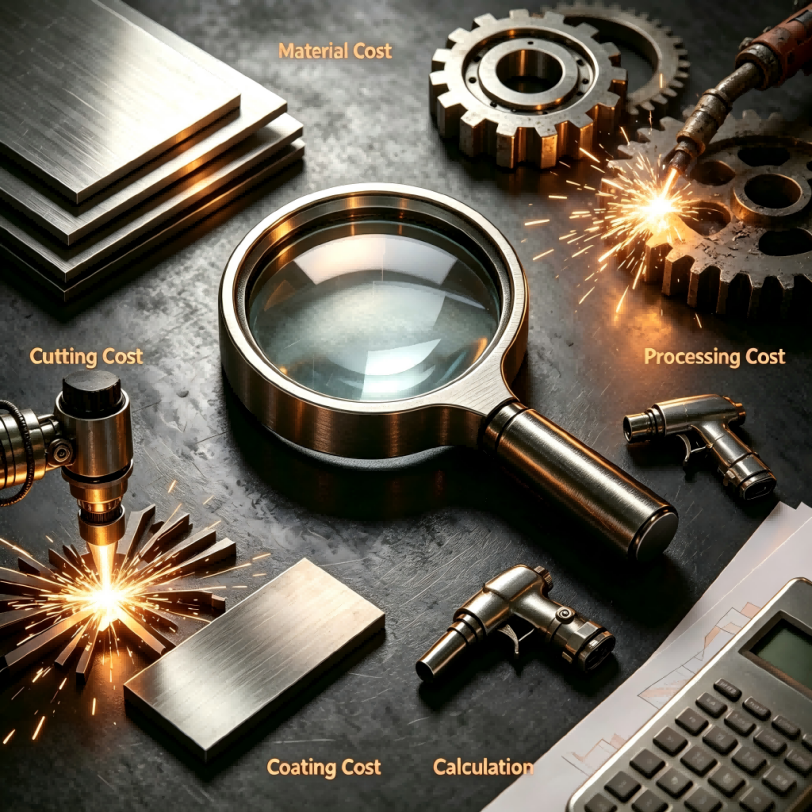
Material Cost
Material cost is the most transparent part of any quote—you can verify it. This line item should clearly indicate the material grade (e.g., 304 stainless steel, 6061 aluminum, or cold-rolled carbon steel), thickness or gauge, quantity required, and unit price. Typical material costs vary significantly: cold-rolled carbon steel typically ranges from $0.80 to $1.20 per kg, while 304 stainless steel ranges from $2.50 to $4.00 per kg.
What many buyers don’t realize is that you also pay for the material you don’t use—the scrap. Sheet metal parts are cut from standard-sized sheets using nesting software that arranges parts as tightly as possible to minimize waste. A supplier with poor nesting efficiency passes the cost of excess scrap on to you. As a general benchmark, material costs often represent roughly 30% of the total sales price for standard parts—if material is 60% of the total, it may be worth investigating why labor and overhead are unusually low or material is overpriced.
Manufacturing Cost: Cutting, Bending, and Forming
This component covers machine time—every hour a laser cutter or press brake is running your job adds to the bill. The primary drivers are:
Part complexity — A part with a hundred tiny holes takes much longer to cut than one with three large holes. Twenty complex bends take significantly more time than two simple bends.
Material thickness — Thicker materials require slower cutting speeds and more machine time.
Setup time — Programming CNC machinery, configuring tooling, and conducting test runs are one-time charges that impact unit costs significantly for small production volumes.
Cutting and fabrication typically account for 25–35% of total cost, while forming and bending account for 10–20%.
Labor Cost
Not everything in sheet metal fabrication is automated. Critical steps like welding, assembly, and surface preparation require the skilled hands of craftsmen. Labor costs typically account for 5–15% of total cost in most quotes, though the exact percentage varies by region and part complexity.
Welding is a prime example—it is a highly skilled, manual process that takes significant time and often requires grinding and smoothing afterward. Complex assembly, such as inserting dozens of nuts or riveting multiple parts together, also adds significant labor cost.
Secondary Operations
Secondary operations include finishing (powder coating, anodizing, electroplating), deburring, heat treatment, and assembly. Surface finishing alone can account for 10–25% of total cost. Packaging and logistics typically add 3–8%.
Overhead, Engineering, and Profit
This includes facility costs, equipment maintenance, quality inspection, engineering support, and the supplier’s margin. A typical industry approach applies a markup to direct costs (labor + material) to cover overhead and profit—commonly in the range of 25–50%, though this varies by supplier and order size. Management fees and profit typically account for 5–20% of the total.
Common Hidden Costs to Watch For
Tooling and Setup Fees. Custom tooling often requires a one-time upfront investment that is amortized over your production volume. For prototypes or small batches, setup costs can be substantial relative to the part price; for larger production runs, they become negligible.
Tight Tolerances Surcharges. Tolerances can double machining or inspection time. A tolerance of ±0.1 mm costs significantly more than ±0.5 mm. Only apply tight tolerances to critical features.
Finishing Charges. What looks like a simple surface finish often hides multiple labor-intensive steps—sanding, preparation, coating, and inspection—each adding cost.
Material Price Fluctuations. Raw material prices change. If a quote lacks a validity date or price-lock statement, the material cost is almost certainly subject to change based on market conditions at the time of order. Always check whether the quote includes a fixed-price commitment.
Rework and Quality Failures. The cheapest quote often hides the most expensive problems downstream. Quality failures—rework, scrap, re-inspection—can add 3–15% to your true program cost.
How to Compare Quotes Effectively
Comparing quotes from different suppliers requires more than looking at the bottom line. Here is a systematic approach:
Normalize the Cost Categories. Different suppliers use different quoting formats. Map every line item to standard cost categories: material, cutting, forming, secondary operations, finishing, tooling, and overhead. Compare apples to apples.
Verify the Assumptions. Check whether vendors use the same assumptions for material grade, tolerances, process selection, and inspection scope. If you specify “stainless steel,” one vendor may quote 201 while another quotes 304 or 316—grades that differ in price by up to 30%.
Include Total Landed Cost. Move beyond piece price. Add freight, duties, packaging, tooling amortization, quality inspection, rework risk, inventory carrying costs, and internal coordination time. True program costs often hide 15–25% outside the piece price.
Check the Validity Period. A locked-in material price means the supplier has committed to a specific cost regardless of what happens in commodity markets. Quotes without a validity date or price-lock statement are subject to change.
What to Ask Your Supplier Before Accepting a Quote
Is the material cost fixed or estimated? How long is the price valid?
What tolerances are assumed in this quote?
Are tooling and setup fees included or separate?
What secondary operations are included? Which are extra?
What is the lead time? Are there rush fees?
How is material waste (scrap) calculated and charged?
Can you provide a fully itemized breakdown?
Lingyufab: Your Trusted Sheet Metal Partner for Transparent Pricing
Lingyufab is a professional sheet metal fabrication manufacturer and supplier based in Shanghai, China, with over 20 years of precision manufacturing experience since 2003. We follow strict Japanese quality standards and are a certified core supplier for Mitsubishi Electric.
As a leading sheet metal supplier, Lingyufab provides clear, itemized quotes that help you understand exactly where your money goes. Our engineering team reviews your drawings before quoting, identifying cost-saving opportunities like simplifying geometry, relaxing unnecessary tolerances, and optimizing material nesting.
Our comprehensive in-house capabilities include:
Laser cutting — High-precision cutting with optimized nesting to maximize material utilization
CNC bending — Precision bending with consistent accuracy and minimal setup waste
Welding — TIG welding for stainless steel, MIG welding for general fabrication, and spot welding for thin sheet connections
Assembly — Complete assembly of fabricated components into finished products and sub-assemblies
Surface treatment — In-house powder coating, anodizing, electroplating, and polishing
Fastener installation — Direct installation of our own manufactured SEMS fasteners, bolts, nuts, and self-clinching fasteners
One supplier, full responsibility. From laser cutting and CNC bending to welding, surface treatment, and fastener installation, we handle everything under one roof. This integration ensures consistent quality, shorter lead times, and a single point of accountability for your entire project. Every batch of raw materials comes with a Mill Test Certificate (MTC), ensuring full traceability and compliance. We operate under ISO 9001, ISO 14001, and TÜV CE certifications, with quality control covering the complete manufacturing process from raw material inspection to finished product inspection.
If you are unsure about your quote or want to ensure you’re getting fair pricing, our engineering team is available to review your drawings and provide a free cost-saving consultation. If you are looking for a reliable sheet metal fabrication supplier, please don’t hesitate to contact us.
Quick Quote Review Checklist for Buyers
| What to Check | What to Look For |
|---|---|
| Material specification | Is the grade, thickness, and price clearly stated? |
| Tolerances | Are assumptions clearly defined? Are tight tolerances applied only to critical features? |
| Tooling and setup | Are these included or separate? Are they amortized over the full order? |
| Secondary operations | What is included? What is extra? |
| Lead time | Is it realistic? Are there rush fees? |
| Validity period | Is the price locked in? For how long? |
| Itemized breakdown | Is the quote fully itemized? |
| Total landed cost | Have you included freight, duties, and other ancillary costs? |
FAQs
Q1: Why do quotes from different suppliers vary so much for the same part? Quotes vary because suppliers use different assumptions about material grade, tolerances, tooling, labor rates, and overhead. Differences in automation levels, material sourcing costs, and quality control rigor also affect pricing. The key is to compare itemized breakdowns, not just the total price.
Q2: What is a reasonable markup for a sheet metal fabrication quote? A typical industry approach applies a markup to direct costs (labor + material) to cover overhead and profit—commonly in the range of 25–50%, though this varies by supplier and order size. Material costs should represent roughly 30% of the total sales price as a general benchmark.
Q3: What are the most common hidden costs in sheet metal quotes? Hidden costs typically include tooling and setup fees, tight tolerances surcharges, finishing charges, material waste (scrap), freight and shipping, rework expenses, and quality inspection costs. Up to 15–25% of the true program cost can sit outside the piece price.
Q4: How can I tell if a material price is locked in or subject to change? Look for a validity date, a price-lock statement, or references to commodity market indices. If the quote lacks these elements, the material cost is almost certainly subject to change based on market conditions at the time of order.
Q5: What should I include in a request for quote (RFQ)? Include both a 3D model (STEP, IGS, SolidWorks) and a 2D drawing (PDF, DWG, DXF) with clearly defined tolerances, material type and grade, and surface finish requirements. Include production volume and estimated annual demand—this lets vendors optimize between manual and automated setups for the best overall cost.
Q6: How can Lingyufab help me get a fair and transparent quote? Lingyufab provides fully itemized quotes with clear breakdowns of material, labor, tooling, finishing, and overhead. Our engineering team reviews your design before quoting, identifying cost-saving opportunities. We also offer free DFM reviews and cost-saving consultations to help you optimize your design for manufacturability.