+8613003178786
  sales@lingyufab.com



Sheet Metal and Fastener Integrated Manufacturing: Why Separate Sourcing Costs You More
21
Aug’2026Sheet Metal and Fastener Integrated Manufacturing: Why Separate Sourcing Costs You More
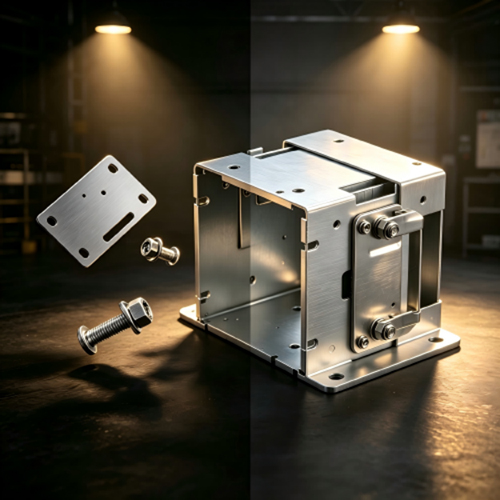
Have you ever found yourself in this situation: your sheet metal parts are made by one factory, your fasteners come from another supplier, and when you try to assemble them, the holes don't align, the threads don't match, and each supplier blames the other—leaving you to absorb the cost of rework? Or perhaps your design looks perfect on paper, but during assembly, screws won't tighten, self-clinching nuts fall out, or welded nuts distort the panels, and your entire supply chain is being dragged down by coordinating two or even three separate vendors? These are among the most frustrating and costly problems faced by procurement professionals, design engineers, and production managers.
This is not an isolated problem. In traditional procurement models, sheet metal parts and fasteners are often treated as two separate purchasing streams—sheet metal from one supplier, fasteners from another, and sometimes even fastener installation outsourced to a third party. Every supplier handoff adds cost, time, and quality risk. In sheet metal assemblies, the precision of fastener-to-sheet mating directly determines product reliability—a hole position deviation of 0.1mm, a thread mismatch, or improper fastener installation can turn a well-designed product into a field failure.
At Lingyufab, we solve this problem differently. We manufacture sheet metal components and fasteners in-house, and install them directly into your assemblies—all under one roof. With over 20 years of precision manufacturing experience since 2003 and certification as a core supplier for Mitsubishi Electric, we have seen firsthand how integrated manufacturing eliminates the coordination costs, quality gaps, and delays that plague multi-supplier sourcing. This guide explains why separate sourcing costs more, how integrated manufacturing solves these problems, and when it matters most.
Why Separate Sourcing Costs More
The conventional approach of sourcing sheet metal and fasteners separately carries hidden costs that are often overlooked until problems arise:
Coordination costs — Managing multiple suppliers requires more engineering reviews, more purchase orders, more expediting, and more follow-up. Every handoff consumes time and resources.
• Quality gaps — When sheet metal and fasteners come from different suppliers, responsibility for fit and function is divided. If a hole is slightly off and the fastener doesn't fit, each supplier points fingers at the other, leaving you to resolve the dispute.
• Lead time accumulation — When you add up the lead times of multiple suppliers, the total project timeline stretches. Sheet metal fabrication takes time, then fasteners must be sourced, then installation must be scheduled—each step adds weeks.
• Logistics complexity — Parts shipped from multiple locations, multiple freight charges, multiple receiving inspections—this adds cost and administrative burden.
• Inconsistent quality — Different suppliers have different quality standards. A sheet metal part that meets its tolerance but is incompatible with a fastener from another supplier creates a mismatch that only shows up at final assembly.
The total cost of separate sourcing — The price difference between a single integrated supplier and multiple separate suppliers might not be obvious in individual component costs. But the total cost of ownership (TCO)—including coordination overhead, rework, delays, logistics, and quality issues—can easily be 15-20% higher.
How Integrated Manufacturing Solves These Problems
Integrated manufacturing addresses each of these hidden costs directly:
• Eliminates coordination costs — One point of contact replaces three. Your engineering team communicates with one supplier, not multiple. Questions are answered faster, changes are implemented more quickly, and there is no time wasted relaying information between vendors.
• Eliminates quality gaps — When one supplier is responsible for sheet metal, fasteners, and installation, there is no finger-pointing. Fit and function are guaranteed. If a hole is misaligned or a fastener is incorrect, the supplier fixes it—you don’t get caught in the middle.
• Reduces lead time — Because fabrication and installation are synchronized, parts move from cutting to bending to finishing to fastener installation without waiting for external suppliers. Total project timelines are compressed by weeks or even months.
• Simplifies logistics — One shipment, one freight charge, one receiving inspection. Your supply chain becomes simpler and more predictable. Less receiving paperwork, fewer supplier communications, and less administrative overhead.
• Ensures consistent quality — One quality standard applies across all steps. Sheet metal, fasteners, and installation are all held to the same ISO 9001, ISO 14001, and TÜV CEcertified quality standards.
Key Advantages of Integrated Manufacturing
Reduced Supply Chain Complexity
Instead of managing relationships with multiple suppliers, you work with one partner. This simplifies procurement, reduces administrative overhead, and allows your team to focus on core business activities.
Lower Total Cost
While individual component costs may be similar, the total cost of ownership is significantly lower. Reduced coordination, fewer logistics steps, eliminated rework from mismatched parts, and faster time-to-market all contribute to lower overall cost. Integrated manufacturing can reduce your total cost by 15-20%.
Faster Time-to-Market
With synchronized production, your project moves faster. No waiting for one supplier to finish before ordering from another. No shipping delays between vendors. Parts move efficiently from fabrication through finishing to final assembly.
Consistent Quality
When the same quality system applies to all steps, you get consistent quality throughout. There is no variation between suppliers—the same standards apply to sheet metal fabrication, fastener manufacturing, and installation.
Single Point of Accountability
If something goes wrong, you have one supplier to hold accountable. No finger-pointing, no disputes, no extended resolution times. One partner takes full responsibility for the entire assembly.
Where Integrated Manufacturing Matters Most
Integrated sheet metal and fastener manufacturing is valuable across a wide range of industries:
• Electronics and Electrical Equipment — Enclosures and cabinets require precision fastening for PCB mounting and component attachment. Mismatched fasteners can cause assembly delays or field failures.
• Industrial Equipment — Machinery frames, control panels, and equipment enclosures require reliable fastening that withstands vibration and heavy use.
• Medical Devices — Medical equipment demands reliability, cleanliness, and traceability with strict compliance standards.
• Automotive and Electric Vehicles — Lightweight designs require precise fastening in tight spaces with high structural integrity requirements.
• Telecommunications and Networking — Communication equipment requires stable, long-term fastening for indoor and outdoor operating environments.
Lingyufab: Your One-Stop Sheet Metal Manufacturing & Assembly Solution
Lingyufab is a professional sheet metal fabrication manufacturer and supplier based in Shanghai, China, with over 20 years of precision manufacturing experience since 2003. We follow strict Japanese quality standards and are a certified core supplier for Mitsubishi Electric.
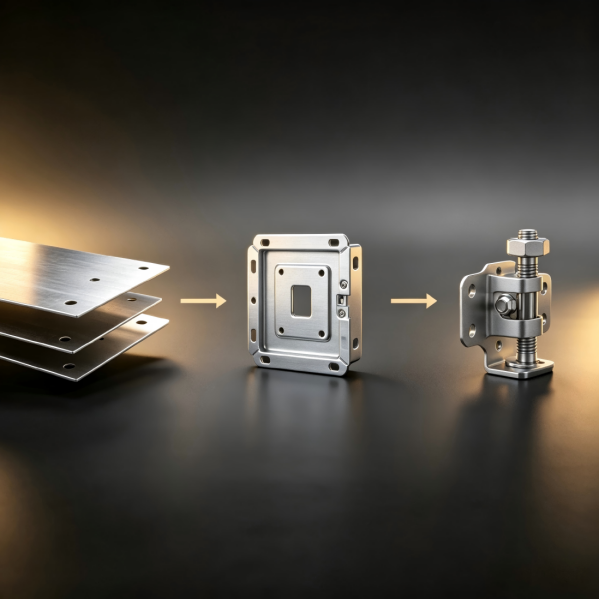
What sets Lingyufab apart is our truly integrated approach. We don’t just produce sheet metal parts—we manufacture custom fasteners and complete in-house fastener installation for full assembly consistency.
Our comprehensive in-house capabilities include:
• Sheet metal fabrication — Laser cutting, CNC bending, welding, and assembly
• Fastener manufacturing —SEMS fasteners and self-clinching fasteners
• Professional fastener installation
• Surface treatment — Powder coating, anodizing, electroplating, polishing
• Quality assurance — ISO 9001 / ISO 14001 / TÜV CEcertified withMill Test Certificate (MTC) traceability
One supplier, full responsibility. We eliminate multi-supplier errors, coordination gaps, and quality uncertainties for your sheet metal assemblies.
Conclusion
Traditional separate sourcing of sheet metal and fasteners creates hidden costs, inconsistent quality, and project delays. Integrated manufacturing unifies all processes under one reliable supplier, lowering total cost, shortening lead time, and ensuring stable assembly quality.
Working with Lingyufab allows you to simplify your supply chain, reduce overhead, and achieve consistent, high-quality sheet metal and fastener solutions for mass production and prototyping.
FAQs
Q1: What is integrated sheet metal and fastener manufacturing?
Integrated manufacturing means a single supplier completes sheet metal fabrication, fastener production, and fastener installation to eliminate multi-vendor errors and coordination risks.
Q2: Why is separate sourcing more expensive?
Separate sourcing causes extra coordination costs, quality mismatches, cumulative lead time delays, and repeated logistics expenses, increasing your total cost of ownership.
Q3: Can Lingyufab install fasteners directly into sheet metal assemblies?
Yes, we provide full in-house fastener installation to guarantee perfect fitting and assembly consistency.
Q4: What types of fasteners does Lingyufab manufacture?
We produce SEMS fasteners, bolts, nuts, and self-clinching fasteners.
Q5: What file formats do you accept for quotes?
We accept STEP, IGS, SolidWorks, PDF, DWG, DXF.
Q6: Does Lingyufab have a minimum order quantity?
No, we support zero minimum order quantity for prototypes, pilot runs, and mass production.