
 +8613003178786
 sales@lingyufab.com
Sheet Metal Fabrication China: Is Your Supplier RFQ-Ready?
What Do Buyers Regret Not Checking Before They Send an RFQ?
Most regrets start the same way. A drawing package goes out, three quotes come back within a day, and nobody notices that none of the suppliers asked a single question about bend radii, material grade or inspection method. Weeks later, the first samples arrive and the gaps show up as burrs, mixed material, or a tolerance nobody agreed on.
With sheet metal fabrication China sourcing, the quote is the cheapest place to find these gaps. The short answer to the question in the title: many suppliers are ready, but readiness is something you can test, not something you should assume from a capability list. A supplier offering a Global Custom Sheet Metal Fabrication Service should be able to show you three things before you share a production package: engineering review, documentation discipline, and response control.
This article answers the questions procurement managers ask at the qualification stage, in the order that affects the next decision.
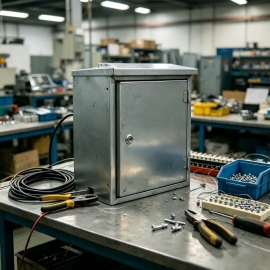
How Can I Test Whether a Supplier Is RFQ-Ready? A Boundary-Based Readiness Test
Run the test with a small, non-confidential sample drawing first. It costs you one email. The table below sets a boundary for each area. If a supplier falls outside the boundary, pause the full package and ask for the missing item before you send production drawings.
| Control area | Inside the boundary (ready) | Outside the boundary (pause) | What to ask for |
|---|---|---|---|
| Engineering | Asks about bend direction, hole-to-edge distance, material grade, and which tolerances are critical | Quotes a price with no questions, or accepts every tolerance on the print without comment | A short DFM note listing 3-5 observations on your sample drawing |
| Engineering | Separates general tolerances from critical features such as ±0.05mm dimensions | Promises one tight tolerance across the whole part with no process explanation | Which process (laser cutting, CNC bending, welding) holds each critical dimension |
| Documentation | Confirms Mill Test Certificates (MTC) per batch and names the inspection records it will supply | Cannot say which material grade or heat lot will be used | A sample MTC and a sample inspection report format |
| Documentation | Controls drawing revisions and confirms the revision on the quote | Quote carries no drawing revision or part number | Quote that cites revision letter, material, thickness, finish and quantity |
| Response control | A named engineer or project manager replies, with clear answers to each of your questions | Replies are generic, or different people answer without context | One accountable contact and an agreed response window |
| Response control | Lead time is split into sample time and bulk time | One lead time is given for every quantity | Separate timelines for samples and production |
How should I score the result?
Treat engineering as a gate. If the supplier shows no engineering review, documentation and speed will not make up for it, because errors in manufacturability only appear after tooling or cutting programs are set. Documentation and response control can often be fixed with a single clarification email.
Limit of the test: it checks process discipline, not capacity. A supplier can pass every row and still lack the equipment for your part size or volume. Confirm that separately by asking for the process route for your specific part.
What Should Be in the RFQ Package, and What Should Come Back?
Send a package complete enough that two suppliers quote the same thing. Otherwise you are comparing assumptions, not prices.
Send a 2D drawing with a revision letter. Include a 3D file (STEP) for reference. Mark critical dimensions, and state the general tolerance for everything else.
State material and thickness explicitly. For example, 304 or 316 stainless steel, carbon steel, or aluminum, with the exact alloy and temper where it matters.
Specify finish and fasteners. Note the surface finishing, plating or powder coating, and any pressed-in or welded hardware.
Give quantities in tiers. For example 1, 100 and a production forecast. Tiered quantities show you where the price breaks.
List the documents you require. MTC per batch, dimensional report, visual inspection standard.
Ask for a written reply with assumptions. The reply should list material, tolerance, finish and lead time separately.
What should come back: a quote that cites your revision, a short DFM note, a split lead time, and the documents you listed. If an item is missing, ask for it before you place a sample order. If the supplier is also making your first samples, a Leading Sheet Metal Prototyping Manufacturer that works without a minimum order quantity lets you check engineering and documentation on real parts before committing to a larger run.
Which Part Types Change the Readiness Questions?
The same test applies to every part, but the questions that matter most shift with the product. The table shows where to push harder.
| Part type | Question that matters most | Why it changes the answer | Where it does not apply |
|---|---|---|---|
| Outdoor or sealed enclosures | Which welding method, which finish, and how are seams checked? | Weld quality and coating adhesion affect long-term performance. See outdoor electrical enclosures for typical requirements. | Indoor mounting plates with no sealing requirement |
| Brackets and mounting plates | Which holes and bends are critical to the mating part? | Hole position drives fit. Flatness matters less on most brackets. | Decorative panels where appearance outranks fit |
| Assemblies with pressed or welded hardware | Who installs the fasteners, and how is installation torque or push-out checked? | A single in-house route avoids hand-offs between vendors. Compare custom self-clinching integrated components against loose hardware. | Parts with no installed hardware |
| Stainless parts (304/316) | How is the grade verified and how are weld areas finished? | Grade confusion and heat tint are the usual causes of rework. | Carbon steel parts that will be coated |
Tolerance claims need the same context. A figure such as ±0.05mm applies to specific features and is achievable only with the right process route and measuring method. A supplier that states which features it can hold at that level, and how it will measure them, is giving you information you can act on.
What Mistakes Do Buyers Make at the Qualification Stage?
Judging by the lowest quote. Compare quotes only after confirming that each one covers the same material, finish, and inspection scope.
Reading certificates as proof of process fit. ISO 9001:2015 shows a quality system exists. It does not show that the supplier handles your part type. Ask for a process route as well.
Sending the full package first. A one-part test drawing tells you more about engineering response than a 40-part package.
Setting every tolerance tight. Tight tolerances on non-critical features add cost and inspection time without improving function.
Skipping document requirements until after the order. Ask for MTCs and inspection reports before the PO, not after the first shipment.
Treating sample lead time as bulk lead time. They are different, and a supplier should state both.
What Can Lingyufab Confirm, and What Needs Your Input?
General guidance in this article applies to any supplier. The points below are Lingyufab's own terms, kept separate so you can verify them in your RFQ.
Quality system: ISO 9001:2015, ISO 14001 and TÜV CE certified. As a Mitsubishi Electric certified core supplier, we work to Japanese quality standards.
Traceability and inspection: Mill Test Certificates for every batch, with 100% dimensional and visual inspection before shipment. If an issue traces to a manufacturing defect, we offer free replacement or repair.
Processes: laser cutting, CNC bending, stamping, TIG/MIG welding and surface finishing, on carbon steel, stainless steel (304/316) and aluminum. Because these run in-house, you deal with one supplier from cutting to assembly. Tolerances down to ±0.05mm are available on drawing-specified features.
Quantities and timing: no minimum order quantity at the prototyping stage, from 1 piece to a 100-piece pilot run and beyond. Samples typically take 7-10 days and bulk orders 20-30 days. The exact timing depends on part complexity, finish and quantity.
Background: we have specialized in sheet metal and fasteners since 2003 and have served more than 50 clients worldwide with OEM/ODM work.
Some answers still need your input. Final lead time depends on your finish and quantity. Final price depends on tolerance scope and material grade. A DFM review can also change the bend sequence or the fixturing, so confirm those once drawings are reviewed. For machined or enclosure-type work, our team can also advise on routes such as precision sheet metal laser cutting services alongside bending and welding.
What Is the Next Step?
Pick one representative part, mark its critical dimensions, and send it to your shortlist with the test table above. Compare the engineering notes, documents and response quality before sharing anything larger. To start with us, send your drawing, material grade, finish and target quantities to our engineering team for a DFM review and quote.

