+8613003178786
  sales@lingyufab.com



Sheet Metal Fastener Selection Guide: How to Choose the Right Fasteners for Your Assembly
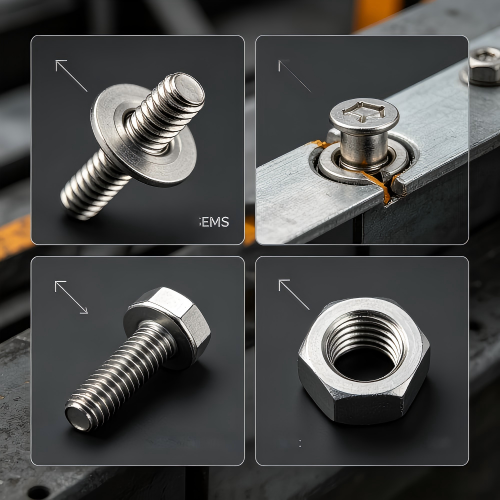
30
Jul’2026Sheet Metal Fastener Selection Guide: How to Choose the Right Fasteners for Your Assembly
Have you ever received a sheet metal assembly where the screws kept loosening during shipping? Or perhaps you have watched your production line slow down because workers were spending extra time searching for dropped washers or aligning misaligned holes? These seemingly small frustrations add up to real costs—rework, customer complaints, warranty claims, and lost productivity. The fastener you choose for your sheet metal assembly is often treated as an afterthought, yet it directly affects assembly speed, product reliability, and long-term performance.
At Lingyufab, we understand fasteners differently. Unlike most sheet metal fabricators who only work with metal parts, we manufacture fasteners in-house and install them directly into your assemblies. With over 20 years of precision manufacturing experience since 2003 and certification as a core supplier for Mitsubishi Electric, we have learned exactly what separates reliable fastening from problematic connections. This guide compares the most common sheet metal fastener types—SEMS fasteners, self-clinching fasteners, bolts, and nuts—to help you choose the right solution for your next project.
Why Fastener Selection Matters
The fastener you choose determines far more than just how parts are held together. It affects:
Assembly speed and efficiency — Some fasteners reduce assembly steps; others add them. The right choice can cut production time significantly.
Reliability in service — Will the fastener stay tight under vibration? Will it loosen during shipping? Will it withstand repeated assembly and disassembly?
Material compatibility — Different fasteners work with different sheet metal thicknesses and materials. The wrong choice can damage your parts or fail under load.
Serviceability — Will the fastener allow for future maintenance? Or is it a permanent installation?
Cost — Fastener cost is not just the price per piece. Consider installation time, rework rates, and field failures.
SEMS Fasteners: The Assembly Efficiency Solution
SEMS fasteners, also known as pre-assembled screws or combination screws, come with one or more washers permanently attached under the screw head. Unlike traditional fasteners where washers are separate components that must be handled individually, SEMS fasteners integrate the washer onto the bolt itself.
The integrated design eliminates the risk of lost or omitted washers during assembly. Workers do not need to handle separate components. One part number replaces two. SEMS fasteners typically include a spring washer that maintains tension to prevent loosening under vibration, a flat washer that distributes clamping pressure evenly, or a serrated washer that enhances grip through friction.
The benefits are clear. Reduced assembly time is the most immediate advantage. With washers pre-assembled, production lines move faster and labor costs are lower. Elimination of washer loss and omission means you never have to worry about missing lock washers that can lead to loose connections and field failures. Vibration resistance is a critical advantage for products that experience transport vibration, thermal cycling, or dynamic loads. The integrated spring washer maintains tension, preventing the fastener from backing out over time.
SEMS fasteners do have some limitations. They are typically limited to standard screw sizes and washer combinations. Custom configurations may require special ordering.
SEMS fasteners are best suited for high-volume assembly lines where every second counts, products that experience vibration during transport or operation, electrical equipment requiring grounding connections, and applications where consistent torque control is important.
Self-Clinching Fasteners: The Thin Sheet Solution
Self-clinching fasteners are specialized fasteners designed for permanent installation into sheet metal. They are installed by pressing the fastener into a prepared hole using a press. The fastener's knurled or ribbed body displaces the surrounding sheet metal, which flows into special undercuts or grooves on the fastener, creating a permanent, flush-mounted attachment that becomes part of the host material itself.
The installation process, known as cold flow, eliminates the need for welding, tapping, or secondary operations. The fastener must be harder than the host sheet metal for the clinching process to work properly. Self-clinching fasteners can be installed in extremely thin sheet metal, much thinner than what can be tapped or welded.
The primary advantage is providing strong, load-bearing threads in thin sheet metal where traditional methods like tapping or welding are not feasible. Tapping produces weak threads in thin materials, and welding can distort thin panels. Self-clinching fasteners solve both problems. Permanent installation means the fastener becomes part of the sheet metal itself. They are flush with the surface, saving space and eliminating protruding hardware that could interfere with other components. They also produce no weld splatter and consume less energy than welding.
Self-clinching fasteners have some limitations. Installation requires a press and proper hole preparation. Once installed, removal is difficult. The fastener is permanent. Self-clinching fasteners are generally more expensive per unit than standard screws and nuts.
Self-clinching fasteners are best suited for thin sheet metal applications where traditional fastening methods fail, electronics enclosures where space is limited, applications requiring reusable threads for maintenance, and products where a clean, flush appearance matters.
Bolts and Nuts: The High-Strength Traditional Choice
Bolts and nuts are the most traditional and widely understood fastening solution. A bolt passes through a hole in the sheet metal and is secured with a nut on the opposite side.
This is a through-hole connection requiring access to both sides of the assembly. Bolts and nuts are available in a wide range of sizes, materials, and strength grades. They can be used with washers for load distribution and vibration resistance.
Bolts and nuts are universally available and easy to source. They offer high strength and load capacity. They allow for easy disassembly and reassembly, making them ideal for maintenance and service access. The wide range of standard sizes and grades means you can find a solution for almost any application.
Bolts and nuts do have some drawbacks. They require access to both sides of the assembly, which is not always possible in enclosed designs. The nut can loosen under vibration without proper locking mechanisms. Multiple components, including bolt, nut, and washers, mean more parts to manage, more assembly time, and more opportunities for errors. Protruding nuts and bolts take up space and may interfere with other components.
Bolts and nuts are best suited for applications requiring high strength and load capacity, products where maintenance access is needed, thicker sheet metal or structural assemblies, and designs where both sides of the assembly are accessible.
How to Choose: A Practical Decision Framework
With these characteristics in mind, here is a practical framework for making your selection:
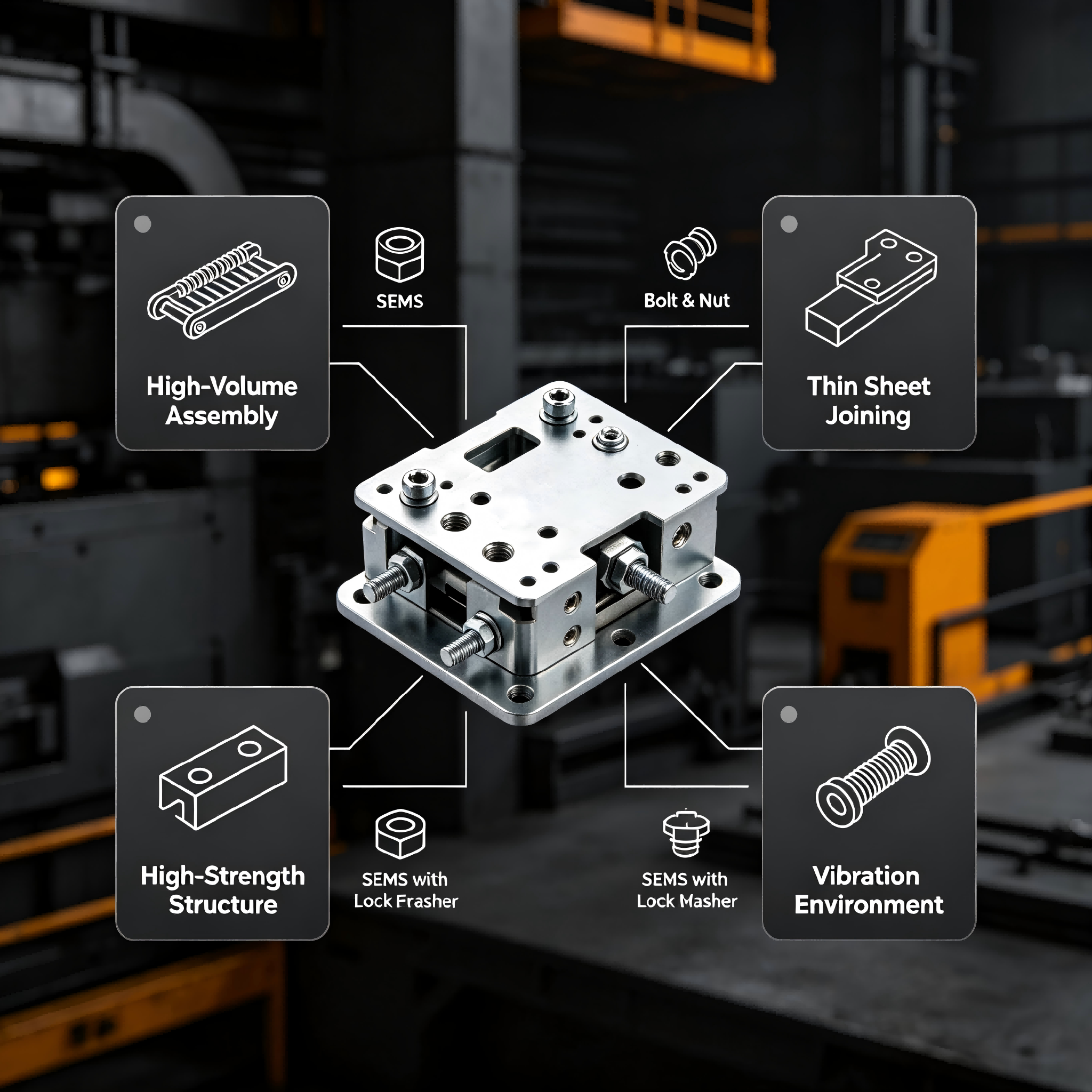
If your primary concern is assembly speed and efficiency, choose SEMS fasteners. They eliminate separate washer handling, reduce assembly steps, and prevent lost components. They are best for high-volume production lines and products where assembly time drives cost.
If your primary concern is creating strong threads in thin sheet metal, choose self-clinching fasteners. They provide permanent, load-bearing threads where traditional methods fail. They are best for electronics enclosures, thin panels, and applications requiring reusable threads.
If your primary concern is high strength and easy disassembly for maintenance, choose bolts and nuts. They offer the highest load capacity and allow for repeated assembly and disassembly. They are best for structural applications and products requiring field service.
If your primary concern is preventing loosening under vibration, choose SEMS fasteners with spring washers or serrated washers. The integrated design maintains tension and prevents backing out. They are best for automotive, transport, and equipment subject to vibration.
Still unsure which fastener fits your project? Lingyufab's engineering team can review your assembly requirements and recommend the optimal fastening solution at no cost.
Where Fastener Selection Matters Most
Fastener choice is critical across a wide range of applications:
Electronics and Electrical Equipment — SEMS fasteners provide secure connections that resist loosening from vibration, while self-clinching fasteners provide strong, reliable threads for mounting PCBs and attaching covers to enclosures, all without protruding through the exterior surface. Lingyufab installs both types in-house, ensuring consistent quality. When evaluating a supplier for electronics fastening, ask: "Do you install fasteners in-house, or do you outsource that step? How do you ensure consistent torque control?"
Automotive and Electric Vehicles — Modern vehicles contain hundreds of electronic control units, sensors, and battery modules, all requiring secure fastening in vibration-prone environments. SEMS fasteners with serrated washers provide anti-loosening performance for automotive applications, while self-clinching fasteners enable smaller, lighter assemblies that reduce weight. When evaluating a supplier for automotive fastening, ask: "What vibration testing do you perform on your fastener assemblies? Can you provide examples of automotive projects you've completed?"
Industrial Equipment and Machinery — Industrial equipment faces constant vibration, thermal cycling, and harsh operating conditions. SEMS fasteners maintain tension and prevent loosening under demanding conditions, while self-clinching fasteners provide permanent, load-bearing threads in control panels and machine guards. When evaluating a supplier for industrial fastening, ask: "How do you ensure fasteners remain secure under continuous vibration? What locking mechanisms do you recommend for heavy machinery applications?"
Medical Devices — Medical equipment demands reliability and cleanliness. Stainless steel self-clinching fasteners provide strong threads without contamination risks, while SEMS fasteners made from corrosion-resistant materials withstand repeated cleaning and sterilization. When evaluating a supplier for medical device fastening, ask: "Do your fasteners meet medical-grade cleanliness standards? Can you provide material certifications and traceability documentation?"
Telecommunications and Networking — Communication equipment requires reliable fastening in both indoor and outdoor environments. SEMS fasteners provide vibration resistance for tower-mounted equipment, while self-clinching fasteners offer strong threads for space-constrained network enclosures. When evaluating a supplier for telecom fastening, ask: "What corrosion protection do you offer for outdoor equipment? What is your track record with outdoor telecom installations?"
Key Considerations for Fastener Selection
When selecting fasteners for your sheet metal project, keep these practical guidelines in mind:
Match fastener to material thickness. Self-clinching fasteners are ideal for thin sheet metal where traditional methods like tapping or welding are not feasible. For thicker materials, bolts and nuts or standard tapped holes may be sufficient.
Consider the operating environment. Will the assembly face vibration, thermal cycling, moisture, or chemicals? SEMS fasteners with serrated washers provide superior vibration resistance. Stainless steel or brass fasteners offer corrosion resistance for harsh environments.
Design for assembly efficiency. SEMS fasteners reduce assembly time by eliminating separate washer handling. Self-clinching fasteners eliminate the need for secondary operations like deburring or thread cleaning.
Consider serviceability. Self-clinching fasteners provide reusable threads that withstand repeated assembly and disassembly. Bolts and nuts offer the easiest disassembly for maintenance. SEMS fasteners are typically permanent but can be removed with standard tools.
How Lingyufab Delivers Integrated Fastener Solutions
Lingyufab is a professional sheet metal fabrication manufacturer and supplier based in Shanghai, China, with over 20 years of precision manufacturing experience since 2003. We follow strict Japanese quality standards and are a certified core supplier for Mitsubishi Electric.
What sets Lingyufab apart is our integrated approach to fastening. Unlike most fabricators who only make sheet metal and leave fastening to the customer or a third-party supplier, we manufacture fasteners in-house and install them directly into your assemblies.
Our comprehensive in-house capabilities include:
Fastener manufacturing — SEMS fasteners, bolts, nuts, and self-clinching fasteners produced using cold heading machines
Fastener installation — Direct installation of our own manufactured fasteners into your sheet metal assemblies, eliminating external sourcing lead times
Laser cutting — High-precision cutting for accurate flat patterns, clean edges, and minimal material waste
CNC bending — Precision bending with consistent accuracy across all parts and batches
Welding — TIG welding for stainless steel, MIG welding for general fabrication, and spot welding for thin sheet connections
Assembly — Complete assembly of fabricated components into finished products and sub-assemblies
Surface treatment — In-house powder coating, anodizing, electroplating, and polishing
One supplier, full responsibility. From laser cutting and CNC bending to welding, surface treatment, and fastener installation, we handle everything under one roof. This integration ensures consistent quality, shorter lead times, and a single point of accountability for your entire project. If you are unsure which fastener is right for your project, please don't hesitate to contact us. Our engineering team is available to review your assembly requirements and provide a free fastener recommendation.
Conclusion
Choosing the right fastener for your sheet metal assembly is not just a component decision. It is a strategic choice that affects assembly speed, product quality, and long-term reliability. SEMS fasteners eliminate lost washers, reduce assembly time, and prevent loosening under vibration. Self-clinching fasteners provide strong, reusable threads in thin sheet metal where traditional methods fail. Bolts and nuts offer high strength and easy disassembly for maintenance applications. Each fastener type has its place, and the optimal choice depends on your specific requirements for assembly efficiency, material thickness, vibration resistance, and serviceability.
By understanding the trade-offs between these fastener types and working with an experienced partner like Lingyufab, who combines sheet metal fabrication with in-house fastener manufacturing, you can reduce assembly costs, improve product quality, and bring your products to market with confidence.
FAQs
Q1: What is the difference between SEMS fasteners and regular screws?
SEMS fasteners come with one or more washers permanently attached to the screw or bolt. Regular screws require washers to be handled separately. This difference eliminates lost washers, reduces assembly time, and ensures the washer is always in the correct position.
Q2: Why do SEMS fasteners prevent loosening?
SEMS fasteners typically include a spring washer that maintains tension even under vibration. Some designs feature serrated washers that increase friction between the bolt and the surface. This dual action of tension plus friction prevents the fastener from backing out over time.
Q3: What are self-clinching fasteners used for?
Self-clinching fasteners are used to provide strong, load-bearing threads in thin sheet metal where traditional methods like tapping or welding are not feasible. They are installed permanently into the sheet metal and provide reusable threads that withstand repeated assembly and disassembly.
Q4: Can self-clinching fasteners be used in very thin sheet metal?
Yes. Self-clinching fasteners can be installed in extremely thin sheet metal, making them ideal for lightweight assemblies where traditional fastening methods would fail. The minimum thickness depends on the specific fastener type and material combination.
Q5: Can Lingyufab install fasteners directly into sheet metal assemblies?
Yes. Lingyufab provides direct fastener installation services. We manufacture fasteners in-house and install them directly into your sheet metal assemblies, eliminating external sourcing lead times and ensuring consistency and reliability. This integrated approach makes us a leading sheet metal and fastener manufacturer.
Q6: What materials are available for fasteners?
Fasteners are available in carbon steel, stainless steel, and brass. The choice depends on strength, corrosion resistance, and conductivity requirements. Lingyufab can recommend the right material based on your application.