+8613003178786
  sales@lingyufab.com



Stamping Die Development: A Buyer‘s Guide to Tooling Decisions
18
Sep’2026Stamping Die Development: A Buyer‘s Guide to Tooling Decisions
Have you ever received a quote for a stamped part and wondered why the tooling cost was so high—or why the lead time stretched to months? Or perhaps you have approved a die development project, only to discover unexpected costs for design changes, material substitutions, or extended tryout time? These are common frustrations for procurement professionals, product developers, and quality managers. A stamping die is not a commodity purchase—it is a custom-engineered tool that requires significant investment in both time and money. Understanding the development process is essential for making informed decisions and avoiding costly surprises.
At Lingyufab, we have been designing and building stamping dies for over 20 years. With certification as a core supplier for Mitsubishi Electric and strict Japanese quality standards, we help customers navigate the complexities of die development from concept to production. This guide explains the die development process, key cost drivers, and what buyers should consider before committing to a tooling project.
What Is a Stamping Die?
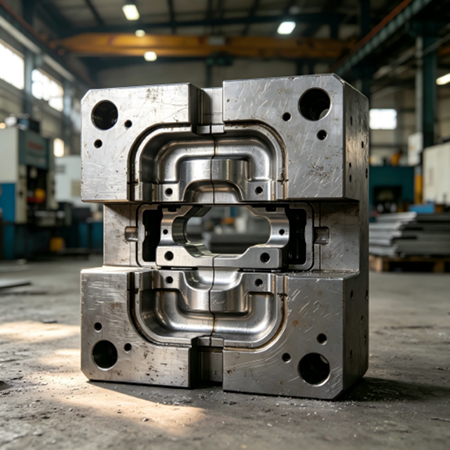
A stamping die is a custom-built precision tool mounted in a stamping press that cuts, bends, and forms flat sheet metal into finished components. The die consists of two primary components: the upper die (containing the punch) and the lower die (die block). The punch applies force to the metal, while the die supports the material and provides the shape.
Unlike machining, which removes material to create a part, stamping reshapes metal through cold-forming. Dies are typically made from specialized tool steel and are designed to withstand millions of cycles. The upfront cost to create a die can be significant, but that one-time expense is spread across large production runs, lowering the per-part cost.
The Die Development Process: 6 Critical Stages
Stage 1: Product Analysis and Feasibility Assessment
The process begins with your part drawing. Engineers analyze the product geometry, material type, thickness, tolerances, and production volume. Not every part can be stamped. It takes years of experience to look at a part and determine if it can be made using conventional stamping.
Key questions asked during this stage: Can the part be formed in a single die, or does it require multiple operations? Are the tolerances realistic for stamping? Is the material suitable for cold-forming? A competent supplier will be honest about feasibility—and Lingyufab‘s engineering team provides free DFM reviews to identify potential issues before design begins.
Stage 2: Process Engineering and Strip Layout
This is the most important step in die development. Process engineers determine the sequence of operations required to transform flat sheet metal into the finished part. For a progressive die, this is called a strip layout.
The strip layout defines everything: the number of stations, the type of carrier strip, how scrap will be shed, how the part moves through the tool, and how it is ejected. The general guideline is to establish all forms first, then trim and pierce in secondary operations. A poor strip layout can doom the entire project, while a well-designed layout maximizes material utilization and minimizes production costs.
For hole placement, two separate guidelines apply: the distance from a hole to a bend line should follow the 4T rule (≥4× material thickness) to prevent distortion during bending; hole-to-hole spacing should be at least 1.5× material thickness to prevent material deformation or tearing between holes.
Stage 3: Die Design
Die designers translate the process layout into detailed engineering drawings. They make critical decisions: tool steel selection, die geometry, punch and die clearance (typically 5–8% of material thickness), and cooling channels for heat-intensive operations.
Experienced designers also consider design for manufacturability (DFM) principles for the die itself: using as few components as possible, making components easy to machine, using off-the-shelf standard components where possible, and making the tool simple to assemble and disassemble. These principles reduce both build time and future maintenance costs.
For complex or critical parts, CAE simulation (using software like AutoForm or Dynaform) may be performed to predict material flow, thinning, wrinkling, and springback before any steel is cut.
Stage 4: Die Manufacturing
Once the design is finalized, manufacturing begins. Key steps include:
Machining — CNC milling, wire EDM (electrical discharge machining), turning, and grinding of die components
Heat treatment — Vacuum quenching and tempering to achieve the required hardness and wear resistance
Assembly — Fitting components together with precision guide pins ensuring accurate alignment between upper and lower die halves
Surface finishing — Polishing cavity surfaces to the required finish
For thick or high-strength materials, appropriate preheating may be applied during forming to help control springback and prevent cracking.
Stage 5: Die Tryout and Validation
The die is installed on a stamping press and tested under real production conditions. During tryout, the team evaluates material flow, trimming quality, piercing accuracy, and overall process stability. The first samples are inspected dimensionally to verify they meet drawing specifications.
This stage often reveals issues that require adjustments—springback compensation, fine-tuning of cutting clearances, or modifications to forming conditions. Die tryout typically takes 4–8 weeks, depending on complexity.
Stage 6: Production and Ongoing Maintenance
Once validated, the die enters production. But the work doesn‘t stop there. Regular maintenance is essential for long-term performance: inspecting for wear, cleaning, sharpening cutting edges, and replacing worn components. A well-maintained die can last millions of cycles; a neglected die will fail prematurely.
Die Types: Which One Is Right for Your Project?
Note: The cost ranges below are industry estimates. Actual costs depend on part complexity, material, tolerances, and supplier capability.
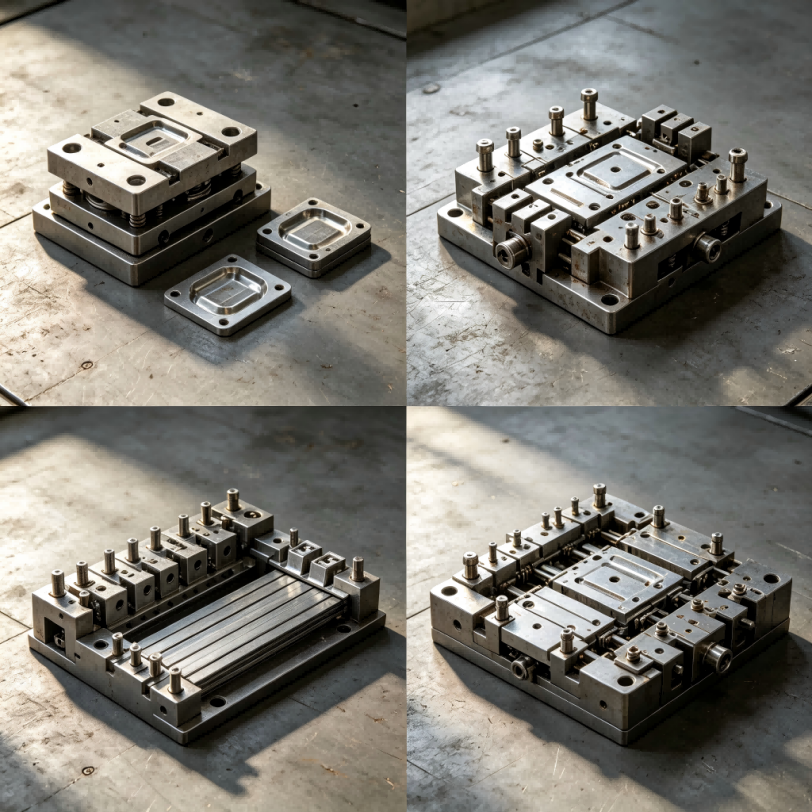
| Die Type | Best For | Typical Tooling Cost | Lead Time | Production Speed |
|---|---|---|---|---|
| Single-Station (Line) Die | Prototypes, small batches, simple parts | $1,000–$5,000 | Fast | Slow |
| Compound Die | Medium volumes, parts with multiple operations in one stroke | $5,000–$30,000+ | Moderate | Moderate |
| Progressive Die | High-volume production, complex parts | $15,000–$80,000 | Long | Very fast |
| Transfer Die | Very large parts, high-volume production | $60,000+ | Very Long | Very fast |
Cost Drivers: What Makes a Die Expensive?
Part Complexity. A part with many operations, tight tolerances, or complex geometry requires more die stations and more precise machining.
Material Type. Stainless steel and high-strength steels require more robust tooling with specialized materials.
Die Type. Progressive dies cost significantly more than single-station dies but deliver much lower per-part costs at scale.
Tolerances. Tighter tolerances demand more precise machining and additional inspection steps.
Tryout and Adjustments. Unexpected issues during tryout—springback, cracking, or wrinkling—can add time and cost.
Lead Times and Planning
Die development lead time typically ranges from 8 to 16 weeks for simple dies, and 16 to 26 weeks for complex progressive dies. Simple blanking tools can be built in 4–6 weeks; complex multi-stage progressive dies for automotive or electronic applications can take 6 months or more.
Buyers should plan accordingly—ordering tooling at the last minute almost always incurs rush fees or compromises quality.
What Buyers Should Provide for an Accurate Quote
To get an accurate die development quote, provide:
3D CAD files (STEP, IGS, SolidWorks) and 2D drawings (PDF, DWG, DXF)
Material specification (grade, thickness, hardness)
Annual production volume and expected part life
Critical tolerances and inspection requirements
Secondary operations required (plating, coating, assembly)
Red Flags to Watch For
Unrealistically low tooling quotes. If the price seems too good to be true, it probably is. Cheap dies often use inferior materials, skip critical heat treatment, or lack proper tryout—leading to premature failure and costly production stoppages.
No DFM discussion. A supplier who doesn't review your design for manufacturability before quoting is likely to encounter surprises during development.
Vague lead time estimates. Reliable suppliers can provide a realistic timeline based on the complexity of your part.
No tryout plan. Tryout is not optional—it is essential for validating die performance before production begins.
Lingyufab: Your Trusted Partner for Stamping Die Development
Lingyufab is a Shanghai-based sheet metal fabrication manufacturer and sheet metal supplier with over 20 years of experience since 2003. We are a certified core supplier for Mitsubishi Electric and operate under strict Japanese quality standards.
What sets us apart is our integrated approach to die development. We help you determine whether stamping is the right process, review your design for manufacturability, and provide transparent cost estimates with realistic lead times.
Our in-house capabilities include:
Die design, die manufacturing, die tryout, stamping production, laser cutting, CNC bending, welding, surface treatment, assembly, and fastener installation—all under one roof. ISO 9001, ISO 14001, and TÜV CE certified. Full material traceability with Mill Test Certificates.
If you are considering stamping for your high-volume project, contact us for a free die development consultation.
Conclusion
Stamping die development is a complex, multi-stage process that requires specialized expertise, precision equipment, and rigorous quality control. By understanding the six stages of development—product analysis, process engineering, die design, manufacturing, tryout, and production—you can make informed decisions about tooling investments and avoid costly surprises.
Working with an experienced partner like Lingyufab—who combines engineering expertise, in-house die manufacturing, and rigorous quality control—helps you get the right tooling for your project, on time and on budget.
FAQs
Q1: What is a stamping die? A stamping die is a custom-built precision tool mounted in a stamping press that cuts, bends, and forms flat sheet metal into finished components. It is designed for high-volume production of identical parts.
Q2: How much does a stamping die cost? Die costs vary widely: simple blanking tools can cost $1,000–$5,000; progressive dies typically range from $15,000 to $80,000; complex transfer dies can exceed $60,000. The exact cost depends on part complexity, material, tolerances, and die type.
Q3: How long does die development take? Lead time typically ranges from 8 to 16 weeks for simple dies, and 16 to 26 weeks for complex progressive dies. Simple tools can be built in 4–6 weeks; complex multi-stage dies can take 6 months or more.
Q4: What is the difference between a progressive die and a single-station die? A single-station die performs one operation per press stroke and is best for prototypes and small batches. A progressive die performs multiple operations in a single stroke as the strip moves through stations, delivering very high production speed for high volumes.
Q5: Can Lingyufab design and build stamping dies? Yes. Lingyufab offers comprehensive stamping capabilities, including die design, die manufacturing, and stamping production—all in-house. Our engineering team can design dies optimized for your part geometry, material, and production volume.
Q6: What file formats do you accept for die development quotes? We accept 3D files in STEP (.stp), IGS (.igs), and SolidWorks (.sldprt) formats, and 2D drawings in PDF, DWG, and DXF formats. For die development, we also need material specifications, production volume targets, and any critical tolerance requirements.