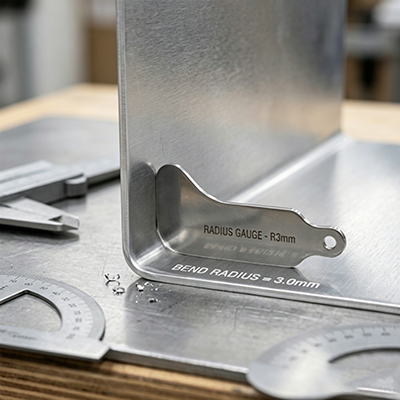
In the field of precision manufacturing, the sheet metal bend radius is not a complex mathematical concept; it is simply the measurement that describes how a metal sheet "turns a corner."
To put it plainly, when a flat piece of metal is bent, the corner does not form a perfectly sharp, knife-edge angle. Instead, it forms a rounded curve. The size of this curve—specifically the radius of the inner arc—is what we call the "bend radius." If the radius is large, the corner will look soft and gradual; if the radius is small, the corner will look tighter and more square.
Why is this measurement so critical? Although metal is strong, it is not infinitely flexible. During the bending process, the surface of the metal undergoes significant stretching on the outside and compression on the inside. If the bend radius is set too small—meaning you are forcing the metal into an excessively sharp angle—the internal fibers of the material will be stretched beyond their limit, leading to microscopic cracks or even structural failure.
Therefore, determining the correct bend radius is essentially about finding a "balance": you want to achieve the precise shape required for your design while ensuring the metal material is not "traumatized" or weakened during the fabrication process.
At Lingyufab, our engineering team rigorously assesses and optimizes these bend radii for every sheet metal fabrication and assembly project. By proactively addressing technical challenges, we help our clients avoid common manufacturing pitfalls, ensuring that every component we produce is not only aesthetically refined and durable but also cost-optimized through efficient assembly-ready design.
In short, the sheet metal bend radius is the key parameter that determines whether your metal component will "bend smoothly" or "crack under stress." When specified correctly, it ensures that your design concept translates perfectly from a computer screen into a high-quality physical product.
Key Impacts of Bend Radius on Forming Quality
The choice of bend radius serves as the foundation for the structural integrity of your part. Beyond mere appearance, it dictates the mechanical health of the metal:
Stress Distribution and Material Integrity:
An excessively tight bend creates extreme stress concentrations on the outer radius. When the radius is too small relative to the material thickness, the outer surface is pushed beyond its elongation limit, leading to micro-cracking. A well-calculated radius allows the material to flow smoothly, distributing the bending forces evenly across the bend zone and maintaining the material’s structural strength.
The Physics of Stretching:
As a sheet is bent, the outer fibers are in tension while the inner fibers are in compression. A proper radius respects the material’s ductility. At Lingyufab, we conduct thorough material analysis to ensure that the chosen radius aligns with the specific temper and grain direction of the metal, preventing brittle failure that often occurs in poorly designed, overly sharp corners.
Dimensional Accuracy and Springback Control:
Springback is the natural tendency of metal to return toward its original, flat state after press brake pressure is released. The bend radius is a primary variable in springback calculation. A larger, well-proportioned radius typically results in more predictable, controllable springback. By optimizing the radius during the design phase, we ensure that your parts arrive at the required angles without needing secondary, costly adjustments.
Designers often focus solely on the part’s final function, but the bend radius has a direct, quantifiable impact on your production budget:
Tooling Expenses and Standardized Radii:
Fabrication shops utilize standard punch and die sets. If your design specifies a non-standard, arbitrary bend radius, the supplier may be forced to order or manufacture custom tooling, which drastically increases lead time and capital expenditure. By adhering to the standard radii available in modern workshops, you can eliminate these extra fees and leverage our existing infrastructure.
Operational Efficiency and Cycle Time:
The complexity of a part’s geometry dictates the number of tool changes required during the fabrication process. If a part features inconsistent radii throughout, the operator must pause to change tools for each specific bend. We advocate for design standardization; using a uniform radius across all bends simplifies the manufacturing workflow, keeps the machine running without interruption, and directly reduces your labor costs.
Scrap Rate and First-Pass Yield:
Poorly specified radii are one of the leading causes of production rejections. Whether it is tearing at the bend line or an inconsistent bend angle, these errors lead to wasted raw material and production downtime. At Lingyufab, we focus on "Design for Manufacturability" (DFM), proactively adjusting radii in the initial model to ensure the highest possible first-pass yield, which significantly lowers your overall project costs.
Even seasoned engineers can overlook the physical limitations of metal forming. Here are the most common pitfalls that lead to production delays and compromised parts:
The "Zero" Radius Myth:
Many designers attempt to specify a "sharp" corner with a radius of zero. However, in physical manufacturing, metal cannot be bent to a perfectly sharp 90-degree angle without inducing massive internal stress or requiring specialized stamping processes. Sharp internal corners act as stress risers, creating significant points of failure and fatigue during the product's lifespan.
Inconsistent Radii on a Single Component:
Designing a part with five different radii across various flanges is a common, yet unnecessary, error. It forces multiple tool changes and increases the risk of operator error. We strongly recommend standardizing the bend radius across your assembly whenever possible to maintain a smooth, error-free production rhythm.
Ignoring Material Thickness vs. Radius Ratio:
A common mistake is applying a fixed, arbitrary radius value to different thicknesses. A radius that works perfectly for 1mm aluminum might be a disaster for 3mm stainless steel. The material’s ability to deform is directly tied to its thickness; failing to adjust the radius to match the material gauge is the fastest way to cause cracking.
Proximity to Bends or Holes:
If a bend is located too close to a hole, slot, or another bend, the material flow will distort the nearby geometry—turning a perfect circle into an oval. Designers must remember that material moves during the bend, and insufficient radius control can lead to dimensional inaccuracies in surrounding features.
To transform your digital vision into a manufacturing reality, implement these design best practices:
Follow the 1:1 Rule:
For most standard steel and aluminum alloys, a safe baseline is to set your internal bend radius (<math xmlns="http://www.w3.org/1998/Math/MathML">
Standardize Your Radii:
Avoid using a unique radius for every flange. Pick one or two standard radii for the entire component. This allows the shop to use the same punch/die set for all bends, drastically reducing setup times and production costs.
Mind the Grain Direction:
When working with metals that have a distinct grain (such as certain high-strength alloys or aluminum), try to design your bends perpendicular to the grain direction. Bending parallel to the grain significantly increases the risk of exterior cracking.
Check Hole Proximity:
As a rule of thumb, ensure the distance from the edge of a hole to the start of the bend is at least 2 to 3 times the material thickness plus the bend radius. This prevents the hole from distorting into an oval shape during the forming process.
Leverage Manufacturer Expertise:
Before finalizing your CAD design, collaborate with your fabrication partner. At Lingyufab, we provide DFM (Design for Manufacturability) reviews that can identify "impossible" bends before they ever reach the press brake, saving you from expensive design revisions later.
Selecting the right manufacturing partner is as critical as the design itself. At Lingyufab, we are a China-based manufacturer specializing in comprehensive sheet metal fabrication services for OEM and industrial customers. We support high-precision CNC bending for a wide variety of custom metal parts, complemented by a full suite of fabrication processes, including laser cutting, welding, hardware insertion, and surface finishing.
However, when searching for an OEM fabrication partner, you should look for more than just a competitive quote; you need a partner that acts as a true extension of your engineering team. When your supplier understands the technical nuances of metal forming, they can help you bridge the gap between a design on paper and a successful, functional product.
An ideal supplier should provide the following:
Proactive DFM Feedback:
Does your supplier simply execute your design, or do they catch potential failures? Lingyufab provides in-depth analysis of bend radii, material clearances, and gauge selection to optimize your product's performance.
Advanced Simulation:
We utilize advanced simulation software to predict how your specific material will behave under pressure, eliminating the costly "trial and error" phase of product development.
Precision Tooling Inventory:
Our extensive library of standard punches and dies allows us to handle most designs without the need for expensive, custom-made tooling.
Commitment to Quality:
From raw material procurement to the final press brake cycle, we maintain rigorous, documented standards at every stage.
Certified Core Supplier for Mitsubishi Electric:
We consistently meet stringent quality and delivery standards.
One-Stop Solution:
We provide integrated manufacturing of fasteners and sheet metal components, streamlining your supply chain.
Flexible Manufacturing:
Our scalable capabilities support everything from initial prototypes to mass production.
Cost-Effective Operations:
By eliminating intermediaries and optimizing logistics, we typically reduce overall costs by 15-20%, boosting your market competitiveness.
Are you looking for a reliable, technically-driven partner for your next sheet metal project? Contact the Lingyufab team today to discuss your requirements and discover how our engineering expertise can help bring your designs to life.
Q: Can I use a bend radius smaller than the material thickness?
A: It is possible with certain ductile materials, but it significantly increases the risk of cracking and may require specialized tooling. It is best to avoid this unless strictly necessary.
Q: Does the material type change the required radius?
A: Absolutely. Brittle materials require larger radii, while highly ductile materials can withstand tighter, more aggressive bends.
Q: How does bend radius affect the "K-factor"?
A: The K-factor is used to calculate the flat pattern. Because changing the radius alters the neutral axis of the material, you must recalculate your flat pattern whenever the radius is adjusted to ensure the final dimensions are accurate.