+8613003178786
  sales@lingyufab.com



Common Defects in CNC Bending and How to Solve Them
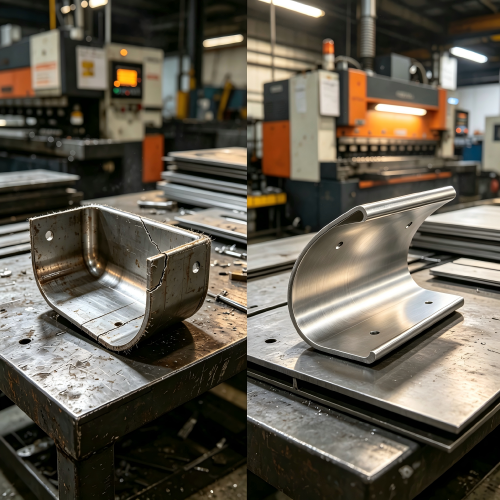
30
Jul’2026Common Defects in CNC Bending and How to Solve Them
CNC bending is one of the most critical processes in sheet metal fabrication, transforming flat metal sheets into precise three-dimensional components. But even the most advanced CNC bending operation can produce defects when parameters are not properly optimized. Have you ever received a batch of bent sheet metal parts where the angles were off by a few degrees, the flanges didn’t align, or the part simply wouldn’t fit into its assembly? Or perhaps you have seen cracks appear on the outside of a bend, ruining an otherwise perfect part? These are among the most common and costly frustrations in sheet metal fabrication. A bend that is off by just one degree can render an entire assembly unusable. And unlike cutting defects, which are often visible immediately, bending defects like springback and internal cracks can hide until assembly—when it’s too late to fix without scrapping the part.
At Lingyufab, we see these defects every day—and we know how to prevent them. With over 20 years of precision manufacturing experience since 2003 and certification as a core supplier for Mitsubishi Electric, our CNC bending centers feature real-time angle monitoring and dynamic crowning systems that ensure consistent accuracy across every part. This guide covers the most common defects in CNC bending, what causes them, and how to solve them.
Why Bending Defects Happen
Most sheet metal bending defects don’t require expensive fixes—they just need better setup, smarter design, and a bit of prevention. Bending quality is influenced by material properties, tooling selection, machine parameters, and part geometry. When any of these factors are misaligned, defects occur.
Understanding the root causes of bending defects is the first step to preventing them. This guide walks you through the four most common defects in CNC bending and shows you what to do about each one.
Defect 1: Springback — The Persistent Problem
Springback is one of the most persistent and frustrating defects in sheet metal bending. When the bending force is released, the material naturally tries to return to its original shape due to its elastic properties. The problem shows up the moment the punch retracts: the part that looked perfect under load suddenly opens a few degrees, or a flange that was flat on the die now carries a visible wave.
What causes it: Springback occurs because materials have elastic memory. High-strength steels and aluminum alloys are particularly prone to springback. The extent of springback depends on multiple factors: material type and thickness, bend radius, bend angle, punch and die geometry, and the clearance between them.
How to solve it: The most common solution is overbending—intentionally bending the part past the target angle so it springs back to the correct position. Modern CNC press brakes with real-time angle monitoring can dynamically measure the angle during the stroke and automatically adjust for metallurgical deviations across different batches of steel and aluminum. Another technique is bottom bending or coining, which applies higher force to plastically deform the material and minimize springback.
How to prevent it: Work with a supplier who understands springback compensation. Lingyufab’s CNC bending centers are programmed with springback compensation for each material and thickness, ensuring final angles match your drawings. Our advanced press brakes feature real-time laser angle tracking that dynamically measures the angle during the stroke, automatically adjusting for material variations.
Defect 2: Cracking and Fracture — The Structural Failure
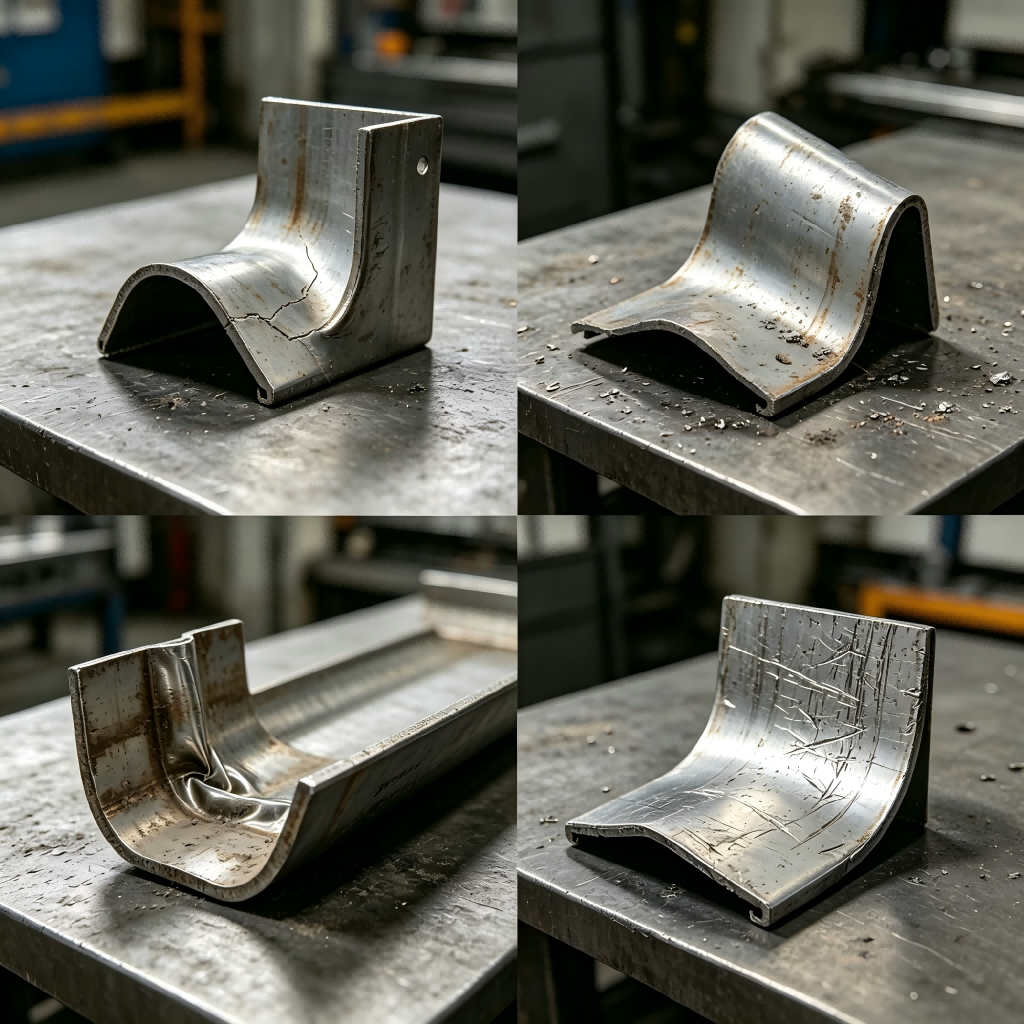
Cracking is one of the most serious bending defects because it compromises structural integrity. Cracks typically appear on the outside of the bend, where the material is stretched beyond its elongation limit.
What causes it: The most common cause is an inside bending radius that is too small for the material thickness. A tight radius concentrates stress on the outer surface, overstretching the material until it fractures. Other contributing factors include bending against the grain direction, using low-ductility materials, and excessive machine force. Edge cracking can also occur when laser cutting parameters were not optimized, creating a hardened heat-affected zone along the cut edge.
How to solve it: For existing cracks, the part typically must be scrapped—cracks cannot be reliably repaired without compromising structural integrity.
How to prevent it: Ensure the inside bend radius is appropriate for the material thickness. As a general rule, the inner bend radius should be at least 1-1.5 times the material thickness. Bend perpendicular to the grain direction whenever possible to minimize cracking. For harder materials, consider using a larger bend radius or applying heat to increase ductility. A suitable lubricant during forming can also help reduce friction and prevent cracking. Lingyufab’s engineering team reviews your drawings before production, flagging potential cracking risks and recommending optimal bend radii for your specific material and thickness.
Defect 3: Wrinkling — The Surface Imperfection
Wrinkling occurs when compressive forces cause the material to buckle inward, creating ripples or bulges on the inside of the bend or along flanges. While wrinkling may not break the part, it ruins the clean, professional look and can affect fitment in precision assemblies.
What causes it: Wrinkling is more likely when thin sections lack internal support or when the material does not have enough stiffness to resist compressive forces. Poor die support lets the material shift instead of holding its shape. Excessive compression, inadequate blank holder pressure, and insufficient lubrication all contribute.
How to solve it: Minor wrinkling can sometimes be corrected through additional forming or grinding. Severe wrinkling typically requires scrapping the part.
How to prevent it: Reduce unsupported flange lengths—long flanges are prone to wrinkling. Use proper blank holder pressure to control material flow during forming. Choose the correct sheet thickness for the application. Apply lubrication to reduce friction and stress. In severe cases, redesigning the tooling may be necessary. Lingyufab’s experienced operators and comprehensive tooling inventory ensure the right die selection for every job, minimizing wrinkling risks.
Defect 4: Tooling Marks and Surface Damage
Tooling marks are visible indentations, scratches, or scoring along the bend. On thin sheet metal, these marks are more than cosmetic—they can affect subsequent finishing operations and create stress concentration points.
What causes it: Worn or incorrect tooling, insufficient lubrication, or burrs on the tooling surface. Hard contact with the sheet surface from rough handling also contributes.
How to solve it: Light marks can sometimes be removed through polishing or finishing. Deep marks that affect structural integrity typically require scrapping the part.
How to prevent it: Keep all tooling clean and regularly maintained. Ensure operators use proper die radii and apply lubrication to reduce friction. For pre-painted or anodized surfaces, use specialized protective urethane tape or non-marking dies to prevent scratches during forming. Lingyufab maintains precision-ground tooling and follows strict tool maintenance schedules to ensure flawless surface quality on every bend.
How Lingyufab Prevents Bending Defects
Lingyufab is a professional sheet metal fabrication manufacturer and sheet metal supplier based in Shanghai, China, with over 20 years of precision manufacturing experience since 2003. We follow strict Japanese quality standards and are a certified core supplier for Mitsubishi Electric.
What sets Lingyufab apart as a sheet metal supplier is our systematic approach to bending quality:
• Real-time angle monitoring — Our advanced CNC press brakes feature real-time laser angle tracking that dynamically measures the angle during the stroke, automatically adjusting for metallurgical deviations
• Springback compensation — We program compensation for each material and thickness, ensuring final angles match your drawings
• Precision-ground tooling — Our comprehensive tooling inventory is regularly maintained to ensure consistent, blemish-free bends
• Design review — Our engineering team reviews your drawings before production, identifying potential defects before they occur
• Quality inspection — We inspect at multiple stages, verifying bend angles, flange lengths, and surface quality before shipment
Our in-house capabilities include: CNC bending — Precision bending with consistent accuracy and springback compensation. Laser cutting, welding, assembly, surface treatment, and fastener installation—all under one roof. ISO 9001, ISO 14001, and TÜV CE certified. Full material traceability with Mill Test Certificates.
One supplier, full responsibility. From laser cutting and CNC bending to welding, surface treatment, and fastener installation, we handle everything under one roof. This integration ensures consistent quality, shorter lead times, and a single point of accountability for your entire project.
If you are concerned about bending defects in your sheet metal parts, our engineering team is available to review your requirements and provide a free consultation. We’ll help you identify risks before production begins. If you are looking for a reliable sheet metal fabrication supplier, please don’t hesitate to contact us.
Quick Bending Defect Prevention Checklist for Buyers
| What to Check | What to Look For |
|---|---|
| Springback | Bend angles match drawing within ±0.5°—check for angles that are too open |
| Cracking | Any cracks on the outside of the bend—any crack is a reject |
| Wrinkling | Ripples or bulges on the inside of the bend or along flanges |
| Tooling marks | Excessive indentations, scratches, or scoring along the bend |
| Flange length | Flange lengths match drawing within specified tolerance |
| Part-to-part consistency | All parts in batch are dimensionally identical |
FAQs
Q1: What is the most common defect in CNC bending?
Springback is one of the most common and persistent defects. When the bending force is released, the material tries to return to its original shape. High-strength steels and aluminum alloys are particularly prone to springback. Modern CNC press brakes compensate for this through overbending and real-time angle monitoring.
Q2: What causes cracking at the bend?
The most common cause is an inside bending radius that is too small for the material thickness. Other factors include bending against the grain direction, using low-ductility materials, and excessive machine force. As a general rule, the inner bend radius should be at least 1-1.5 times the material thickness.
Q3: How can I prevent wrinkling during bending?
Reduce unsupported flange lengths, use proper blank holder pressure, apply lubrication, and ensure the die provides adequate support. Poor die support and insufficient material stiffness are the primary causes of wrinkling.
Q4: What is the typical tolerance for CNC bending?
Typical CNC bending tolerances are ±0.5° for bend angles and ±0.05mm for linear positioning. Lingyufab’s advanced CNC press brakes achieve these tolerances consistently through real-time angle monitoring and dynamic crowning systems.
Q5: Can Lingyufab bend both thin and thick sheet metal?
Yes. Lingyufab bends materials from 0.5mm thin sheet up to 20mm heavy gauge plate, with bending force ranging from 40 tons to 400 tons (and up to 1,000+ tons for heavy plate). We adjust tooling, bend radius, and forming parameters based on material type and thickness.
Q6: What file formats do you accept for bending quotes?
We accept 3D files in STEP (.stp), IGS (.igs), and SolidWorks (.sldprt) formats, and 2D drawings in PDF, DWG, and DXF formats. If you don’t have drawings, we offer reverse engineering services from physical samples.