+8613003178786
 sales@lingyufab.com



Common Defects in Sheet Metal Stamping and How to Prevent Them
20
Oct’2026Common Defects in Sheet Metal Stamping and How to Prevent Them
Sheet metal stamping is one of the most efficient manufacturing processes for high‑volume production, capable of producing thousands of identical parts per hour with remarkable consistency. But even the most well‑tuned stamping operation can produce defects when parameters drift, tooling wears, or material properties vary. Have you ever received a batch of stamped parts with burrs that required secondary deburring, cracks that compromised structural integrity, or dimensional drift that made assembly impossible? These are among the most common and costly frustrations in high‑volume sheet metal production. A stamping defect that goes undetected can multiply across thousands of parts, turning a small problem into a massive scrap pile.
At Lingyufab, we understand the complexities of stamping quality. With over 20 years of precision manufacturing experience since 2003 and certification as a core supplier for Mitsubishi Electric, our stamping operations are supported by rigorous process control, regular tool maintenance, and systematic quality inspection. This guide covers the most common defects in sheet metal stamping, what causes them, and how to prevent them.
Why Stamping Defects Happen
Stamping defects typically arise from a combination of factors: improper die clearance, worn tooling, incorrect press speed or force, material quality issues, inadequate lubrication, or inconsistent strip feeding. Understanding these root causes is the first step to preventing defects. This guide covers the most common stamping defects and shows you what to do about each one.
Defect 1: Burrs — The Surface Problem
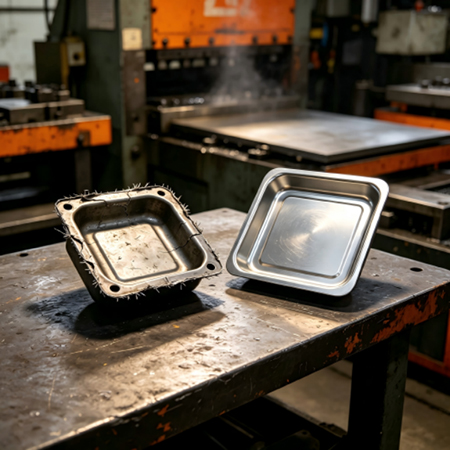
Burrs are rough, raised edges along the cut line of a stamped part. They are among the most visible and frustrating defects in stamping, often requiring secondary deburring operations that add time and cost.
What causes it: Burrs are typically caused by improper die clearance—too large, too small, or uneven. Worn or dull cutting edges on the punch and die also contribute. Misalignment between the punch and die, or poor strip feeding, can also cause uneven burr formation.
How to solve it: Existing burrs can be removed through mechanical deburring, tumbling, or grinding. For parts with tight tolerance requirements, burr removal may require specialized equipment.
How to prevent it: Maintain proper die clearance for the material thickness. Regularly inspect and sharpen cutting edges. Ensure proper alignment between punch and die. Use consistent strip feeding with proper pilot pin engagement. Monitor tool wear and replace tooling before it becomes excessively worn.
Defect 2: Cracking and Tearing — The Structural Failure
Cracking is one of the most serious stamping defects because it compromises structural integrity. Cracks can appear at the edges of stamped parts or in areas of high deformation during forming.
What causes it: Cracking occurs when the material's strain exceeds its formability limit. Common causes include unsuitable material properties, excessive punch speed creating impact stress, insufficient lubrication increasing friction, and improper die design. Wrinkling in the blank holder area can also force the material to unwrinkle, leading to splitting.
How to solve it: Cracks typically require scrapping the part. For minor edge cracking, trimming may be possible, but the part's structural integrity may still be compromised.
How to prevent it: Use materials with adequate ductility for the forming operation. Optimize punch speed—too fast increases cracking risk; too slow causes incomplete forming. Ensure proper lubrication to reduce friction. Adjust draw bead parameters and blank holder force to control material flow. Regularly monitor material properties and adjust parameters accordingly.
Defect 3: Wrinkling — The Surface Imperfection
Wrinkling occurs when compressive forces cause the material to buckle inward, creating ripples or folds on the surface. While wrinkling may not break the part, it ruins appearance and can affect assembly fit.
What causes it: Wrinkling is caused by differences in material flow resistance during the stamping process. Inadequate blank holder force allows the material to move too freely. Insufficient lubrication increases friction and causes uneven material flow. Improper die design with incorrect draw bead placement is also a common cause.
How to solve it: Minor wrinkling may be corrected through secondary forming or grinding. Severe wrinkling typically requires scrapping the part.
How to prevent it: Adjust blank holder force to provide adequate material control without restricting flow. Ensure proper lubrication to reduce friction. Optimize die design with appropriate draw bead placement and geometry. Use CAE simulation to predict wrinkling before die manufacturing.
Defect 4: Springback — The Dimensional Problem
Springback is one of the most common and challenging dimensional accuracy issues in sheet metal stamping. When the forming force is released, the material tries to return to its original shape, causing dimensional deviation.
What causes it: Springback is inherent to the elastic recovery of metal after plastic deformation. It can cause multiple quality issues: dimensional inaccuracy in bending angles, misalignment during assembly, and warping or twisting in structural parts. Material property variations and process parameter changes are the main causes of springback variation.
How to solve it: Springback can be corrected through overbending compensation, secondary coining operations, or mechanical straightening. However, these add cost and time.
How to prevent it: Compensate for springback through overbending or tool angle adjustment. Use bottoming or coining to minimize elastic recovery. Maintain consistent material properties and process parameters. Consider using higher‑strength materials with predictable springback behavior.
Defect 5: Surface Scratches and Galling
Surface scratches, scoring, and galling are visible defects that affect appearance and can compromise corrosion resistance.
What causes it: Galling occurs when metal particles adhere to the die surface during sliding contact. Contamination on the die or sheet surface—such as dirt, metal fragments, or debris—can also cause scratches and indentations. Insufficient lubrication increases friction and wear.
How to solve it: Light scratches may be removed through polishing or finishing. Deep scratches or galling typically require scrapping the part.
How to prevent it: Keep die surfaces clean and free of debris. Maintain proper lubrication. Regularly inspect and polish die surfaces. Use tool coatings to reduce friction and wear. Ensure material surfaces are clean before stamping.
Defect 6: Dimensional Drift
Dimensional drift occurs when part dimensions gradually shift out of tolerance over a production run. This is particularly problematic for high‑volume production where defects can accumulate before detection.
What causes it: Tool wear is the primary cause of dimensional drift. Material variability between batches can also contribute. Inconsistent press operation, including speed and force variations, is another factor.
How to solve it: Dimensional drift requires process adjustment—typically tooling replacement or parameter changes. Parts outside tolerance must be scrapped.
How to prevent it: Implement regular tool inspection and maintenance schedules. Monitor critical dimensions throughout production runs. Use statistical process control (SPC) to detect drift early. Maintain consistent press parameters and material specifications.
How Lingyufab Prevents Stamping Defects
Lingyufab is a professional sheet metal fabrication manufacturer and sheet metal supplier based in Shanghai, China, with over 20 years of precision manufacturing experience since 2003. We follow strict Japanese quality standards and are a certified core supplier for Mitsubishi Electric.
What sets Lingyufab apart as a sheet metal supplier is our systematic approach to stamping quality:
Die maintenance — Regular inspection and sharpening of cutting edges to prevent burrs and maintain dimensional accuracy
Process control — Consistent press parameters, lubrication, and strip feeding for stable production
Material verification — Incoming material inspection with Mill Test Certificates (MTC) to ensure consistent properties
In‑process inspection — Regular dimensional checks to detect drift early
First Article Inspection — Full dimensional verification before production runs
Our in‑house capabilities include:
Stamping — High‑speed production with consistent quality across millions of cycles.
Laser cutting — High‑precision fiber laser cutting for accurate flat patterns.
CNC bending — Precision bending with consistent accuracy and springback compensation.
Laser welding — High‑speed, low‑distortion welding with minimal heat input.
Sheet metal fabrication — Complete assembly, surface treatment, and fastener installation.
ISO 9001, ISO 14001, and TÜV CE certified.
Full material traceability with Mill Test Certificates.
One supplier, full responsibility. From laser cutting and CNC bending to stamping, welding, surface treatment, and fastener installation, we handle everything under one roof. This integration ensures consistent quality, shorter lead times, and a single point of accountability for your entire project.
If you are concerned about stamping quality in your parts, our engineering team is available to review your requirements and provide a free consultation. If you are looking for a reliable sheet metal fabrication supplier, please don't hesitate to contact us.
Quick Stamping Defect Prevention Checklist for Buyers
| What to Check | What to Look For |
|---|---|
| Burrs | Rough edges along cut lines—indicates die clearance or wear issues |
| Cracking | Any cracks on part surface or edges—any crack is a reject |
| Wrinkling | Ripples, folds, or buckling on the part surface |
| Springback | Dimensional deviation from drawing—check critical angles and dimensions |
| Surface scratches | Visible marks, scoring, or galling on the part surface |
| Dimensional consistency | All parts in batch within tolerance—check for drift over the run |
FAQs
Q1: What is the most common defect in sheet metal stamping?
Burrs are among the most common stamping defects. They are typically caused by improper die clearance or worn cutting edges. While burrs are visible and require deburring, they are generally less serious than cracks or dimensional drift.
Q2: What causes cracking in stamped parts?
Cracking is caused by material strain exceeding its formability limit. Common causes include unsuitable material properties, excessive punch speed, insufficient lubrication, and improper die design. Wrinkling in the blank holder area can also force material to unwrinkle and split.
Q3: What is springback and why does it matter?
Springback is the elastic recovery of metal after forming forces are released, causing dimensional deviation from the intended shape. It matters because it can cause bending angle inaccuracy, misalignment during assembly, and warping in structural parts.
Q4: How can I prevent dimensional drift in stamped parts? Dimensional drift is typically caused by tool wear, material variability, or inconsistent press operation. Prevention strategies include regular tool inspection and maintenance, in‑process dimensional monitoring, statistical process control, and maintaining consistent press parameters and material specifications.
Q5: What is galling and how can it be prevented?
Galling is a surface defect where metal particles adhere to the die surface during sliding contact, causing scratches and scoring. Prevention includes keeping die surfaces clean, maintaining proper lubrication, using tool coatings, and ensuring material surfaces are clean before stamping.
Q6: Can Lingyufab help me prevent stamping defects?
Yes. Lingyufab provides systematic quality control including die maintenance, in‑process inspection, and material verification. Our engineering team can review your requirements and recommend process improvements to prevent defects. We also offer free DFM reviews to catch potential issues before production begins.