+8613003178786
  sales@lingyufab.com



Laser Welding Parameters: A Practical Guide to Optimizing Power, Speed, Focus, and Pulse
16
Oct’2026Laser Welding Parameters: A Practical Guide to Optimizing Power, Speed, Focus, and Pulse
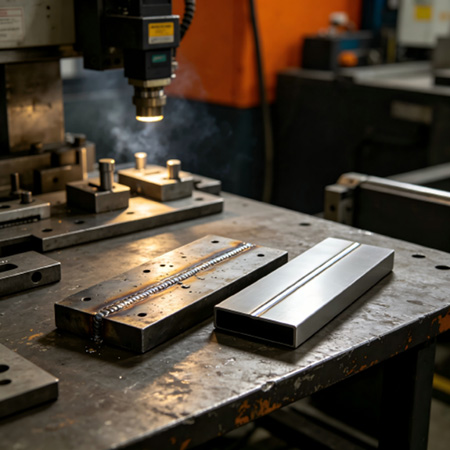
Laser welding delivers exceptional precision, speed, and minimal thermal distortion, making it one of the most advanced joining technologies in modern manufacturing. But even the most sophisticated laser welding system can produce inconsistent results if parameters are not properly optimized. Have you ever adjusted laser power or welding speed on a machine, only to find the weld quality didn’t improve—or got worse? Or perhaps you have struggled with inconsistent penetration, porosity, or cracking across different batches of the same material? These are among the most common frustrations faced by welding engineers, production managers, and quality inspectors. Unlike traditional welding, where experienced operators can make real‑time adjustments, laser welding requires precise parameter control before the first weld is made. Even small variations can lead to defects that compromise joint strength and reliability.
At Lingyufab, we understand that achieving consistent, high‑quality laser welds starts with parameter optimization. With over 20 years of precision manufacturing experience since 2003 and certification as a core supplier for Mitsubishi Electric, our advanced fiber laser welding systems are equipped with precise control over power, speed, focus, and pulse parameters. This guide explains the critical parameters that affect laser welding quality, how they interact, and practical strategies for optimization.
Why Laser Welding Parameters Matter
Laser welding relies on concentrated light energy to fuse materials. Unlike conventional welding, it offers minimal heat distortion and exceptional control—but this precision hinges on selecting the right combination of parameters. Incorrect settings can lead to defects like porosity, cracks, incomplete fusion, or excessive spatter, compromising structural integrity.
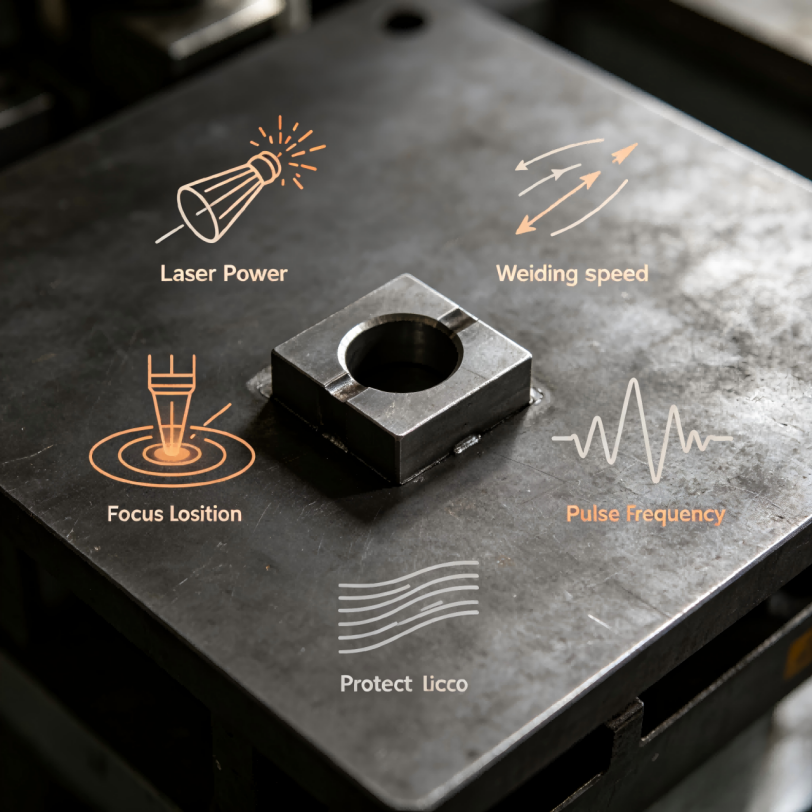
The quality of a laser weld is determined by the interaction of several interdependent parameters: laser power, welding speed, focus position, pulse settings (for pulsed lasers), shielding gas, and joint preparation. Understanding how these parameters interact is the first step to achieving optimal results.
Continuous Wave vs. Pulsed Welding
Before diving into specific parameters, it is essential to understand the two primary laser welding modes, as they fundamentally affect how other parameters are set.
Continuous Wave (CW) Welding provides a steady, uninterrupted laser beam. It is ideal for applications requiring deep penetration and high‑speed production, particularly effective for welding thicker materials where consistent energy input is needed. CW mode is the default for most handheld and automated laser welding systems.
Pulsed Welding delivers energy in short bursts, which helps minimize heat input. This technique is commonly used for thin materials or applications where heat‑sensitive components must be protected from excessive thermal distortion. Pulsed welding offers improved weld quality and significantly reduced heat input, making it ideal for thin, heat‑sensitive sheet metals, delicate meshes, and welding dissimilar metals.
Modulated CW Lasers allow for dynamic power adjustments during welding, fine‑tuning energy delivery in real‑time for different materials and thicknesses.
The Critical Laser Welding Parameters
Laser Power
Laser power determines the energy delivered to the workpiece, directly affecting penetration depth and weld strength. Higher power increases penetration but risks overheating thinner materials. The appropriate power setting depends on material type, thickness, and joint design.
General guidelines: For stainless steel, 2–4 kW is typically required, while aluminum alloys need lower power (1–3 kW) to avoid burn‑through. For thin sheets under 1mm, power settings as low as 20‑50 watts may be used for precise applications. Heavier structural components may require 6‑10 kW systems.
The relationship between power and speed is interdependent—increasing power allows for higher welding speeds while maintaining penetration, but excessive power without corresponding speed adjustment causes burn‑through and excessive spatter. Modern fiber laser systems incorporate real‑time power monitoring and adjustment capabilities, ensuring consistent energy delivery even as environmental conditions or material properties change.
Welding Speed
Welding speed affects heat input and weld geometry. Faster speeds reduce heat exposure, minimizing distortion—ideal for thin sheets or heat‑sensitive alloys. Slower speeds enhance penetration for thicker materials.
Typical speed ranges: Automotive manufacturers often use speeds of 5–10 meters per minute for sheet metal, while heavy machinery parts may require 1–3 meters per minute. For handheld laser welding, speeds of 8–15 mm/s are common for thin materials.
The power‑speed balance is critical. Increasing speed without adjusting power can result in incomplete fusion, while decreasing speed without reducing power might cause excessive heat input, leading to material degradation or excessive spatter.
Focus Position
Focus position determines where the laser beam reaches its smallest spot size, directly affecting the energy density at the material surface. Even small changes in focus position can significantly affect weld penetration depth and shape.
Focus position fundamentals: A defocusing amount of 0 mm (focus on the surface) typically produces a straight weld. Negative focus (focus below the surface) increases penetration depth and is commonly used for deep penetration welding. Positive focus (focus above the surface) produces a wider, shallower weld.
Typical focus settings: For 6mm carbon steel, a negative focus of ‑1.5mm is a typical starting point. For thin sheets, zero focus or slight negative focus is often preferred.
Pulse Frequency and Duration (for Pulsed Welding)
For pulsed laser welding, two additional parameters become critical:
Pulse duration (or pulse length) refers to how long the laser beam remains active during each pulse. Longer pulse lengths (5–10 ms) improve penetration in thicker components but introduce more heat into the weld. Shorter pulse lengths (1–3 ms) minimize heat input but reduce travel speed.
Pulse frequency refers to how often pulses are fired per second (Hz). Higher frequencies (200–500 Hz) allow faster welding but can increase weld spatter. Lower frequencies (50–100 Hz) can result in higher quality and more aesthetically pleasing welds but reduce welding speed.
Shielding Gas
Shielding gas protects the weld pool from oxidation and contamination. The choice of gas and flow rate affects weld quality, appearance, and mechanical properties.
Common shielding gases: Argon (Ar) is the most commonly used shielding gas for laser welding, suitable for most materials. Nitrogen (N₂) is often used for stainless steel to prevent oxidation. Helium (He) provides deeper penetration but is more expensive.
Flow rate guidelines: Typical flow rates range from 10–20 L/min, depending on material and joint configuration.
Joint Fit‑Up and Gap Control
Laser welding requires tighter joint fit‑up than conventional welding. The laser beam is highly focused and cannot bridge gaps as effectively as arc welding processes.
General guidelines: For autogenous welding (without filler wire), gaps should ideally not exceed 0.1–0.2mm. For gaps up to 0.5–1.0mm, filler wire or wobble techniques may be required. Ensuring proper joint preparation and fixturing is essential for consistent weld quality.
How to Optimize Laser Welding Parameters
A systematic approach to parameter optimization helps ensure consistency and minimize trial‑and‑error:
1. Start with Baseline Parameters — Use established machine presets or manufacturer recommendations for your material and thickness. Most laser welding machines include presets designed to address common materials and thicknesses.
2. Perform a Test Weld — Make a short weld and observe penetration depth, bead appearance, and any defects. A good starting point is to weld a test coupon and section it to check penetration.
3. Adjust One Parameter at a Time — Make small changes to one parameter while keeping others constant. This helps identify the true cause of quality improvements or problems.
4. Evaluate Weld Quality — Check for penetration depth, bead width, surface appearance, porosity, cracks, and distortion.
5. Document Successful Settings — Store optimized parameters by material and thickness for future consistency.
Common Parameter Mistakes to Avoid
• Power too high for material thickness — Causes burn‑through, excessive spatter, and wide heat‑affected zones.
• Speed too fast — Results in incomplete penetration or lack of fusion.
• Speed too slow — Causes excessive heat input, wide HAZ, and potential distortion.
• Incorrect focus position — Reduces penetration depth or creates inconsistent weld profiles.
• Inadequate shielding gas — Leads to oxidation, porosity, and discolored welds.
• Poor joint fit‑up — Causes inconsistent penetration and potential weld defects.
How Lingyufab Optimizes Laser Welding Parameters
Lingyufab is a professional sheet metal fabrication manufacturer and sheet metal supplier based in Shanghai, China, with over 20 years of precision manufacturing experience since 2003. We follow strict Japanese quality standards and are a certified core supplier for Mitsubishi Electric.
What sets Lingyufab apart as a sheet metal supplier is our systematic approach to laser welding parameter optimization. Our engineering team reviews your material and joint requirements before production, recommending the optimal parameters for your specific application. Our advanced fiber laser welding systems feature precise control over power, speed, focus, and pulse settings, ensuring consistent quality across all parts.
Our in‑house capabilities include:
• Laser welding — High‑speed, low‑distortion welding with optimized parameters for each material and thickness.
• Laser cutting — High‑precision fiber laser cutting with optimized parameters for clean edges.
• CNC bending — Precision bending with consistent accuracy and springback compensation.
• Sheet metal fabrication— Complete assembly, surface treatment, and fastener installation.
• ISO 9001, ISO 14001, and TÜV CE certified.
• Full material traceability with Mill Test Certificates.
One supplier, full responsibility. From laser cutting and CNC bendingto welding, surface treatment, and fastener installation, we handle everything under one roof. This integration ensures consistent quality, shorter lead times, and a single point of accountability for your entire project.
If you are unsure which laser welding parameters are right for your project, our engineering team is available to review your requirements and provide a free consultation. We'll help you identify the optimal settings for your material, thickness, and quality requirements. If you are looking for a reliable sheet metal fabrication supplier, please don't hesitate to contact us.
Quick Laser Welding Parameter Checklist for Buyers
| What to Check | What to Consider |
|---|---|
| Material type | Stainless steel, aluminum, or other—each requires different parameter settings |
| Material thickness | Thicker materials require higher power and slower speeds |
| Joint design | Butt, lap, or fillet—each requires different parameter approaches |
| Weld penetration | Does the weld fully penetrate the joint? |
| Surface appearance | Clean, uniform bead with minimal spatter |
| Distortion | Minimal warping or distortion of the welded assembly |
FAQs
Q1: What is the difference between continuous wave and pulsed laser welding?
Continuous wave (CW) welding provides a steady, uninterrupted laser beam, ideal for deep penetration and high‑speed production on thicker materials. Pulsed welding delivers energy in short bursts, minimizing heat input and making it ideal for thin materials, heat‑sensitive components, and delicate assemblies.
Q2: How do I choose the right laser power for my material?
The appropriate power depends on material type and thickness. For stainless steel, 2–4 kW is typical; for aluminum, 1–3 kW to avoid burn‑through; for thin sheets under 1mm, power may be as low as 20‑50 watts. The best approach is to start with manufacturer presets and adjust based on test weld results.
Q3: What is the relationship between laser power and welding speed?
Power and speed are interdependent. Increasing power allows for higher welding speeds while maintaining penetration. Increasing speed without adjusting power can result in incomplete fusion, while decreasing speed without reducing power might cause excessive heat input.
Q4: Why is focus position important in laser welding?
Focus position determines the energy density at the material surface, directly affecting weld penetration depth and shape. Negative focus (below the surface) increases penetration; zero focus (on surface) produces a straight weld; positive focus produces a wider, shallower weld.
Q5: How do I prevent porosity in laser welding?
Porosity is typically caused by inadequate shielding gas, contaminated material surfaces, or incorrect parameter settings. Ensure proper shielding gas flow (10‑20 L/min), clean material surfaces before welding, and optimize power and speed for your material.
Q6: Can Lingyufab help me optimize laser welding parameters for my specific application?
Yes. Lingyufab's engineering team can review your material, thickness, and joint requirements and recommend the optimal parameters for your specific application. We also provide free DFM reviews to catch potential issues before production begins.