+8613003178786
  sales@lingyufab.com


How to Predict and Compensate for Springback in Sheet Metal Bending
13
Oct’2026How to Predict and Compensate for Springback in Sheet Metal Bending
Springback is one of the most persistent and costly challenges in sheet metal bending. Have you ever programmed a perfect 90° bend on a CNC press brake, only to measure 92° after the part was released? Or perhaps you have spent hours on trial‑and‑error adjustments, wasting material and operator time, while the angles still didn't match the drawing? These are among the most common frustrations faced by production managers, quality engineers, and press brake operators. A bend that is off by just one degree can render an entire assembly unusable—and when you are running batches of hundreds or thousands of parts, that error multiplies into significant scrap, rework, and lost productivity.
At Lingyufab, we understand that springback is not a defect to be eliminated—it is a physical property to be understood and compensated for. With over 20 years of precision manufacturing experience since 2003 and certification as a core supplier for Mitsubishi Electric, our CNC bending centers are equipped with advanced real‑time angle monitoring and dynamic compensation systems that predict and adjust for springback automatically. This guide explains what springback is, why it happens, how to predict it, and the most effective compensation strategies to achieve consistent, accurate bends every time.
What Is Springback and Why Does It Happen?
Springback is the elastic recovery of metal after the bending force is released. When a sheet metal part is bent, the material undergoes both elastic (temporary) and plastic (permanent) deformation. The outer region of the bend is stretched in tension, while the inner region is compressed. When the press brake punch retracts, the elastic portion of the deformation tries to recover, causing the part to "spring back" toward its original flat shape.
The result is a final angle that is more open than the tool angle used to create it. If you bend to 90° on the press brake, the part might spring back to 92° or more. The amount of springback depends on several interacting variables: material strength (higher tensile strength = more springback), yield strength‑to‑elastic modulus ratio (a higher ratio increases springback), material thickness, bend radius, bend angle, and the bending method used (air bending, bottom bending, or coining).
How Different Materials Behave
Not all metals spring back the same way. Understanding material‑specific behavior is essential for accurate compensation:
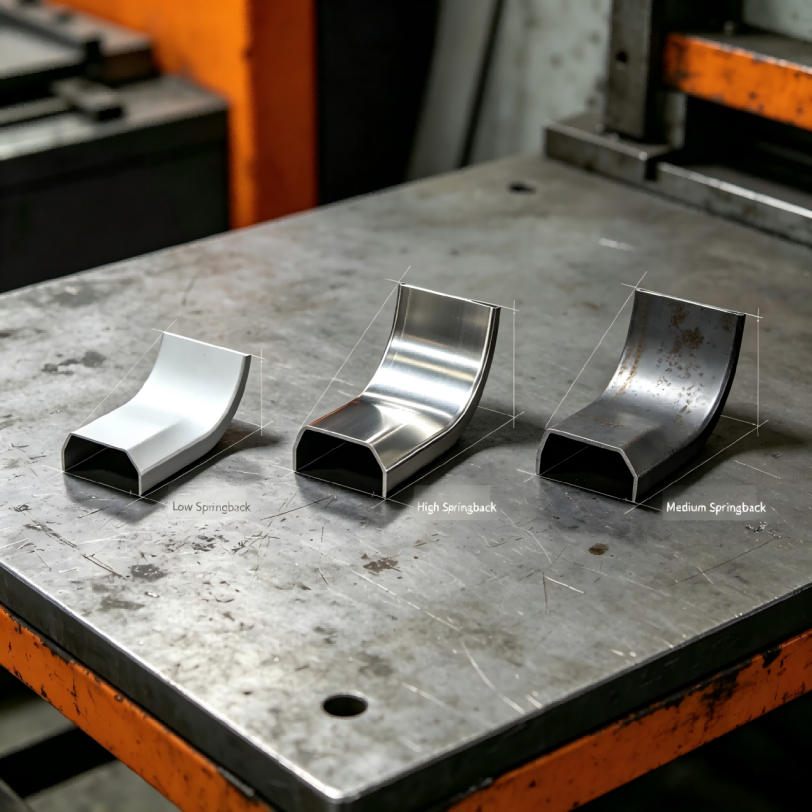
Aluminum exhibits the lowest springback among common sheet metals. However, its lower stiffness means springback impacts dimensional accuracy proportionally more. Longer load holding times help reduce springback, with aluminum showing the greatest reduction. When bending 5052 or 6061 aluminum, springback is typically more predictable than with steel, but the material's softer nature requires careful tooling selection to avoid surface marking.
Stainless Steel exhibits the highest springback among common materials. Bending 304 stainless steel typically produces 2 to 3 degrees of springback. The higher the material strength and the larger the bend radius, the greater the springback effect. High‑strength steels can spring back by 5 degrees or more depending on thickness and bend radius. The higher yield strength of stainless steel means more elastic recovery.
Carbon Steel falls between aluminum and stainless steel in terms of springback behavior. Low‑carbon steels like 1008 or 1010 are more forgiving and exhibit moderate springback. High‑strength low‑alloy (HSLA) steels and advanced high‑strength steels (AHSS) can exhibit springback comparable to or exceeding stainless steel. The springback of carbon steel increases with carbon content and tensile strength. The springback behavior of carbon steel is generally more consistent batch‑to‑batch than stainless steel, making compensation more predictable.
How to Predict Springback
Accurate prediction is the foundation of effective compensation. Several approaches are available, ranging from simple calculations to advanced simulation.
The Quick Test Method
The most practical approach for production environments is to run a test bend using the actual material from the same batch. Program a known angle, measure the resulting angle with a digital angle gauge, and calculate the difference. For example, if you program 90° and measure 92°, the springback is approximately 2°. This direct measurement captures all variables—material properties, thickness variations, tooling condition, and lubrication—in one simple test.
The K‑Factor and Springback Formula
For a more analytical approach, the K‑factor—which defines where the neutral axis sits through the material thickness—can be used to calculate springback. Steel typically has a K‑factor around 0.33, while aluminum is around 0.38. The springback angle can be estimated using the formula: Δθ ≈ θ × (1 − K), where K = 4X³ − 3X + 1, and X = σy × R / (E × t)—with σy being yield stress, R the inside bend radius, E the elastic modulus, and t the material thickness.
Advanced Prediction Methods
For critical or high‑value applications, more sophisticated methods are available. Finite Element Analysis (FE) simulation can model the bending process and predict springback with high accuracy. Iterative compensation algorithms can refine predictions by using data from previous bends to improve accuracy for subsequent parts. Machine learning models trained on historical bending data can predict springback based on material properties and process parameters.
Proven Compensation Strategies
Once springback is understood and predicted, the next step is compensation. Here are the most effective workshop‑proven methods:
Overbending Compensation
The most common and direct method is controlled overbending. Program the CNC press brake to bend beyond the target angle by an amount equal to the predicted springback. If you need a final 90° bend and expect 2° of springback, program 88°. Modern CNC systems such as Delem allow angle correction directly in the control interface, storing compensation values for consistent production. This method is especially effective for batch production where repeatability matters.
Bottom Bending
Bottom bending drives the punch into the die until the material contacts the bottom of the V‑die, creating more plastic deformation and reducing springback. This method requires three to five times the tonnage of air bending but delivers more consistent angles. The material is forced to conform to the tool angle, minimizing elastic recovery.
Coining
Coining applies the highest force to plastically deform the material completely, eliminating springback entirely. The punch tip penetrates the neutral axis while thinning the material at the point of bend, realigning the molecular structure. Coining requires the highest tonnage but delivers the most precise results—the final product has virtually no springback. However, it requires higher tonnage and proper machine capacity.
Optimize Tooling Selection
Tooling plays a critical role in minimizing springback. For mild steel, use a V‑die opening of 6‑8 times material thickness. For stainless steel, reduce the V‑opening slightly to control elastic recovery. A smaller punch tip radius increases plastic deformation and reduces the elastic recovery portion of the bend. However, balance this with the risk of cracking, especially when bending high‑strength materials.
Bottoming, Coining, and Air Bending: A Quick Comparison
Air bending is the most flexible method but produces the most springback. Bottom bending minimizes springback but requires higher tonnage. Coining applies the highest force, eliminates springback entirely, and delivers the most precise results.
Load Holding Time and Heat Treatment
Research has shown that longer load holding times help reduce springback by promoting stress relaxation, with aluminum showing the greatest reduction. Annealing significantly decreases springback by softening the material, while normalizing and quenching provide varying levels of reduction, particularly for steel. Synergistic effects between applied load and holding time yield more effective springback reduction than when factors are considered separately.
How Lingyufab Handles Springback Compensation
Lingyufab is a professional sheet metal fabrication manufacturer and sheet metal supplier based in Shanghai, China, with over 20 years of precision manufacturing experience since 2003. We follow strict Japanese quality standards and are a certified core supplier for Mitsubishi Electric.
What sets Lingyufab apart as a sheet metal supplier is our systematic approach to springback compensation. Our CNC bending centers feature real‑time angle monitoring and dynamic crowning systems that ensure consistent accuracy across every part. We maintain comprehensive springback data for all common materials—aluminum, stainless steel, carbon steel, and galvanized steel—across various thicknesses and bend radii. This database allows us to predict springback accurately without extensive trial‑and‑error.
Our in‑house capabilities include:
CNC bending — Precision bending with springback compensation programmed for each material and thickness, featuring real‑time angle monitoring.
Laser cutting — High‑precision fiber laser cutting with optimized parameters for clean edges.
Laser welding — High‑speed, low‑distortion welding with minimal heat input.
Sheet metal fabrication — Complete assembly, surface treatment, and fastener installation.
ISO 9001, ISO 14001, and TÜV CE certified.
Full material traceability with Mill Test Certificates.
One supplier, full responsibility. From laser cutting and CNC bending to welding, surface treatment, and fastener installation, we handle everything under one roof. This integration ensures consistent quality, shorter lead times, and a single point of accountability for your entire project.
If you are struggling with springback issues in your sheet metal parts, our engineering team is available to review your requirements and provide a free consultation. We'll help you identify the right compensation strategy for your specific material and application. If you are looking for a reliable sheet metal fabrication supplier, please don't hesitate to contact us.
Quick Springback Compensation Checklist for Buyers
| What to Check | What to Consider |
|---|---|
| Material type | Aluminum, stainless, or carbon steel—each has different springback characteristics |
| Bend angle accuracy | Angles match drawing within specified tolerance |
| Overbending compensation | Has the supplier programmed compensation for springback? |
| Test bend validation | Has a test bend been performed to verify compensation? |
| Batch-to-batch consistency | Are all parts in the batch dimensionally identical? |
| Tooling condition | Are punches and dies in good condition? |
FAQs
Q1: What is springback in sheet metal bending?
Springback is the elastic recovery of metal after the bending force is released. When the press brake punch retracts, the material tries to return to its original flat shape, causing the final angle to be more open than the tool angle. Springback is a natural physical behavior of metal—not a defect.
Q2: Why does stainless steel have more springback than aluminum?
Stainless steel has higher tensile strength and a higher yield strength‑to‑elastic modulus ratio than aluminum. The higher the material strength, the greater the springback effect. Research confirms that stainless steel exhibits the highest springback among common materials, while aluminum exhibits the lowest.
Q3: How do I calculate springback for my material?
The most practical method is to run a test bend using the actual material. Program a known angle, measure the result, and calculate the difference. For example, if you program 90° and get 92°, the springback is approximately 2°. Modern CNC systems also allow direct angle compensation in the control interface.
Q4: What is the difference between air bending, bottom bending, and coining for springback control?
Air bending is the most flexible method but produces the most springback. Bottom bending minimizes springback but requires three to five times the tonnage. Coining applies the highest force to eliminate springback entirely and delivers the most precise results—the final product has virtually no springback.
Q5: Can Lingyufab compensate for springback on my parts?
Yes. Lingyufab's CNC bending centers feature real‑time angle monitoring and springback compensation programmed for each material and thickness. Our comprehensive springback database allows us to predict springback accurately without extensive trial‑and‑error.
Q6: How much springback should I expect for a typical 90° bend?
Springback varies by material. For aluminum, springback is typically lower—often 1‑2°. For stainless steel, springback is typically higher—often 2‑3° or more. For carbon steel, springback falls between these ranges. The exact amount depends on material thickness, bend radius, and specific alloy. Always verify with a test bend using your actual material.