+8613003178786
  sales@lingyufab.com



Laser Welding Fixture Design: A Critical Factor for Weld Quality
06
Aug’2026Laser Welding Fixture Design: A Critical Factor for Weld Quality
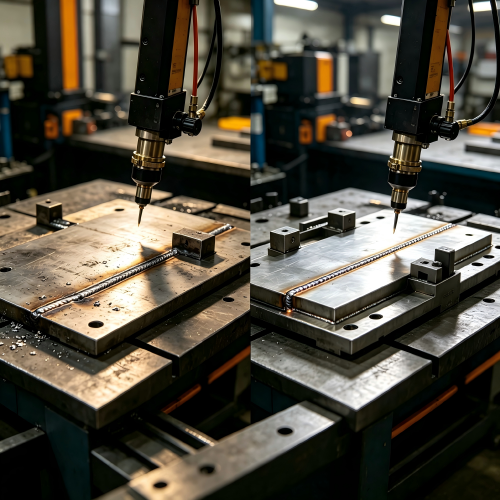
Laser welding fixtures are the foundation of consistent, high-quality welds. Have you ever optimized laser parameters and prepared the perfect material, only to find that the welded parts were misaligned, gaps were inconsistent, or distortion was severe? Many people assume that laser welding quality depends only on the laser source and parameters, but one critical factor is often overlooked: fixture design. A poorly designed fixture can render all your parameter optimization efforts useless.
Laser welding imposes much tighter requirements on fixtures than conventional welding. The laser beam focus diameter is only a fraction of a millimeter, and seam tracking accuracy must be within 0.1mm. If the fixture does not position and clamp the workpiece securely, the weld seam will deviate from its intended path, leading to defects or even scrap. At the same time, laser welding is extremely fast with concentrated heat input—if the fixture cannot effectively dissipate heat and control distortion, thin sheets will warp and deform.
At Lingyufab, we understand the critical role of fixture design in welding quality. As a professional sheet metal fabrication manufacturer and sheet metal supplier, we not only provide laser welding services but also design and manufacture custom welding fixtures for our clients. With over 20 years of precision manufacturing experience since 2003 and certification as a core supplier for Mitsubishi Electric, we know that good fixtures = good welds. This guide covers the key principles and best practices for laser welding fixture design.
Special Requirements of Laser Welding Fixtures
Laser welding fixtures differ from conventional welding fixtures in several important ways. They must simultaneously meet the following requirements:
High-precision positioning. Laser welding requires seam tracking accuracy within 0.1mm, so fixture positioning accuracy must exceed this standard. The machining accuracy of locating pins, locating blocks, and locating surfaces directly affects weld seam position accuracy.
Reliable clamping force. Clamping force must be sufficient to prevent workpiece movement during welding, while also being evenly distributed to avoid localized indentation or distortion. For thin sheets, clamping force control is particularly critical—too much force causes indentation, too little allows movement.
Good heat dissipation. Laser welding is fast with concentrated heat input. If heat accumulates in the workpiece, it will cause distortion and reduce weld quality. The fixture itself can act as a heat sink, quickly conducting heat away from the weld zone.
Sufficient laser access. Fixture design must consider the laser beam angle and accessibility. The fixture must not obstruct the laser path or interfere with the welding head's movement.
Quick changeover capability. For mixed-volume production, changeover time directly affects production efficiency. Modular, standardized fixture designs can significantly reduce changeover time.
Common Fixture Types and Their Applications
Manual fixtures. Simple to operate, low cost, suitable for small batch production and prototyping. The drawback is inconsistent clamping force and high reliance on operator skill.
Pneumatic fixtures. Consistent clamping force, fast operation, good repeatability, suitable for batch production. Requires compressed air supply, moderate cost.
Hydraulic fixtures. High clamping force, high rigidity, suitable for large parts or thick plate welding. Higher cost, larger capital investment.
Vacuum fixtures. Use vacuum suction to hold thin sheets without causing indentation, suitable for thin sheets, irregular shapes, and parts with high appearance requirements. Limited to flat parts and requires clean workpiece surfaces.
Key Fixture Design Principles
Selection of locating datums. Locating datums should be based on critical features of the workpiece, such as assembly reference surfaces or machining reference surfaces. Avoid using raw surfaces or non-critical surfaces as datums.
Arrangement of clamping points. Clamping points should be located close to the weld seam to minimize thermal distortion. At the same time, avoid interference between clamping points and the laser beam path.
Heat dissipation design. Add heat dissipation features on the fixture-to-workpiece contact surface, such as cooling slots or fins, or use materials with good thermal conductivity (such as copper alloys) for fixture contact surfaces.
Clearance design. Leave sufficient space for the laser head and seam tracking sensor. Avoid fixture obstruction of the laser path. For complex parts, consider segmented or sequential clamping.
Distortion prevention design. For thin sheets, use backup plates or counter-deformation fixtures to counteract welding thermal distortion.
Material selection. Fixture bodies are typically made of 45# steel or Q235 steel, machined after heat treatment to ensure accuracy. Contact surfaces with the workpiece can be made of copper alloy or stainless steel to prevent surface scratching.
Common Fixture Design Mistakes
Incorrect locating datum selection. Choosing a non-critical or unstable surface as the datum leads to poor repeatability of weld position.
Clamping force too high or too low. Excessive clamping force causes indentation or distortion; insufficient clamping force fails to secure the workpiece effectively.
Ignoring heat dissipation design. Welding heat accumulates in the workpiece, causing distortion and reduced weld quality.
No allowance for laser access. The fixture obstructs the laser beam path, preventing the welding head from reaching the intended position.
Excessive changeover time. Fixture design does not consider quick changeover needs, requiring extensive adjustment time for each changeover.
How to Evaluate Fixture Design Quality
A good laser welding fixture should meet the following criteria:
Positioning accuracy within 0.05mm
Stable and reliable clamping force, high repeatability
Good heat dissipation, minimal welding distortion
Good laser accessibility, accurate weld position
Short changeover time, high production efficiency
Simple operation, easy maintenance
Lingyufab's Fixture Design and Manufacturing Capabilities
Lingyufab is a professional sheet metal fabrication manufacturer and sheet metal supplier based in Shanghai, China, with over 20 years of precision manufacturing experience since 2003. We follow strict Japanese quality standards and are a certified core supplier for Mitsubishi Electric.
In laser welding fixture design, we provide end-to-end services from design to manufacturing:
Design review — During the welding process planning stage, we simultaneously evaluate fixture requirements and propose optimal solutions
Fixture design — We design custom fixtures based on part geometry, weld location, and production volume requirements
Fixture manufacturing — We manufacture high-precision fixtures using our in-house machining capabilities (CNC, wire EDM, grinding, etc.)
On-site commissioning — We install and commission fixtures on welding equipment to ensure weld quality meets specifications
Our in-house capabilities include:
Laser welding — High-speed, low-distortion welding suitable for thin sheets and precision parts. Laser cutting — High-precision fiber laser cutting with clean edges. CNC bending — Precision bending with consistent accuracy. Sheet metal fabrication — Complete assembly, surface treatment, and fastener installation. ISO 9001, ISO 14001, and TÜV CE certified. Full material traceability with Mill Test Certificates.
One supplier, full responsibility. From laser cutting and CNC bending to welding, surface treatment, and fastener installation, we handle everything under one roof. This integration ensures consistent quality, shorter lead times, and a single point of accountability for your entire project.
If you need custom fixture design for your laser welding project, our engineering team is available to provide a free consultation. If you are looking for a reliable sheet metal fabrication supplier, please don't hesitate to contact us.
Quick Fixture Design Checklist for Buyers
| What to Check | What to Consider |
|---|---|
| Positioning accuracy | Machining accuracy of locating surfaces, repeatability |
| Clamping force | Is clamping force sufficient? Is it evenly distributed? Will it cause indentation? |
| Heat dissipation | Are there cooling features? Is material thermal conductivity adequate? |
| Laser accessibility | Is the laser path unobstructed? Is there sufficient space for the welding head? |
| Changeover time | Is the fixture easy to load and unload quickly? |
| Service life | Are clamping and locating surfaces wear-resistant? Is heat treatment required? |
FAQs
Q1: Why does laser welding require custom fixtures?
Laser welding requires extremely high positioning accuracy (seam tracking accuracy within 0.1mm), and the process is fast with concentrated heat input. Custom fixtures are essential for precise positioning and clamping to prevent thermal distortion and position deviation.
Q2: What should I consider when designing fixtures for thin sheet welding?
Thin sheets are prone to distortion. The fixture must provide adequate support and clamping while avoiding excessive force that causes indentation. Vacuum fixtures or fixtures with backup plates are good choices for thin sheet welding.
Q3: How do I choose between pneumatic and hydraulic fixtures?
Pneumatic fixtures offer fast response and moderate cost, suitable for small to medium batch production. Hydraulic fixtures offer high clamping force and rigidity, suitable for large parts or thick plate welding. The choice depends on part size and welding requirements.
Q4: What positioning accuracy is required for laser welding fixtures?
Laser welding seam tracking accuracy is typically within 0.1mm, so fixture positioning accuracy should be better than 0.05mm to ensure accurate weld seam position.
Q5: What materials are used for welding fixtures?
Fixture bodies are typically made of 45# steel or Q235 steel, machined after heat treatment. Contact surfaces with the workpiece are often made of copper alloy or stainless steel to prevent surface scratching. For applications requiring good heat dissipation, copper alloys are recommended for contact surfaces.
Q6: Can Lingyufab design and manufacture custom welding fixtures?
Yes. Lingyufab provides end-to-end fixture services including design review, concept development, manufacturing, and on-site commissioning. Our engineering team can design custom fixtures based on your part geometry and welding requirements.