+8613003178786
 sales@lingyufab.com



Thick Sheet vs. Thin Sheet Bending: Key Differences and Practical Tips
22
Oct’2026Thick Sheet vs. Thin Sheet Bending: Key Differences and Practical Tips
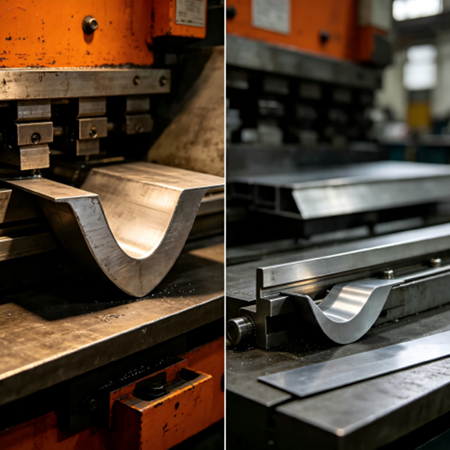
Sheet metal bending is one of the most fundamental processes in fabrication, transforming flat metal into functional three‑dimensional shapes. But bending a 1mm sheet is fundamentally different from bending a 10mm plate—and understanding these differences is essential for engineers, procurement professionals, and quality managers. Have you ever designed a part assuming a certain bend radius, only to find that the thick material cracked or the thin material warped beyond repair? These are among the most common and costly mistakes in sheet metal fabrication. The thickness of the material you specify affects everything—tooling selection, machine tonnage, bend radius, springback, and even the cost of the part.
At Lingyufab, we bend materials across the full thickness spectrum—from 0.5mm thin sheets to 20mm heavy plates. With over 20 years of precision manufacturing experience since 2003 and certification as a core supplier for Mitsubishi Electric, our CNC bending centers are equipped to handle both thin and thick materials with the right tooling, parameters, and techniques. This guide compares thick sheet and thin sheet bending across key factors, helping you make informed decisions for your next project.
What Is Considered Thin Sheet vs. Thick Sheet?
In sheet metal fabrication, thickness categories are typically defined as follows:
Thin sheet: 0.5mm to 3.0mm
Medium sheet: 3.0mm to 8.0mm
Thick sheet/plate: 8.0mm to 15.0mm, with plate extending up to 120mm
Industry reference: Materials below 6.35mm (0.250 inches) are generally referred to as sheet, while thicker materials are classified as plate.
Understanding these categories is the first step to selecting the right approach for your part.
Key Differences Between Thin and Thick Sheet Bending
Bend Radius
The bend radius must scale with material thickness to avoid defects.
Thin sheet: The inside bend radius can generally equal the material thickness. For plates up to 6mm, the bending inner radius can be used directly as the radius when bending.
Thick sheet: Requires larger bend radii to prevent cracking. For 6‑12mm, the bend radius is typically 1.25‑1.5× material thickness; for 12mm and above, 2‑3× material thickness. If the radius is too tight, the outer fibers stretch too far and cracking becomes much more likely.
Springback
Springback is the elastic recovery of metal after bending.
Thin sheet: Exhibits higher springback angles—typically 5°‑8° for 16‑24 gauge materials. This is because the material has less mass to resist elastic recovery. Thin sheets require larger compensation angles during bending.
Thick sheet: Shows lower springback angles—typically 1°‑2°. As sheet thickness increases, the amount of springback decreases. However, the absolute deviation (in length terms) may be larger, and the higher force required means equipment deflection becomes a factor.
Required Tonnage
The force required for bending increases exponentially with thickness.
Thin sheet: Requires relatively low tonnage. For example, 1mm thick 304 stainless steel needs approximately 3 tons of bending force for a 1‑meter bend.
Thick sheet: Requires significantly higher tonnage. For 10mm thick carbon steel with a 70mm die opening, the required force is approximately 9.3 tons per meter. The relationship is tonnage ∝ thickness²—doubling the thickness quadruples the force requirement.
Tooling and Die Selection
Tooling requirements differ dramatically between thin and thick materials.
Thin sheet: Uses smaller V‑die openings—typically 6‑8× material thickness. Standard tooling is usually sufficient. Tooling marks and surface scratches are a major concern, requiring careful die surface condition and often protective measures.
Thick sheet: Requires larger V‑die openings—typically 6‑10× material thickness. For 10mm plate, V=60‑80mm is recommended. Thick plate bending typically uses larger die openings (V24‑V300) and heavy‑duty tooling, with mold size and weight often exceeding normal handling capacity. Tool steel such as Cr12MoV is often required for durability.
Surface Quality and Defects
Thin sheet: Prone to scratches, tooling marks, and indentation from clamping. Surface protection is critical. Thin sheets are also susceptible to wrinkling and hole deformation during bending.
Thick sheet: Prone to cracking at the bend, edge bulging, and longitudinal bows from stress release. Thick materials also have different surface hardness on the top and bottom due to cooling during steel manufacturing, which affects bend results.
Equipment Requirements
Thin sheet: Standard press brakes are usually sufficient. Accuracy and precision are the primary concerns.
Thick sheet: Requires high‑rigidity machines with sufficient tonnage (e.g., 100T+ for 10mm plate). Equipment must have crowning/deflection compensation to maintain bend angle consistency. Machine frame deflection can cause dimensional errors of ±1mm or more.
Post‑Processing
Thin sheet: Typically ready for use after bending, with minimal post‑processing required.
Thick sheet: Often requires stress relief annealing (500‑600°C for 1 hour) or vibration stress relief to ensure dimensional stability. Deburing and flattening may also be necessary.
Practical Tips for Thin Sheet Bending
Use protective measures. Thin sheets are easily scratched. Use protective film, polyurethane‑coated tooling, or non‑marking dies to prevent surface damage.
Control clamping force. Excessive clamping force can cause indentation. Use vacuum fixtures or adjustable clamping to minimize marks.
Mind the bend sequence. Thin sheets can warp easily. Use proper bend sequencing to distribute stress evenly.
Watch for hole deformation. Holes near bend lines can distort. Maintain adequate hole‑to‑bend distance (typically 2‑3× material thickness).
Practical Tips for Thick Sheet Bending
Use the right die opening. Follow the 6‑10× material thickness rule for V‑die selection. Too small = cracking; too large = excessive springback.
Apply the appropriate punch radius. For thick materials, use a larger punch tip radius to prevent cracking and reduce stress concentration.
Slow down. Use lower bending speeds (5‑10mm/s) to prevent impact deformation. Thick materials require controlled, deliberate forming.
Hold pressure. After reaching the target angle, hold pressure for 3‑5 seconds to allow stress relaxation and improve angle stability.
Consider pre‑heating. For very thick or high‑strength materials, pre‑heating can reduce cracking risk and improve formability.
Use deflection compensation. Ensure the machine has crowning/deflection compensation to maintain consistent bend angles across the full length of the part.
How Lingyufab Handles Both Thin and Thick Sheet Bending
Lingyufab is a professional sheet metal fabrication manufacturer and sheet metal supplier based in Shanghai, China, with over 20 years of precision manufacturing experience since 2003. We follow strict Japanese quality standards and are a certified core supplier for Mitsubishi Electric.
What sets Lingyufab apart as a sheet metal supplier is our comprehensive bending capability across the full thickness spectrum. From 0.5mm thin sheets to 20mm heavy plates, our CNC bending centers feature real‑time angle monitoring, dynamic crowning systems, and a comprehensive tooling inventory to handle any thickness requirement.
Our in‑house capabilities include:
CNC bending — Precision bending with consistent accuracy across all thicknesses, with springback compensation programmed for each material.
Laser cutting — High‑precision fiber laser cutting for accurate flat patterns.
Laser welding — High‑speed, low‑distortion welding with minimal heat input.
Sheet metal fabrication — Complete assembly, surface treatment, and fastener installation.
ISO 9001, ISO 14001, and TÜV CE certified.
Full material traceability with Mill Test Certificates.
One supplier, full responsibility. From laser cutting and CNC bending to welding, surface treatment, and fastener installation, we handle everything under one roof. This integration ensures consistent quality, shorter lead times, and a single point of accountability for your entire project.
If you are unsure which approach is right for your material thickness, our engineering team is available to review your requirements and provide a free consultation. We’ll help you select the right tooling, parameters, and techniques for your specific application. If you are looking for a reliable sheet metal fabrication supplier, please don’t hesitate to contact us.
Quick Thickness Selection Checklist for Buyers
| What to Check | Thin Sheet (<3mm) | Thick Sheet (>8mm) |
|---|---|---|
| Bend radius | ≥ material thickness | 1.5–3× material thickness |
| Springback | High (5°–8°) | Low (1°–2°) |
| Tonnage | Low | High (increases with thickness²) |
| Die opening | 6–8× thickness | 8–10× thickness |
| Surface protection | Critical | Moderate |
| Post-processing | Minimal | Often requires stress relief |
| Key risk | Scratches, warping | Cracking, edge bulging |
FAQs
Q1: What thickness is considered “thin sheet” vs. “thick sheet”?
Thin sheet typically ranges from 0.5mm to 3.0mm. Thick sheet ranges from 8.0mm to 15.0mm, with plate extending up to 120mm. Materials between 3mm and 8mm fall into the medium category, requiring a balanced approach.
Q2: Why does thick sheet require a larger bend radius? Thicker materials have less flexibility and are more prone to cracking when bent too tightly. The outer fibers of the bend stretch significantly more in thick materials—if the radius is too tight, the tensile stress exceeds the material’s elongation limit and cracking occurs.
Q3: Does thin sheet or thick sheet have more springback?
Thin sheet generally has higher springback angles (5°‑8°) because there is less material mass to resist elastic recovery. Thick sheet has lower springback angles (1°‑2°) but higher absolute force requirements.
Q4: How much does tonnage increase with thickness? Tonnage increases with the square of the thickness. For example, if you double the thickness from 1mm to 2mm, the required tonnage increases by approximately four times.
Q5: What is the recommended die opening for bending thick sheet?
The V‑die opening should typically be 8‑10× the material thickness. For 10mm plate, a V=60‑80mm opening is recommended. Harder materials (like stainless steel) should use larger V values, while more ductile materials (like aluminum) can use smaller values.
Q6: Can Lingyufab bend both thin and thick sheet metal?
Yes. Lingyufab bends materials from 0.5mm thin sheet up to 20mm heavy plate. Our CNC bending centers feature real‑time angle monitoring and dynamic crowning systems that ensure consistent accuracy across all thicknesses. We adjust tooling, bend radius, and forming parameters based on material type and thickness to ensure optimal quality.