+8613003178786
  sales@lingyufab.com



Aluminum vs. Stainless Steel vs. Carbon Steel: How to Choose the Right Material for Your Sheet Metal Project
30
Jul’2026Aluminum vs. Stainless Steel vs. Carbon Steel: How to Choose the Right Material for Your Sheet Metal Project
Have you ever specified a material for a sheet metal part, only to find that it corroded within months of installation? Or perhaps you chose a material based solely on cost, only to discover that your parts were too heavy, too difficult to fabricate, or simply didn't perform as expected? These are common frustrations faced by design engineers, product developers, and procurement professionals. The material you choose for your sheet metal project affects everything—strength, weight, corrosion resistance, cost, manufacturability, and ultimately, product reliability. Choose wrong, and you may face expensive rework, field failures, or lost customers. Choose right, and you build products that perform reliably and cost-effectively.
At Lingyufab, we work with a wide range of materials every day. With over 20 years of precision manufacturing experience since 2003 and certification as a core supplier for Mitsubishi Electric, we understand the practical trade-offs between different materials. This guide compares the most common sheet metal materials—aluminum, stainless steel, carbon steel, and galvanized steel—to help you make the right choice for your next project.
Why Material Selection Matters
The material you choose determines more than just the appearance of your finished part. It affects:
Strength and durability — Will your part withstand the loads and stresses it will face in service? Different materials offer vastly different strength characteristics.
Corrosion resistance — Will your part rust or degrade in its operating environment? Some materials naturally resist corrosion; others require protective coatings.
Weight — For portable equipment, electric vehicles, or aerospace applications, every gram matters. Aluminum offers significant weight savings over steel.
Manufacturability — How easily can the material be cut, bent, welded, and finished? Some materials are forgiving; others require specialized equipment and skills.
Cost — Material cost is typically the single largest component of any sheet metal fabrication quote. But the cheapest material upfront is not always the most cost-effective over the product's lifetime.
Lingyufab's engineering team can help you navigate each of these dimensions—from material recommendation to manufacturability analysis—ensuring your choice balances performance, cost, and production efficiency from the very start.
Aluminum: The Lightweight Choice
Aluminum is valued for its lightweight properties and excellent corrosion resistance. It weighs approximately one-third as much as steel, making it the material of choice when weight is a critical factor. It provides excellent natural corrosion resistance through its oxide layer and offers good strength-to-weight ratio. Aluminum is easy to machine, bend, and weld, making it suitable for transportation equipment, communication products, electronic enclosures, and renewable energy systems.
Common grades include 5052 and 6061. 5052 offers very good corrosion resistance, excellent formability, and moderate strength—ideal for applications requiring complex forming. 6061 provides higher strength and excellent appearance after anodizing, making it suitable for more demanding structural applications. However, aluminum's lower stiffness means parts may require thicker walls than steel equivalents. It is also generally more expensive than carbon steel by weight, though often less costly than stainless steel by volume. And while aluminum offers good high-frequency shielding, its low-frequency magnetic shielding is inferior to steel.
Lingyufab has extensive experience processing aluminum for EV battery enclosures, communication cabinets, and electronic housings. We provide full support from material selection to forming and finishing—ensuring lightweight designs meet structural and durability requirements.
Stainless Steel: The Corrosion-Resistant Performer
Stainless steel is one of the most widely used materials in sheet metal fabrication because of its excellent corrosion resistance and mechanical strength. It performs well in humid environments and applications that require high hygiene standards, making it a preferred choice for medical equipment, food processing machinery, and laboratory devices. Stainless steel also offers an attractive appearance and requires relatively little maintenance over its lifetime.
Common grades include 304 and 316. 304 is the most widely used stainless steel grade, offering excellent corrosion resistance for most indoor applications. 316 contains molybdenum, providing enhanced resistance to chlorides and making it suitable for marine environments and chemical processing equipment. However, stainless steel is the most expensive common enclosure material. It is also harder to bend and requires more powerful equipment than carbon steel or aluminum. And while stainless steel provides very good shielding effectiveness, formability is more challenging than with other materials.
Lingyufab provides precision TIG welding and surface finishing for 304 and 316 stainless steel components, serving medical device manufacturers and food processing equipment suppliers who demand cleanability, corrosion resistance, and full material traceability.
Carbon Steel: The Workhorse Option
Carbon steel is often selected when high strength and cost efficiency are priorities. It is commonly used in industrial machinery, construction equipment, and structural components that require reliable mechanical performance. Cold-rolled carbon steel is stronger and stiffer than aluminum, making it suitable for load-bearing applications. It can be fabricated using conventional methods and offers excellent formability and weldability.
However, carbon steel lacks the corrosion resistance of stainless steel or aluminum and must be protected from rust through galvanizing, powder coating, or painting. Without protection, it will rust rapidly in humid environments. Carbon steel is generally the most economical material option upfront, though lifecycle costs must include protective finishing.
Lingyufab's Japanese-quality welding and precision fabrication ensure carbon steel components meet the strength and dimensional requirements of industrial machinery and structural applications. Our in-house powder coating and surface finishing services provide complete corrosion protection under one roof.
Galvanized Steel: The Best of Both Worlds
Galvanized steel starts as carbon steel and adds a protective zinc coating during the rolling process. This eliminates the need for separate corrosion protection while maintaining the strength and formability of carbon steel. The zinc coating provides sacrificial corrosion protection, meaning the enclosure resists rust even if the coating is scratched. Galvanized steel inherits the physical properties of carbon steel while offering significantly better corrosion resistance.
This material is widely used for outdoor electrical cabinets, communication equipment, ventilation systems, and construction projects where long-term environmental protection is required. It offers excellent value—slightly more expensive than bare carbon steel but far more durable in challenging environments. In many applications, galvanized steel represents the optimal balance of cost, shielding, and durability.
Lingyufab has extensive experience fabricating galvanized steel for outdoor electrical enclosures and telecom cabinets. From laser cutting to assembly and fastener installation, we handle every step in-house—ensuring consistent quality and short lead times.
How to Choose: A Practical Decision Framework
With these material characteristics in mind, here is a practical framework for making your selection:
If your primary concern is lowest upfront cost — Choose Carbon Steel (CRS). It offers the lowest material cost and is easiest to fabricate. Just remember to budget for surface finishing to prevent rust. Best suited for indoor industrial controls, server racks, and cost-sensitive projects.
If your primary concern is outdoor use with good shielding plus rust protection — Choose Galvanized Steel (SGCC). It delivers the same strength as carbon steel with built-in corrosion protection. The best cost-to-performance choice for most outdoor applications.
If your primary concern is harsh environments (medical, marine, food processing) — Choose Stainless Steel (304 or 316). It will not rust—even if scratched. The mandatory choice for sanitary and wash-down applications.
If your primary concern is lightweight for portable equipment or EV mounting — Choose Aluminum (5052 or 6061). One-third the weight of steel with excellent corrosion resistance. Ideal for EVs, handheld devices, and telecom equipment.
If your primary concern is low-frequency magnetic field shielding (below 1 MHz) — Choose Steel (CRS or SGCC). Steel's high magnetic permeability absorbs low-frequency magnetic fields far better than aluminum.
Still unsure which material fits your project? Lingyufab's engineering team is ready to review your application requirements and provide a data-backed recommendation—at no cost.
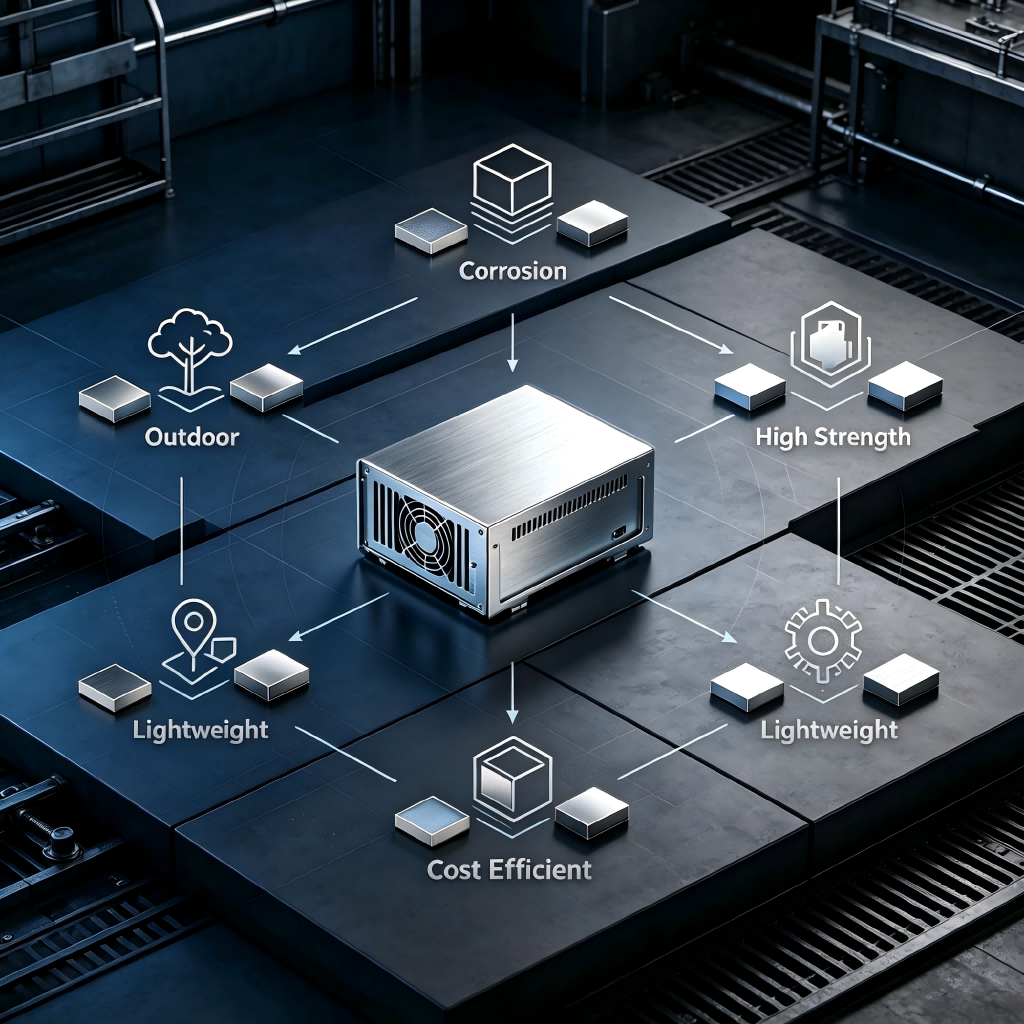
Where Material Selection Matters Most
Material choice is critical across a wide range of applications:
Medical Equipment — Stainless steel is the default choice for medical devices, diagnostic equipment, and surgical instruments, combining corrosion resistance with cleanability and durability. Lingyufab works with medical device manufacturers to produce stainless steel enclosures that meet stringent hygiene and quality standards, with full material traceability and surface finish verification.
Industrial Equipment and Automation — Carbon steel and galvanized steel are commonly used for industrial machinery frames, control cabinets, and equipment enclosures where strength and cost efficiency are priorities. Lingyufab's in-house fabrication capabilities—from laser cutting to welding and powder coating—ensure consistent quality across industrial applications, backed by ISO 9001 certified processes.
Electronics and Telecommunications — Aluminum is widely used for electronic enclosures, telecom cabinets, and networking equipment where weight reduction and thermal management are important. Lingyufab produces lightweight aluminum enclosures with precision tolerances for electronic applications, supported by CNC bending and assembly capabilities that ensure repeatable accuracy.
Automotive and Electric Vehicles — Modern vehicles use a mix of materials: high-strength steel for structural components, aluminum for weight reduction, and stainless steel for corrosion-resistant parts. Lingyufab supports automotive OEMs with custom fabricated assemblies, combining sheet metal fabrication with in-house fastener manufacturing for complete sub-assembly solutions.
Outdoor and Renewable Energy — Galvanized steel and stainless steel are preferred for outdoor electrical cabinets, solar mounting systems, and wind power equipment, providing the corrosion resistance needed for long-term outdoor performance. Lingyufab has supplied components for renewable energy projects across multiple markets, with a proven track record of durability and on-time delivery.
Key Considerations for Material Selection
When selecting a material for your sheet metal project, keep these practical guidelines in mind:
Match material to environment — Indoor, climate-controlled environments allow for carbon steel with basic finishing. Outdoor or harsh environments demand galvanized steel or stainless steel. High-chloride environments (marine, coastal) require 316 stainless steel or specialized coatings.
Consider formability requirements — Aluminum 5052 offers excellent formability for complex bends. Stainless steel and 6061 aluminum are less formable but offer higher strength. Carbon steel offers good formability with predictable springback.
Plan for finishing — Carbon steel always requires protective finishing. Galvanized steel is pre-finished. Stainless steel and aluminum offer natural corrosion resistance but may require additional finishing for appearance or enhanced protection.
Account for fabrication differences — Each material behaves differently on the shop floor. Aluminum is softer and requires different tooling than steel. Stainless steel work-hardens and requires more powerful equipment. Carbon steel is the most forgiving to fabricate.
Your Trusted Partner for Material Selection and Fabrication
Beyond understanding material properties, the success of your project depends on selecting a fabrication partner who can guide you through material selection and deliver consistent quality.
Lingyufab is a professional sheet metal fabrication and fastener manufacturer based in Shanghai, China, with more than 20 years of precision manufacturing experience since 2003. The company follows strict Japanese quality standards and is a certified core supplier for Mitsubishi Electric.
Our Material Capabilities:
Lingyufab works with a wide range of materials to meet diverse application requirements. Here is an overview of what we offer:
| Material | Grades We Work With | Key Applications |
|---|---|---|
| Stainless Steel | 304, 316 | Medical equipment, food processing, marine environments |
| Aluminum | 5052, 6061 | Electronics, aerospace, transportation, EV components |
| Carbon Steel | CRS, various grades | Industrial machinery, structural components, frames |
| Galvanized Steel | SGCC | Outdoor cabinets, communication equipment, construction |
| Copper | Various grades | Electrical components, heat transfer applications |
| Brass | Various grades | Precision fittings, decorative applications |
Our experienced engineering team helps customers select the optimal material for their specific application, operating environment, and budget. We provide material recommendations based on strength requirements, corrosion exposure, weight constraints, and cost considerations. Our Design for Manufacturability (DFM) reviews identify potential issues before production begins—saving you time and money.
Our Quality Assurance:
Every batch of raw materials comes with a Mill Test Certificate (MTC), ensuring full traceability and compliance. We operate under ISO 9001, ISO 14001, and TÜV CE certifications, with quality control covering the complete manufacturing process from raw material inspection to finished product inspection. We also support third-party laboratory composition analysis upon request.
If you are unsure which material is right for your project, please don't hesitate to contact us. Our engineering team is available to review your application requirements and provide a free material recommendation.
Conclusion
The material you choose for your sheet metal project is not just a cost decision—it is a fundamental engineering decision that affects strength, weight, corrosion resistance, manufacturability, and long-term reliability. Aluminum offers lightweight performance with natural corrosion resistance. Stainless steel delivers superior corrosion protection for harsh environments. Carbon steel provides the lowest upfront cost with excellent strength. Galvanized steel offers the best balance of cost and corrosion protection for outdoor applications. Each material has its place, and the optimal choice depends on your specific requirements.
By understanding the trade-offs between these materials and working with an experienced fabrication partner like Lingyufab, you can make informed decisions that balance performance, cost, and reliability.
FAQs
Q1: What is the cheapest sheet metal material?
Carbon steel is typically the least expensive sheet metal material upfront. However, you must budget for protective finishing (powder coating, painting, or galvanizing) to prevent rust. Galvanized steel costs more initially but eliminates the need for separate finishing in many applications.
Q2: When should I choose aluminum over steel?
Choose aluminum when weight reduction is critical—for portable equipment, electric vehicles, aerospace applications, or handheld devices. Aluminum weighs approximately one-third as much as steel and offers excellent corrosion resistance without additional finishing.
Q3: What is the difference between 304 and 316 stainless steel?
304 stainless steel offers excellent corrosion resistance for most indoor applications. 316 stainless steel contains molybdenum, providing enhanced resistance to chlorides—making it the better choice for marine environments, coastal areas, and chemical processing applications.
Q4: Is galvanized steel as strong as carbon steel?
Galvanized steel starts as carbon steel, so it offers similar strength. The zinc coating adds corrosion protection without significantly affecting mechanical properties. However, galvanized steel is slightly more expensive than bare carbon steel.
Q5: What material should I choose for outdoor electrical cabinets?
Galvanized steel is typically the best choice for outdoor electrical cabinets. It provides excellent corrosion protection through its zinc coating while maintaining the strength and formability of carbon steel. For extremely harsh environments (marine, coastal), 316 stainless steel may be required.
Q6: Can Lingyufab help me select the right material for my project?
Yes. Our engineering team provides free material selection guidance based on your application requirements, operating environment, and budget. We work with stainless steel, aluminum, carbon steel, galvanized steel, copper, and brass—and can recommend the optimal material for your specific needs.