+8613003178786
 sales@lingyufab.com



Laser Welding for EV Battery Enclosures: Precision, Sealing, and Lightweighting
23
Oct’2026Laser Welding for EV Battery Enclosures: Precision, Sealing, and Lightweighting
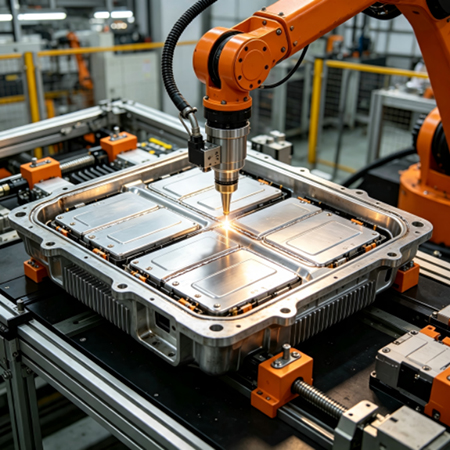
Laser welding has become an essential technology in electric vehicle battery enclosure manufacturing, driven by the industry's relentless pursuit of lightweighting, safety, and production efficiency. Have you ever wondered how EV battery enclosures achieve the precision and sealing required to protect sensitive cells from moisture, vibration, and thermal runaway? The answer lies in advanced laser welding—a process that delivers the high‑speed, low‑distortion, and hermetic welds that traditional welding methods simply cannot achieve at production scale.
At Lingyufab, we understand the unique demands of battery enclosure manufacturing. With over 20 years of precision manufacturing experience since 2003 and certification as a core supplier for Mitsubishi Electric, our laser welding capabilities are engineered to meet the stringent quality, sealing, and productivity requirements of the EV industry. This guide explores why laser welding is the preferred technology for EV battery enclosures, the key applications, and how it addresses the critical challenges of this rapidly growing sector.
Why Battery Enclosures Demand Advanced Welding
EV battery enclosures are not just metal boxes—they are critical safety components that must meet exacting standards:
Structural integrity. The enclosure must withstand crash loads, vibration, and thermal events while protecting the battery cells inside. Welded joints must maintain strength throughout the vehicle's service life.
Hermetic sealing. Battery enclosures must meet IP67 or higher ingress protection ratings to prevent moisture and contaminants from reaching the cells. Welds must be 100% leak‑tight—defects like porosity, spatter, or hot cracking can compromise this seal and create risks of electrolyte leakage or structural failure.
Lightweighting. Every kilogram saved extends driving range. Battery enclosures typically use thin‑wall aluminum designs (wall thickness ≤3mm) to reduce weight, but thin materials are highly susceptible to welding distortion.
Thermal management. Many enclosures integrate cooling plates or channels that must be welded without compromising flatness or thermal performance.
High‑volume production. With EV production scaling rapidly, welding processes must be fast, repeatable, and automatable to meet production targets.
How Laser Welding Addresses These Challenges
Laser welding offers several distinct advantages that make it uniquely suited for battery enclosure manufacturing:
Low heat input, minimal distortion. Laser welding delivers concentrated energy with minimal heat‑affected zone (HAZ), significantly reducing thermal distortion—a critical advantage for thin‑wall aluminum enclosures. This eliminates the need for costly post‑weld straightening and rework.
High speed and productivity. Laser welding is typically 3‑5 times faster than conventional MIG welding. A single laser welding cell can complete a battery tray in minutes—enabling the high throughput required for mass EV production.
Hermetic seal quality. Laser welding produces smooth, defect‑free welds with minimal porosity, ensuring the leak‑tight seals required for IP67‑rated enclosures. The process is highly repeatable, delivering consistent quality across millions of parts.
Automation‑ready. Laser welding integrates seamlessly with robotics and vision systems, enabling fully automated production lines with real‑time quality monitoring.
Precision control. Laser welding can achieve penetration depth control to within ±0.1mm, meeting the tight tolerances required for thin‑wall aluminum assemblies.
Key Applications in Battery Enclosure Manufacturing
Battery Tray and Frame Welding
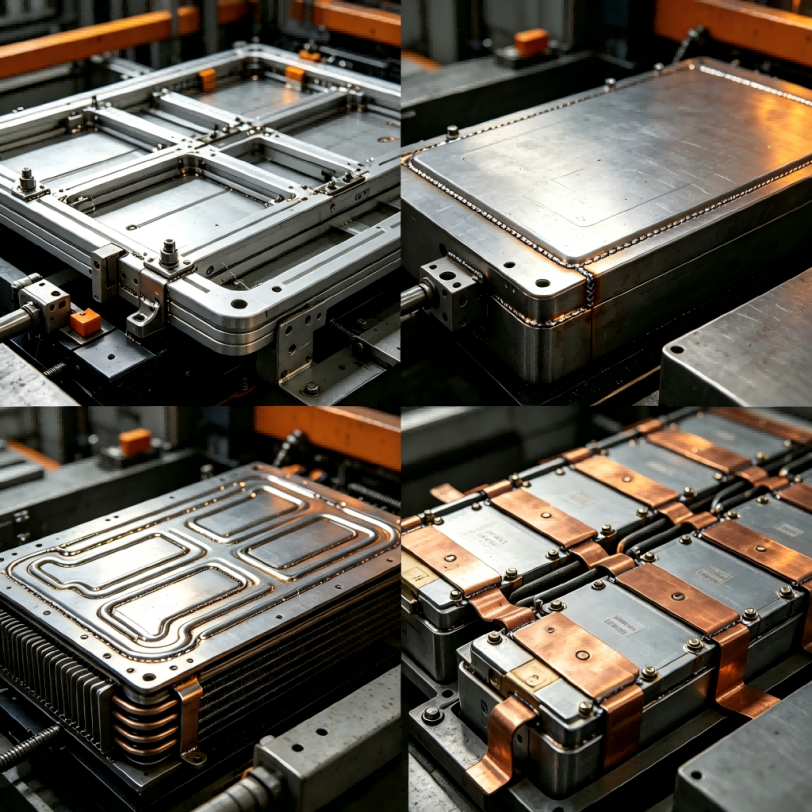
The battery tray is the structural foundation of the enclosure, typically made from aluminum extrusions or stamped sheets that must be joined into a rigid, lightweight frame. Laser welding provides the strength and precision required for these structural joints while minimizing distortion.
Lingyufab's fiber laser welding systems (1kW to 12kW+) deliver deep penetration welds with minimal heat input, ensuring structural integrity without compromising flatness. We optimize parameters for 5000 and 6000 series aluminum alloys—the most common materials for EV battery trays.
Cover and Lid Sealing
The battery cover must be hermetically sealed to the tray to prevent moisture ingress. This requires continuous, defect‑free welds along the full perimeter of the enclosure.
Lingyufab's advanced fiber laser welding systems produce leak‑tight, spatter‑free seams with minimal heat input, preserving the flatness of thin‑gauge aluminum covers. With laser welding speeds up to 8.0 m/min, we achieve the productivity required for high‑volume EV production.
Cooling Plate and Thermal Management Integration
Many EV battery enclosures integrate cooling plates or channels directly into the tray structure to manage thermal loads. These components must be welded without compromising flatness or thermal performance.
Lingyufab's laser welding systems deliver precise, low‑distortion welds on thin materials and heat‑sensitive assemblies. For applications requiring filler material, we offer laser welding with wire feed to bridge gaps and ensure consistent joint quality.
Busbar and Tab Welding
Inside the battery enclosure, laser welding is used to join busbars and tabs—critical electrical connections that must have low resistance and high strength. These connections often involve dissimilar metals, such as aluminum to copper, which present unique welding challenges.
Lingyufab's laser welding systems are capable of joining dissimilar metals with minimal intermetallic compound formation—including the aluminum‑to‑copper connections common in battery pack assemblies.
The Manufacturing Process: From Flat Sheet to Sealed Enclosure
The journey from flat sheet metal to a fully sealed battery enclosure involves multiple steps, many of which can be accomplished with laser technology:
Laser cutting — Precise cutting of flat patterns for tray, cover, and internal components
Laser welding — Joining tray components, sealing covers, integrating cooling channels
Surface treatment — Enhancing corrosion resistance and appearance
By combining laser cutting, laser welding, and surface treatment in one facility, integrated suppliers eliminate the coordination gaps and quality risks that arise when working with multiple vendors.
Lingyufab: Your Trusted Sheet Metal Partner for EV Battery Enclosure Solutions
Lingyufab is a professional sheet metal fabrication manufacturer and sheet metal supplier based in Shanghai, China, with over 20 years of precision manufacturing experience since 2003. We follow strict Japanese quality standards and are a certified core supplier for Mitsubishi Electric.
What sets Lingyufab apart as a sheet metal supplier is our integrated approach to EV battery enclosure manufacturing. Our advanced fiber laser welding systems (1kW to 12kW+) deliver high‑speed, low‑distortion welding with minimal heat input—critical for thin‑wall aluminum assemblies. When combined with in‑house laser cutting and CNC bending, we provide a complete manufacturing solution for battery enclosure components.
Our in‑house capabilities include:
Laser welding — High‑speed, low‑distortion welding for aluminum, steel, and dissimilar metal joints.
Laser cutting — High‑precision fiber laser cutting for accurate flat patterns and complex geometries.
CNC bending — Precision bending with consistent accuracy and springback compensation.
Sheet metal fabrication — Complete assembly, surface treatment, and fastener installation.
ISO 9001, ISO 14001, and TÜV CE certified.
Full material traceability with Mill Test Certificates.
One supplier, full responsibility. From laser cutting and CNC bending to welding, surface treatment, and fastener installation, we handle everything under one roof. This integration ensures consistent quality, shorter lead times, and a single point of accountability for your entire project.
If you are developing battery enclosure components and need a reliable manufacturing partner, our engineering team is available to review your requirements and provide a free consultation. We'll help you select the right laser welding approach for your specific application. If you are looking for a trusted sheet metal fabrication supplier for EV applications, please don't hesitate to contact us.
Quick EV Battery Enclosure Welding Checklist for Buyers
| What to Check | What to Consider |
|---|---|
| Material type | Aluminum (5000/6000 series) or steel—each requires different laser parameters |
| Wall thickness | Thin materials (≤3mm) require precise heat control to prevent distortion |
| Sealing requirements | IP67 or higher requires leak-tight, defect-free welds |
| Production volume | Laser welding is most cost-effective for high-volume production |
| Supplier integration | Integrated suppliers eliminate coordination costs and quality gaps |
| Quality verification | Does the supplier offer weld inspection and documentation? |
FAQs
Q1: Why is laser welding preferred for EV battery enclosures?
Laser welding offers low heat input for minimal distortion, high speed for production efficiency, hermetic seal quality for IP‑rated enclosures, and seamless automation integration. These advantages make it the preferred choice over conventional MIG or TIG welding for battery enclosure manufacturing.
Q2: What materials are commonly used for EV battery enclosures?
Aluminum alloys—particularly 5000 and 6000 series—are the most common materials due to their lightweight properties and corrosion resistance. Some applications also use high‑strength steel or stainless steel for specific structural requirements.
Q3: How does laser welding handle the thin walls of battery enclosures?
Laser welding's concentrated energy and minimal heat input make it ideal for thin‑wall materials (≤3mm). It prevents burn‑through and distortion while achieving full penetration and strong joints.
Q4: What quality standards apply to battery enclosure welds?
Battery enclosure welds must typically meet IP67 or higher ingress protection standards and often require 100% leak testing. Defects such as porosity, spatter, hot cracking, and incomplete fusion can compromise the seal and create risks of electrolyte leakage.
Q5: Can laser welding join dissimilar metals in battery assemblies?
Yes. Laser welding is capable of joining dissimilar metals—such as aluminum to copper for busbar connections—with proper parameter control to minimize intermetallic compound formation.
Q6: What file formats do you accept for battery enclosure projects?
We accept 3D files in STEP (.stp), IGS (.igs), and SolidWorks (.sldprt) formats, and 2D drawings in PDF, DWG, and DXF formats. For battery enclosure projects, we also need material specifications, sealing requirements, and production volume targets.