+8613003178786
 sales@lingyufab.com


Sheet Metal Bending Design Guide: Rules, Tips, and Common Pitfalls
27
Oct’2026Sheet Metal Bending Design Guide: Rules, Tips, and Common Pitfalls
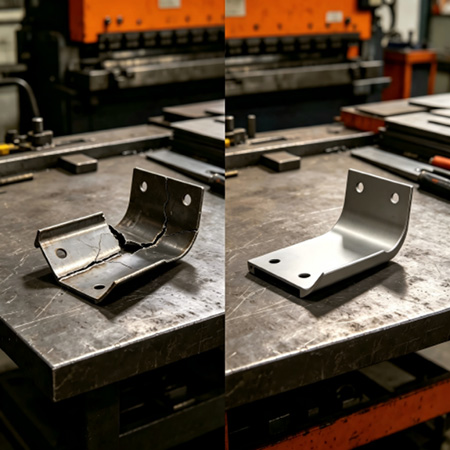
Sheet metal bending design is one of the most critical aspects of creating manufacturable, cost‑effective parts. Have you ever designed a part that looked perfect on the screen, only to receive prototypes with cracked corners, distorted holes, or flanges that simply didn't fit? These problems don't happen by accident—they happen because bending has its own set of rules, and when those rules are ignored, the results are predictable.
At Lingyufab, we see the consequences of poor bending design every day. With over 20 years of precision manufacturing experience since 2003 and certification as a core supplier for Mitsubishi Electric, our CNC bending centers are equipped with the tooling and expertise to handle complex geometries across a wide range of materials and thicknesses. This guide covers the essential rules, practical tips, and common pitfalls of sheet metal bending design—so you can get parts that work the first time.
Why Bending Design Matters
Bending is not just about folding metal. When a sheet is bent, the material stretches on the outside of the bend and compresses on the inside. This deformation creates stresses that can cause cracking, distortion, hole deformation, and springback if the design doesn't account for them. A design that ignores the physics of bending will fail in production—no matter how good the fabricator is.
The Golden Rules of Bending Design
Rule 1: Bend Radius = Material Thickness (or More)
The inside bend radius should be at least equal to the material thickness. A bend radius that is too tight concentrates stress on the outside of the bend, causing cracking or material failure. As a general rule, match the inside bend radius to the material thickness for most applications. For harder materials like stainless steel, consider using a larger radius. For softer materials like aluminum, a radius equal to thickness is usually sufficient.
Rule 2: Minimum Flange Length
The flange height should be at least four times the material thickness. Short flanges don't provide enough support for the tooling, causing the material to slip, deform, or twist during bending. If a flange is too short, the press brake tooling can't grip the material properly, resulting in inconsistent angles and distorted parts.
Rule 3: Holes Need Distance from Bend Lines
Holes placed too close to a bend line will distort, ovalize, or crack during bending. The minimum distance from the edge of a hole to the bend line should be at least two times the material thickness. For critical applications, use three times the material thickness. If a hole must be located near a bend, consider using slot holes instead of round holes to allow for deformation.
Rule 4: Add Bend Relief at Corners
When a bend line meets an edge or another bend, the material needs room to deform. Without relief cuts, the material will tear, bulge, or crack at the corner. Relief width should be at least the material thickness, and relief depth should be at least the material thickness plus the bend radius.
Rule 5: Keep Bend Radii Consistent
Using the same inside bend radius for all bends on a part reduces tooling changes, speeds up production, and lowers costs. Every time the bend radius changes, the fabricator must change tooling—adding setup time and cost. Design with a single bend radius whenever possible.
Rule 6: Bend in the Same Direction Where Possible
When all bends on the same plane go in the same direction, the press brake can complete the bends without repositioning the part. This reduces handling time, improves accuracy, and lowers cost. If bends must go in different directions, plan the bend sequence carefully to avoid collisions.
Rule 7: Account for Springback
Springback is the elastic recovery of metal after bending. All materials spring back slightly—aluminum less, high‑strength steel more. The final angle will always be slightly more open than the tool angle. Compensate by designing for overbending or by specifying the final angle and letting the fabricator adjust the tooling accordingly.
Common Design Pitfalls and How to Avoid Them
Pitfall 1: Sharp Internal Corners
Sharp internal corners create stress concentration points that can crack during bending. Always add a radius to internal corners—at least half the material thickness.
Pitfall 2: Uneven Flange Heights
When flanges on the same part have different heights, the fabricator must adjust tooling or use different setups. Design flanges with consistent heights whenever possible.
Pitfall 3: Overlooking Grain Direction
Sheet metal has a grain direction from the rolling process. Bending perpendicular to the grain produces stronger, crack‑free bends. Bending parallel to the grain increases the risk of cracking. Specify grain direction on your drawing if it matters for your application.
Pitfall 4: Designing Without Considering Tooling Clearance
Bends that are too close together can interfere with tooling. The press brake tooling needs clearance to form each bend without colliding with previously formed features. For complex parts, discuss bend sequence with your fabricator early in the design phase.
Pitfall 5: Ignoring the K‑Factor
The K‑factor determines where the neutral axis sits during bending and affects flat pattern accuracy. Starting with a K‑factor in the range of 0.30 to 0.45 and calibrating per material and thickness improves flat pattern accuracy and reduces tryout loops. If your flat pattern is wrong, every subsequent bend will be wrong.
How to Design for Manufacturability
Think about the bend sequence. When you design a part, imagine how the fabricator will bend it. Which bends come first? Which bends will be difficult to access? A part that requires multiple repositionings costs more to make.
Use standard material thicknesses. Design with commonly available material thicknesses to avoid sourcing delays and higher costs.
Specify tolerances realistically. Over‑tolerancing a non‑critical feature adds cost without adding value. Use standard tolerances for everything except critical features.
Communicate with your fabricator early. The best designs are created in collaboration with the people who will make them. Your fabricator can tell you what works and what doesn't before you commit to production.
How Lingyufab Helps You Get Bending Right
Lingyufab is a professional sheet metal fabrication manufacturer and sheet metal supplier based in Shanghai, China, with over 20 years of precision manufacturing experience since 2003. We follow strict Japanese quality standards and are a certified core supplier for Mitsubishi Electric.
What sets Lingyufab apart as a sheet metal supplier is our commitment to engineering support. Our team reviews your designs before production, identifying potential bending issues like tight radii, insufficient flange heights, or holes too close to bend lines. We provide free DFM feedback to help you optimize your design for manufacturability.
Our in‑house capabilities include:
CNC bending — Precision bending with consistent accuracy and springback compensation.
Laser cutting — High‑precision fiber laser cutting for accurate flat patterns.
Laser welding — High‑speed, low‑distortion welding with minimal heat input.
Sheet metal fabrication — Complete assembly, surface treatment, and fastener installation.
ISO 9001, ISO 14001, and TÜV CE certified.
Full material traceability with Mill Test Certificates.
One supplier, full responsibility. From laser cutting and CNC bending to welding, surface treatment, and fastener installation, we handle everything under one roof. This integration ensures consistent quality, shorter lead times, and a single point of accountability for your entire project.
If you are unsure whether your design is manufacturable, our engineering team is available to review your drawings and provide a free DFM consultation. We'll help you identify potential bending issues before production begins. If you are looking for a reliable sheet metal fabrication supplier, please don't hesitate to contact us.
Quick Bending Design Checklist for Engineers
| What to Check | Recommended Guideline |
|---|---|
| Inside bend radius | ≥ material thickness |
| Flange length | ≥ 4 × material thickness |
| Hole-to-bend distance | ≥ 2 × material thickness |
| Bend relief | Width ≥ thickness; depth ≥ thickness + radius |
| Bend radii consistency | Use same radius for all bends |
| Bend direction | Keep bends in same direction where possible |
| Internal corners | Add radius (≥ 0.5 × material thickness) |
| Grain direction | Bend perpendicular to grain |
| Springback compensation | Account for material springback |
FAQs
Q1: What is the minimum bend radius for sheet metal?
The inside bend radius should generally be at least equal to the material thickness. For harder materials like stainless steel, consider a larger radius to prevent cracking. The specific minimum depends on material type, thickness, and temper.
Q2: How far should holes be from bend lines?
Holes should be at least two times the material thickness from the bend line. For critical applications, use three times the material thickness. This prevents distortion, ovalization, and cracking during bending.
Q3: What is the minimum flange height for bending?
The minimum flange height should be at least four times the material thickness. Short flanges don't provide enough support for the tooling, causing inconsistent bends and deformation.
Q4: Why do my bends crack at the corners?
Corners crack because there's no relief for the material to deform. Add bend relief slots at bend terminations—width at least the material thickness, depth at least the thickness plus the bend radius.
Q5: What is springback and how do I compensate for it?
Springback is the elastic recovery of metal after bending. All materials spring back slightly—aluminum less, high‑strength steel more. Compensate by designing for overbending or by specifying the final angle and letting the fabricator adjust the tooling.
Q6: Can Lingyufab review my design before production?
Yes. Lingyufab provides free DFM reviews. Our engineering team can review your drawings, identify potential bending issues, and suggest design improvements that reduce costs and simplify production.